

Articles & Reports
Featured

One Consumer, Dozens of Touchpoints, One Campaign
Every new touchpoint used to mean another campaign to build, budget, and measure. Brands pulling ahead in retail media reach consumers across all of them with one campaign and no extra workload.

Where Crunch Meets Clean Label: Sunflower Kernels for the Next Generation of Better-for-You Snacks
Canada’s healthy snacks market is experiencing strong growth. According to Grand View Research, the market generated $3,713.6 million (USD) in 2025 and is projected to reach $7,282.5 million (USD) by 2033, growing at a compound annual growth rate (CAGR) of 8.8% from 2026 to 2033.¹ The research also identifies Canada as the fastest-growing regional market in North America, highlighting significant opportunities for food manufacturers looking to innovate in the category. For food scientists and product developers, this growth presents a complex formulation challenge. Consumers increasingly seek snacks that deliver nutritional value, convenience and recognizable ingredients, without sacraficing the taste,texture and overall eating experience they expect. Success depends on balancing these priorities to create better-for-you products that satisfy both nutritional goals and consumer expectations. Why Texture Matters in Snack Innovation Texture is a powerful influence on how consumers experience food, shaping everything from first impressions to repeat purchases. Puratos’s Taste Tomorrow research found that nearly half of consumers prioritize texture over ingredients when purchasing food, while 68% of millennials say texture directly influences their choices.² Ingredion research further indicates that 70% of global consumers would switch to a different product or brand if they were dissatisfied with its texture.³ For snack food manufacturers, these findings underscore the importance of getting texture right from the outset. Crunch, crispness and contrast can help distinguish a product in a competitive market, while combinations of complementary textures can create a more engaging and premium eating experience. Innova Market Insights’ Global Texture Trends 2026 report highlights the appeal of combining textures such as creamy, crunchy, and soft. Its research also revealed that one in four consumers globally is interested in trying snacks in formats that are new to them.⁴ Together, these insights point to opportunities for food manufacturers to explore fresh ingredient combinations and textural experiences that make better-for-you snacks stand out. Where Sunflower Kernels Fit In U.S.-grown sunflower kernels give food manufacturers a practical way to build that contrast. Their mild flavour and satisfying crunch add dimension to both sweet and savoury product innovations without overpowering other ingredients. They also bring plant-based protein, fibre and healthy fats, along with vitamin E, zinc, folate, iron and magnesium, so the texture upgrade comes with a nutritional one. Available raw, roasted and ready-to-eat, sunflower kernels can be used across a wide range of applications, including: • Better-for-you snack bars • Granola and trail mixes • Crackers and savoury snacks • Bakery products and breakfast cereals • Plant-based snacks and bites Clean Label and Allergen-Friendly by Design Consumers worldwide are increasingly prioritizing clean-label products made with recognizable ingredients and greater transparency. Innova Market Insights reports that more than two in three consumers globally say they are at least somewhat influenced by clean ingredient decks, and that nearly one in three new products now carries some type of clean label claim.⁵ Innova also notes that non-GMO claims are most established in North America.⁵ Sunflower kernels are naturally non-GMO and sustainably grown, which supports the transparency and recognizable-ingredient positioning shoppers respond to. They are also an allergen-friendly alternative to tree nuts, delivering the crunch consumers expect from nuts and seeds. Unlike tree nuts, sunflower kernels are not considered a priority allergen in Canada, making them a versatile option for manufacturers developing new products or reformulating existing ones. Turning Texture Trends into Product Opportunities As Canada's healthy snacks market continues to expand, food manufacturers have an opportunity to differentiate their products through thoughtful ingredient choices and more engaging eating experiences. Texture is an important part of that equation, influencing consumer appeal while creating opportunities to innovate across familiar snack formats. U.S.-grown sunflower kernels bring together satisfying crunch, plant-based nutrition and application versatility, making them a valuable ingredient to consider for the next generation of healthy snacks. From bars and granola to crackers and savoury mixes, they can help product developers create food innovations that balance texture, taste and nutritional value. Explore how U.S.-grown sunflower kernels can add texture, nutrition and versatility to your next snack innovation. Connect with a supplier today > {link to lead to the NSA Kernel suppliers page} References: 1. Grand View Research, Canada Healthy Snacks Market Size & Outlook, 2026–2033. https://www.grandviewresearch.com/horizon/outlook/healthy-snacks-market/canada 2. Puratos, “Why texture is important in food,” February 19, 2025. https://www.puratos.com/blog/why-texture-is-important-in-food 3. Ingredion research, as reported in “New approaches to texture innovation,” Food Business News, May 7, 2026. https://www.foodbusinessnews.net/articles/30275-new-approaches-to-texture-innovation

Inside SIAL Canada 2026: Driving Food Innovation Through Connection and Collaboration
CFIN had the honour of taking a bite out of SIAL Canada 2026 in Montréal 🍎—connecting with partners, members, and industry leaders shaping the future of food innovation across Canada and beyond. Representing CFIN on site were CEO @Dana McCauley and @Julie Daigle , Regional Innovation Director (Quebec), who engaged with the ecosystem throughout the event. Their presence reflected CFIN’s ongoing commitment to strengthening Canada’s food innovation ecosystem and supporting high-potential foodtech ventures. Attendees could also catch Julie as a Foodtech Focus expert at the SIAL Canada Expert Hub, where she connected directly with innovators and shared insights with the community. Dana also took the stage as part of the Dairy Talks program, contributing to a forward-looking discussion on innovation as a driver of market leadership in the Canadian dairy sector. Her session explored the shift from incremental product development toward a broader innovation mindset—highlighting next-generation ingredients, value-added dairy formats, new go-to-market strategies, and the role of Industry 4.0 technologies like AI, robotics, automation, and digital supply chains in strengthening productivity and global competitiveness. A key highlight of the week was CFIN’s involvement in the 7th edition of the Startup Pitch Competition, held on April 30 on the Food & Bev Connect stage. Julie Daigle participated as the President of the Foodtech jury, joining a panel of industry experts evaluating promising entrepreneurs from the Startup Village. Beyond the competition, the Startup Pitch stage served as a strategic platform connecting entrepreneurs with buyers, investors, and key decision-makers across the agri-food ecosystem. A standout moment for the CFIN community was the recognition of Maia Farms, a CFIN member and funding recipient, which earned the Gold Prize in the foodtec h competition 🍄🏆 CFIN’s presence at SIAL Canada underscored the momentum of Canada’s food innovation sector and the value of convening the ecosystem to accelerate ideas from concept to commercialization. 📖 Explore more from SIAL Canada 2026 R elive the stories, innovations, and key moments captured throughout the show in the official SIAL Canada Daily: SIAL Canada Daily – 2026 Edition (Photos Courtesy of SIAL)

Five Years of CFIN: A Letter to the Network
Thirty years ago, I worked as a chef in the kitchen of one of Canada’s top restaurants standing should er to shoulder with people who ca red about the sensory experience of food above all else . Our tech stack was al most all analog and , to be honest, we didn’t give our ordering system or the way we did inventory a lot of thought. My career broadened over time , and I ’ ve also held roles where I developed recipes at Canadian Living and wrote about food trends; built innovation strategies and products for national brands, founded a business incubator, and ran a venture creation office at a prestigious Canadian u niversity . Food was always the thread , and technology was always present but in most of the food focused businesses I’ve worked for, it was taken for granted, and creativity and hard work were what drove the businesses forward. While smart people with great ideas are essential to food business success, it’s not enough to be competitive in today’s world. Old ways of running restaurants, innovation labs and food and beverage processi ng businesses can’t compete internationally or absorb the trade shocks that have become commonpla ce in recent history. That’s why I feel l ik e CFIN is the perfect place for me to be today and why we’re adding dozens of new members per week. When CFIN was created in 2021, the mandate was intentionally broad : cata lyze Canadian food innovation with funding , build community, connect an ecosystem that had been operating in silos for decades. The funding programs took shape quickly. Since 2022, we’ve awar ded $23.3 million to 133 projects across six program s. For every $1 CFIN invested, our members committed $7.65 of their own capital toward innovation. This leverage ratio of nearly 8-to-1 has unlocked over $140 m illion in private sector spending on R&D and capital infrastructure. The other work was harder to define . What do "build community" and "connect an ecosystem" mean in practice for a sector span ning startups, processors, researchers, investors, policymakers, and operators spread across this vast country ? Th at question didn't have a tidy answer. As a result , fostering and serving this network was (and remains ) an exercise in innovation itself : something new to be built , and then tested, adjusted, and iterated upon , ad infinitum . I’m immensely proud of what we’ve built so far . A team of Regional Innovation Directors who've supported more than 2,200 organizations, brokering the introductions that became commercial partnerships, strategic investments, leadership hires, and research collaborations. A digital platform , YODL, connecting Canada's food sector across industry silos and bridging interprovincial barriers . The first comprehensive analysis of Canadian foodtech . A network of 8,500 members from every province, every part of the food value chain, every stage of business . On any given week, our community is discussing topics ranging from precision fermentation bioreactor designs and funding stacks to food packaging labeling regulations and export strategies, all in the same space. Members benefit from purpose-built tools and resources — like our Funding Finder that aggregates food and beverage funding opportunities across the country and a growing library of original sector research and analysis — alongside direct access to our Regional Innovation Directors. Canada has strong regional funders, accelerators, trade associations, and tech transfer offices, each doing necessary work in a defined lane. What this sector didn't have was a place where the conversation s , the tools, and the connections all showed up at once — where the range of problems and the range of capabilities were dense enough that the right solutions could emerge . That's what CFIN has built. That foundation is important because the next five years will be even more dynamic, and often more challenging, than the last five . To keep pace and flourish in an increasingly volatile world, Canada's food sector needs to modernize faster and more strategic ally than ever before . Trade disruption is dramaticall y reshaping supply chains . L abour constraints are compounding a productivity gap that was widening long before tariffs became front-page news. Climate pressures are intensifying. Food 4.0 — a tech-enabled food s ector that's more collaborative, productive, resilient, and competitive — is the framework CFIN is building toward, and the case for it gets more urgent by the quarter. I ’m confident that we’re up to the task . Five years ago, Canada's food innovation ecosystem was fragmented, underleveraged, and often invisible to the investors, operators, policymakers, and media who needed to see it. That's no longer true. The capacity to respond to the challenges ahead is here. Not in any single program or policy, but in the breadth of this network — the founders , processors , researchers , and investo rs who are hungry to innovate and build a better Canadian food sector . My own wide-ranging path through the food sector taught me that no single role ever showed me the full picture. It took working across kitchens, labs, newsrooms, boardrooms, and startups to understand how innovation really moves through this industry — and where it get s stuck. CFIN was built on the same insight. A sector this complex, facing challenges this urgent, needs more than funding or advice or connections in isolation. It needs all of them in the same room. That's what we've spent five years building, and I'm betting the next five will prove its value at a scale none of us can yet imagine. Thank you for being part of it. Dana McCauley, CEO, Canadian Food Innovation Network

How BC is Becoming a National Foodtech Hub
Editor's Note: This article was o riginally published in the Vancouver Tech Journal on March 13, 2026 The province has a diverse food processing industry, world-class research facilities, and a deep bench of tech talent — everything a foodtech ecosystem needs to thrive. Foodtech builds the software, automation, and applied science for how food gets processed, manufactured, packaged, distributed, and sold. The industry behind it is enormous — food and beverage processing alone is Canada's largest manufacturing sub-sector , bigger than automotive, bigger than aerospace. It's a serious market, and in British Columbia, it's growing fast. But if you work in the province's broader tech ecosystem, you might not even know that. Foodtech hasn't traditionally drawn the same attention as sectors like cleantech or enterprise SaaS despite being a comparable market in scale and complexity — and one where demand for new technology is accelerating fast. What BC brings to the table BC's food processing sector is substantial — over 3,200 companies producing roughly $12.6 billion in value-added products annually. And it's being treated as a strategic priority. The province has funded a network of shared food processing hubs, UBC just opened a Food and Beverage Innovation Centre with pilot-scale production labs that processors and startups previously had to leave BC to access, and SFU's BC Centre for Agritech Innovation is partnering directly with SMEs on cost-shared R&D. At the same time, much of what the food industry needs is already being built in BC for other thriving tech sectors. Process automation, energy management, supply chain software, safety and traceability systems, data-driven quality control — these are cleantech and software problems applied to production floors and distribution networks. The talent, research base, and trade infrastructure to support a serious foodtech cluster are all here. A different kind of tech sector Foodtech doesn't work like enterprise SaaS or consumer tech. Processors and manufacturers adopt slowly and carefully, because failure is expensive in ways that go beyond lost revenue — a food safety issue, a botched line integration, a regulatory problem. Sales cycles run in quarters. The investor community that understands food is small and specialized. And the industry's own networks run through trade associations, existing supply relationships, and sector-specific events that sit well outside the broader tech community's orbit. None of this means foodtech is closed off. It means that if you want in — as a founder, investor, developer, or potential partner — you need a way to access the conversations, the deal flow, and the operating knowledge that don't surface through the usual channels. The Canadian Food Innovation Network The Canadian Food Innovation Network is a national not-for-profit, established in 2021 that functions as the operating infrastructure for Canada's foodtech sector. CFIN runs cost-shared funding programs that help companies de-risk R&D and move technology into commercial settings. Since launch , the organization has awarded over $22 million to 122 Canadian foodtech projects, matched by $25 million in industry co-investment. Those funded companies have generated $90 million in economic impact, created over 355 jobs and co-op placements, and attracted more than $82 million in follow-on investment. The network's 8,000-plus members include food processors, technology companies, ingredient suppliers, retailers, researchers, and investors — connected through YODL, CFIN's member platform, and supported by Regional Innovation Directors embedded across the country, who work directly with members to broker introductions, navigate funding, and connect emerging technology with the processors and buyers who need it. CFIN also produces the sector's most detailed intelligence . The Foodtech in Canada 2025 Ecosystem Report mapped investment flows, identified sector strengths, and gave both companies and investors a clearer picture of where the Canadian foodtech market stands. And then there's Foodtech Frontier , CFIN's annual program identifying the country's highest-potential foodtech companies. The inaugural cohort of 35 winners included eight BC companies. For investors, it works as curated, vetted deal flow in a sector where sourcing is otherwise hard. For the companies, it's structured national visibility. Plug into Canada’s foodtech ecosystem If you work in technology or investment and you've been curious about the food sector, then signing up for a free CFIN membership is the best place to start. Members get access to funding programs, sector intelligence, a national innovation community, and regional team members that know the BC landscape specifically.
Other Articles
Closing the Loop: Japan’s Food Waste Challenge Meets Canadian Foodtech Innovation
This October, the Smart Kitchen Summit (SKS) Japan will gather hundreds of companies, investors, policymakers, and researchers to explore the future of food and foodtech . To make sure Canadian innovators are part of that conversation, CFIN is leading a group of member companies to Tokyo to showcase solutions that can compete on a global stage. Among those companies is Ottawa-based Food Cycle Science, whose FoodCycler ® units turns household and commercial food scraps into a nutrient-rich soil amendment. We spoke with CEO Bradley Crepeau about why Japan’s tightening waste regulations make this the right time to enter the market, and how CFIN’s delegation to SKS Japan can help accelerate their entry . 1. Tell us a little about what problem your company solves and why it matters right now. Food Cycle Science (FCS) is transforming one of today’s biggest environmental challenges, food waste, into an opportunity for positive change. Instead of food scraps creating methane in landfills, clogging drains or piling on curbs and attracting pests, our FoodCycler ® transforms them into a reusable, nutrient-rich by-product, reducing waste volume by up to 90%. With climate change and circular economy solutions — alongside tightening waste regulations and rising disposal costs — we see enormous potential for households, businesses, and communities to take actio n right at the source. Our technology makes food waste reduction simple, clean, and impactful, empowering people everywhere to be part of the solution. 2. What’s unique about your technology or approach that sets you apart from others in the market? FoodCycler ® products use our patented Vortech™ grinding technology, multi-blade design, ceramic non-sticking coating and closed-loop odor control to quietly and efficiently process a wide range of food scraps . Unlike compost bins, sink disposals or industrial systems, FoodCycler is compact, reliable and simple enough for homes, businesses, and municipalities. We bridge the gap between consumer convenience and industrial-scale diversion, with proven results across North America, Europe, and Asia through municipal pilots, B2B programs, and direct consumer adoption. 3. What specific goals or outcomes are you hoping to achieve during SKS Japan? Our main goals are: Establishing partnerships with Japanese municipalities and sustainability agencies. Identifying distribution partners and retailers to expand FoodCycler access in Japan. Gaining market insights into Japan’s unique consumer expectations, cultural attitudes toward waste, and regulatory frameworks. Raising awareness of FoodCycler as a Canadian innovation that aligns with Japan’s circular economy and zero-waste goals. 4. Japan has its own cultural and regulatory approach to waste management. Why is this the right market for Food Cycle Science, and why is SKS Japan the right venue? Japan has long been a leader in waste separation and recycling, yet food waste remains a challenge. Regulations around organic waste and landfill use are tightening, and households are highly engaged in sustainability practices. This makes Japan a uniquely strong fit for FoodCycler : a solution that is clean, quiet, and easily integrates into the daily life of Japanese households. SKS Japan brings together innovators, policymakers, and industry leaders in food systems, offering us the perfect platform to showcase our technology and align with Japan’s waste reduction priorities. 5. How do you see participating as part of the Canadian Food Innovation Network delegation helping you achieve things in Japan that would be harder — or even impossible — on your own? Can you share the kinds of introductions, visibility, or market insights you expect this collective presence to create? Being part of the Canadian Food Innovation Network (CFIN) delegation amplifes our reach. As a collective, we gain credibility and access that would be difficult alone, from government introductions to retail contacts and municipal stakeholders. We expect CFIN’s presence to open doors with policymakers, accelerate B2B connections, and provide cultural insights that help us adapt our messaging and offering for the Japanese market. It also reinforces Canada’s reputation for sustainable innovation, making our story stronger within an international context. 6. Looking ahead, how do you see FCS shaping the future of food globally — either in Japan or elsewhere? Our vision is to make food waste recycling as standard as household recycling bins. By scaling FoodCycler technology across homes, businesses, and municipalities worldwide, we aim to encourage better food waste habits, cutting methane emissions at the source, diverting millions of tons of waste from landflls , and returning nutrients to the soil. In Japan, where efficiency and environmental stewardship are cultural cornerstones, FoodCycler can help close the loop on food waste while inspiring broader global adoption. 7. If SKS Japan opens doors to new markets and high-volume orders, how do you plan to finance the export expansion required , and how did you know that FCS was ready to deliver at that scale? We are backed by a proven track record of scaling internationally, including 200+ municipal pilots and several retail partnerships across North America, Asia and Europe. Financing for export expansion will come from a combination of internal reinvestment, established manufacturing partnerships in China and potential external financing sources such as grants (such as CFIN), and investors and strategic partners. With our supply chain, production facilities, and quality assurance processes already in place, we are confident in our ability to deliver at scale to new markets like Japan. Want to learn more about what makes Japan a high-potential export opportunity for Canad a ? Read CFIN’s Going Global: A Market Guide for Canadian Food Innovators for insights on where the biggest international opportunities lie, and how we’re helping Canadian companies take their technologies to the world.

Canada’s Foodtech Innovators Go Global at SKS Japan 2025
This October, the Canadian Food Innovation Network (CFIN) will lead three of its member companies to Tokyo for SKS Japan 2025 —the country’s largest foodtech conference and one of Asia’s most influential gatherings of its kind. Japan is something of a paradox for food innovators: a market that eagerly embraces new ingredients and technolog ies , ye t uncompromising in its expectations for safety, quality, and compliance. It’s a tough nut to crack, but the opportunities are nearly unmatched . Food waste remains a national priority, labour shortages are testing the limits of hospitality and retail, and seafood— a dietary and cultural staple—is facing pressure from depleted stocks and shifting consumer values. These are just some of the immediate and rapidly intensifying market pressures that demand practical solutions . And they are precisely the problems that Canadian innovators like those joining us at SKS Japan are equipped to take on . However, developing foodtech solutions is only part of the challenge. Getting those solutions to international markets like Japan is another challenge entirely , and f oodtech entrepreneurs often face export challenges unlike those in other sectors. The Export Challenge for Canadian Foodtech Canadian e xport programs for agri-food are robust, as are supports for technology firms, but foodtech products and services tend to exist in a “ messy middle ” between the se two categories . They don’t qualify as traditional agri-food expor ts , nor do they fit neatly into tech export frameworks. As a result, this fast-growing class of innovators is often left without the tailored support they need to successfully cross borders. One of the aims of CFIN’s SKS Japan mission is to show what a different model could look like: export support designed specifically for foodtech , rooted in the realities of scaling innovations into tightly regulated, highly competitive markets. That includes financing strategies for expansion, proving operational readiness for large orders, and creating trusted entry points through trade missions, accelerators, and ecosystem partnerships. A New Model for Showcasing Canadian Food Innovation CFIN’s approach to SKS Japan goes well beyond setting up a n exhibit booth. We’re building a program around the event that combines visibility on trade show floors with curated ecosystem engagements: site visits to the Gastronomy Innovation Campus and Tokyo Living Lab, meetings with accelerators like Sunryse and Shibuya QWS, and briefings at the Canadian Embassy. The aim is to give our member companies not only exposure to potential partners and investors at the conference itself, but also the cultural and regulatory context they need to enter the Japanese market with confidence. T he three companies joining us in Japan demonstrate the breadth of Canadian food innovation : Food Cycle Science is tackling food waste with its suite of sleek, hyper-efficient Foodcycler units that quickly transform household and commercial food scraps into a nutrient-rich soil amendment—a practical solution in a country where waste disposal is costly and regulations are tightening. N S/TX Industries ( formerly New School Foods) is taking on one of the most ambitious tests imaginable: introducing plant-based salmon fillets into a market where seafood is both cultural identity and culinary art. Their readiness to test the waters of the discerning Japanese market is a testament to the exceptional quality of their product, which has earn ed the stamp of approval from Michelin-starred chefs in North America. Dispension Industries is rethinking alcohol concessions in stadiums and arenas with SmartServ™, an automated kiosk that cuts lines, lowers staffing costs, and ensures compliance in high-volume environments. It’s a natural fit for a country renowned for its unique vending machine culture and receptivity to automation . Looking Ahead By surrounding the companies with introductions, narrative support, and on-the-ground learning, we’re creating a model tuned to the unique needs of foodtech that could be replicated in other priority markets. More than a one -off trade mission , this initiative is will help us develop a blueprint for how Canada can better suppor t our foodtech innovators globally. In the coming weeks leading up to SKS Japan , we’ll be publishing in-depth Q&As with each of the companies joining us to explore what their companies do, why Japan matters to them , and why participating in this mission with CFIN could shape the next stage of their growth. If you’d like to learn more about what makes Japan a high-potential export opportunity for Canada, be sure to download CFIN’s Going Global: A Market Guide for Canadian Food Innovators for insights on where the biggest international opportunities lie, and how we’re helping Canadian companies take their technologies to the world.

Friday Food Innovation Round-Up – October 3, 2025
We’re suckers for a great “best-of” list . W e’re also suckers for great ice cream . Suffice it to say, it’s been a pretty great few weeks for food innovation. Highlights include d : 🌎 EDC scaling up support for Canadian food exporters chasing new global markets 🥇 CFIN announcing the winners of the inaugural Foodtech Frontier List 🌱 Protein Industries Canada investing $1.3M to strengthen local food supply 🍦 C hapman’s pour ing $200M+ into expanding ice cream manufacturing in Ontario Let’s dive in! Canada Trade Brief: EDC Scales Support as Canadian Food Exports Eye New Frontiers Breaking down what’s changing in global trade relations —and what it means for Canad a’s food sector. What’s the Latest Export Development Canada (EDC) announced it is ramping up its support for Canadian agri-food exporters. The focus is primarily on helping companies expand beyond traditional U.S. markets and tap into opportunities in the Indo-Pacific, Europe, and Latin America. Complementing that development , a new analysis from Farm Credit Canada suggests Canada currently has a $12-billion diversification opportunity: shifting food and beverage exports away from the U.S. toward Asian and European markets. What You Should Know EDC’s push is subsector-specific : support is targeted not just at commodity exports, it also explicit l y priorit izes high-growth food categories like plant-based proteins, functional foods, and clean-label in gredient s. Private-label is a strategic lever : EDC notes strong international demand for Canadian-made private-label products, opening doors for processors to scale globally without the overhead of building consumer brands abroad. Financing + matchmaking = acceleration : EDC’s tools combine capital with direct buyer/distributor introductions, reducing both the financial and relationship barriers that often keep SMEs locked in the North American market. Key Takeaway Canada’s trade strategy continues a remarkable shift from U.S. dependence to global diversification, especially in the food sector. With EDC current scaling its support tools and federal programs expanding to back marketing and market access, now is the moment for Canadian food innovators to lean in. Use trade credits, matchmaking services, and promotional programs to venture into new markets while strengthening domestic capabilities. 💡 Food Innovation News CFIN Unveils Winners of Inaugural Foodtech Frontier Awards This week, we announced the winners of the inaugural Foodtech Frontier Awards, spotlighting 25 rising startups and 10 established leaders in foodtech . Collectively, winners have created 1,700+ jobs, generated $440M in sales, and invested $35M in R&D over the past year. As part of the awards program, Redstick Ventures awarded $100,000 each to Cubbi and Dispension , providing a total of $200,000 in catalytic funding to accelerate their growth and impact. Learn more about all of the winners here. Protein Industries Canada Commits $1.3 Million to Strengthen Local Food Supply Protein Industries Canada is investing $1.3M across five projects aimed at reducing reliance on imported ingredients and strengthening domestic food security. Partners include Earth’s Own (transitioning soy sourcing to Canada), Oat & Mill (switching to Canadian pea protein), and Cedar Valley Selections (incorporating pulses into its pita chips). By scaling Canadian-grown crops into mainstream foods, these initiatives aim to support local farmers while bringing Canada's plant-based sector closer to its full potential. Chapman’s Invests $200M+ to Expand Ice Cream Manufacturing in Ontario The i conic ice cream brand Chapman’s is making its biggest move yet with a $200M+ expansion of its Markdale, ON facility, adding 175,000 sq. ft. of space, three new production lines (with three more on the way), and 200 new jobs. The investment positions the family-run ice cream maker to fend off multinational competitors, ramp up exports, and introduce new products. Backed by provincial support through Invest Ontario, the reinforc es Chapman’s role as both a local anchor employer and a national player in Canada’s food manufacturing landscape. 💰 New Opportunities We h ave some exciting in-person events on the horizon from coast to coast, including regional celebrations of the 35 companies named to our inaugural Foodtech Frontier list and the Foodtech Next Showcase in Ottawa . See everything else we have planned on our Events Page . 🛠️ Job Openings Here’s a few cool food innovation jobs that popped up recently: Operations Coordinator – Food Cycle Science – Ottawa, ON Food Technologist Assistant – Lovingly Made – Calgary, AB Marketing & Events Associate – SVG Ventures | THRIVE – Calgary, AB Have an open position you’re looking to fill? Be sure to post it on the Food Innovator Career Hub ! 🌟 Highlights from YODL Catch up on this week’s top YODL conversations … How CFIN Helped Maia Farms Kickstart a Canadian Plant Protein Revolution Release of Cellular Agriculture Prairies Ecosystem Market Analysis Report Do you have something worth including in our next Friday Food Innovation Roundup? Reply to this post to let us know about your news, events, or job openings! Thanks for reading!

How CFIN Helped Maia Farms Kickstart a Canadian Plant Protein Revolution
Editor's Note: Photo Courtesy of Maia Farms In 2021, the three co-founders—and three sole employees—of Maia Farms were working out of a small, subleased lab in North Vancouver, dedicated to solving on of the most urgent challenges facing our food system : how can we produce more protein without pushing the plane t past its limits? The team was convinced they had an answer . They were working with mycelium —the dense, protein-packed root-like structure of mushrooms that grows quickly, uses minimal land and water, and can be cultivated year-round in indoor, controlled environments. It had all the makings of a more resilient, sustainable protein source—if they could figure out how to scale it. A Breakthrough, and a Bottleneck Maia’s early efforts working to scal e their production of mycelium wasn’t glamorous. The company’s Chief Science Officer, Sean Lacoursiere, recall s spending long days running fermentation trials, refining fungal strains, and troubleshooting contamination—while also keeping the operation afloat in every other way. “I was everything from janitor to grant writer,” he says. “Just trying to grow enough mushroom mycelium to bring to a customer of some sort.” They didn’t yet have investors or a commercial production line, just talent, vision, and a lot of belief in the potential of mycelium -based protein . T hat belief was validated when Maia connected with Big Mountain Foods , a plant-based food company from Vancouver that had spent nearly a decade searching for a Canadian-grown source of mycelium. “ They said, ‘If you guys can supply us with a mushroom mycelium ingredient, we’d want to work with you, we’d want to buy it ,” says Lacoursiere . This huge opportunity came with a huge operational challenge for the startup . Big Mountain Foods needed at least 800 kilograms of mycelium to align with their production run—far beyond anything Maia had ever produced. At the time, Lacoursiere was using solid-state fermentation, a common method for early-stage mycelium cultivation that involves growing fungi on sterilized grains in small containers. It’s accessible, inexpensive, and works well in lab conditions—but it’s also slow, labour-intensive , and hard to scale. Lacoursiere immediately busied himself sourcing grain for the mycelium feedstock, sterilizing it in pressure cookers, inoculating each batch by hand “After about a month and a half I had 30kg of dry material,” he says. “ It was clear it wasn' t going to work.” To make good on their big break, Maia needed a new approach —and fast. The Birth of CanPro Realizing their small-batch process wasn’t going to cut it, the team went back to the drawing board. While Lacoursiere continued experimenting in the lab, Maia’s Chief Operating Officer and co-founder Ashton Ostrander began looking into new production methods. That search led him to the Saskatchewan Food Centre , and to extrusion—a process typically used in producing textured plant proteins. The idea was to blend Maia’s mushroom mycelium with a complementary vegetable protein to improve texture and increase yield. The team packed samples into suitcases, flew to Saskat oon , and spent several days running extrusion trials—testing different strains, blends, and inclusion rates until they landed on a combination that delivered on both function and flavour . The result was a complete protein with superior texture and a clean ingredient list , just mycelium and pea protein. They named it CanPro—short for “Canadian Protein .” It is a subtle nod to the Canadarm, Canada's iconic contribution to space exploration. This reference was more than symbolic; it reflected Maia's origins as a project at Ecoation , a BC-based agtech company that had previously participated in the Deep Space Food Challenge. Designing efficient, closed-loop protein systems for space missions influenced their approach to food production on Earth, emphasizing sustainability and resource-conscious methods. A System Designed to Support Growth Maia now had the process and the product, but they still needed the right support to scale production. In early 2024, the company applied to the Canadian Food Innovation Network’s Food t ech Next program , which helps companies demonstrate and pilot novel food technologies in operational environments. Their proposal was successful, and Maia was awarded $ 226,119 to pilot CanPro in a real-world production environment with Big Mountain Foods. The funding allowed Maia to move beyond benchtop R&D and into full production trials—testing CanPro’s hydration, pumpability, mixability, and cooking performance at scale. The results helped finalize the specs that would form the backbone of Maia’s first commercial product line. Scaling Through Connection T he impact of the project reached far beyond technical validation. One of the most transformative outcomes came through a connection facilitated by CFIN: food scientist and chef Karen McAfee . Lavina Gully (CFIN’s Regional Innovation Director for B.C. & Yukon), made the introduction . McAfee was exactly who Maia Farms needed, at exactly the right time. “ In the last year, Karen has progressed us as ingredient suppliers to a level we didn’t know existed , ” says Lacoursiere . McAfee turned Maia’s clean-label base into fully developed prototypes that made it easier for manufacturers to say yes. One of her creations, a mushroom -based granola bar, was showcased at industry events by CFIN and went on to spark its own wave of interest. “We just have people come up at conferences saying, ‘Oh my goodness, I was at this trade show last week, and I tried your granola bar, and it's the best thing I've had,’” says Lacoursiere. “If nothing else happened through CFIN but the connection with Karen, that would have been a huge benefit to us.” Scaling Canadian -Made Protein Production Since launching their Foodtech Next project , t he Maia Farms team has expanded from three founders to nine full-time employees. They are now produc ing several ton ne s of mycelium protein per month, supplying a growing roster of Canadian manufacturers who are using it to replace soy- and wheat-based textured proteins that are often imported from the U.S. or Asia. “Food manufacturers are dropping their entire textured protein ingredients and switching right to us,” Lacoursiere says. “It’s a testament to the quality of the material and how well it works in all the recipes.” Th is impressive trajectory growth was powered by the right support coming at the right time. CFIN's funding supported gave Maia the runway t hey needed to refine their process, scal e output, and build the confidence of early customers. As Lacoursiere puts it, “ CFIN helped us get out of the lab and into operational and commercial facilities where we needed to be.” A Foundation for What’s Next Maia's products w ere shaped, tested, and scaled within a growing network of funding programs , researchers, investors, and manufacturers who see food not just as a commodity—but as critical infrastructure. This network effect is precisely what innovators like Maia Farms need to flourish and help Canada build a food system that’s both climate-resilient and nationally secure. That’s n o small task, to be sure. But the se are the challenges that get Canad ian innovators like Lacoursiere out of bed every morning . “Solving hard problems is the point of Maia Farms,” he says. “When we find a proper solution, we just find another hard problem and work to solve it.” It’s a mindset fitting of the current moment — in which we need more Canadian companies solving hard problems, creating more opportunities , and building a more prosperous future along the way . Maia Farms is a reminder that the se solutions can be found right at home . T hey just need the right conditions to grow.

Friday Food Innovation Round-Up – September 18
New Canadian foodtech venture accelerators, big funding wins, and even bigger collaborations . Here’s some of the food innovation highlights from the past two weeks: 🌎 Canada rolls out new trade resilience supports while deepening ties with Mexico 🌱 MaRS launches national Food & Ag t ech Mission with FCC backing 🥗 Phytokan a & Maia Farms announce $32.5M fava bean processing project in Alberta ☕ RFINE raises $1.7M to scale upcycling tech for spent coffee grounds Let’s dive in! Canada–U.S. Trade Brief: Buying Local, Thinking Global Breaking down what’s changing in Canada-U.S. relations —and what it means for Canad a’s food sector. What’s the Latest Earlier this month, Prime Minister Mark Carney announced what he called the most comprehensive suite of trade resilience measures in Canadian history. Then, this week, Carney reinforced this focus on resilience abroad, meeting President López Obrador in Mexico City to align on cooperation ahead of the 2026 CUSMA review. Both leaders pledged to coordinate closely as U.S. trade policy grows more unpredictable. What You Should Know The Strategic Response Fund will channel $5B into industries adapting to trade disruptions, with a focus on competitiveness and technology adoption. A new Buy Canadian Policy formalizes Ottawa’s push for consumers and retailers to source homegrown goods, giving processors and food manufacturers a chance to expand domestic share. The Regional Tariff Response Initiative ( RTRI ) is being scaled across regions, with $80M recently earmarked for Atlantic Canada to help food, seafood, and manufacturing businesses modernize and diversify. Canada and Mexico are presenting a united front as they prepare for the 2026 CUSMA review, highlighting food and agriculture as priority sectors for cooperation. Key Takeaway Canada’s latest moves signal a pivot from reactive tariff management to a long-term resilience strategy—one that hints at a permanent move away from U.S. trade reliance. For food innovators, the message is twofold: domestically, expect stronger incentives to highlight Made-in-Canada products and build tighter, technology-enabled supply chains . G lobally, expect a more deliberate effort to reduce dependence on U.S. access by forging deeper partnerships with markets like Mexico and beyond. The opportunity lies in treating trade disruption not as a headwind, but as a catalyst to modernize domestic food sector operations and position Canadian food as both locally favour ed and globally competitive. 💡 Food Innovation News MaRS Launches National Food & Agtech Mission Backed by FCC MaRS Discovery District has launched a new Food and Agtech Mission with support from Farm Credit Canada. The initiative will channel capital to high-impact ventures, scale innovations that cut emissions and waste, and build resilience in supply chains. Core components include a venture accelerator (supporting up to 10 startups), an 18-month corporate adopter cohort to co-develop pilots, and guidance from a national coalition of industry leaders and investors. Applications for the accelerator are open until October 17, 2025. Phytokana & Maia Farms Launch $32.5M Project to Turn Fava Beans into Plant-Based Ingredients Alberta’s Phytokana Ingredients and B.C.-based Maia Farms are spearheading a C$32.5 million initiative (including C$6.6M in funding from Protein Industries Canada) to convert Canadian-grown fava beans into protein concentrate, starch flour, and flours. The plan includes building a fully automated facility near Strathmore, AB, with the capacity to process 30,000 tonnes /year, and Maia will upcycle those fava ingredients into mycelium proteins. RFINE Biomass Solutions Closes $1.7M Equity Round Halifax startup RFINE has closed an oversubscribed $1.7 million CAD equity round (surpassing its $1.5M target) to scale its technology that transforms spent coffee grounds into shelf-stable, food-grade ingredients. The company will use the new funds to accelerate commercialization across quick-service coffee partners and broaden its operations in sustainable upcycling. 💰 New Opportunities We h ave some exciting in-person events on the horizon from coast to coast, including regional celebrations of the pioneering companies named to our inaugural Foodtech Frontier list and the Foodtech Next Showcase in Ottawa . See everything else we have planned on our Events Page . Elsewhere, applications have opened for the 2025 FoodTech 500, the definitive list of the world's most promising and influential agrifoodtech startups and scaleups. Learn more and submit your application here . 🛠️ Job Openings Here’s a few cool food innovation jobs that popped up recently: Chief Executive Officer – Protein Industries Canada – Remote Food Technologist Assistant – Lovingly Made – Calgary, AB Marketing & Events Associate – SVG Ventures | THRIVE – Calgary, AB Have an open position you’re looking to fill? Be sure to post it on the Food Innovator Career Hub ! 🌟 Highlights from YODL Catch up on this week’s top YODL conversations … Indulge me: Why are you here? Who are your go-to food safety & regulatory consultants? Do you have something worth including in our next Friday Food Innovation Roundup? Reply to this post to let us know about your news, events, or job openings! Thanks for reading!

Catch Up: Inside Canada’s Food Lab’s Webinar Recording Now Available
Missed last week's I nside Canada’s Food Labs webinar ? You can now watch the full recording . This session—featuring experts from Vineland Research and Innovation Centre , Agriculture and Agri-Food Canada , and BioFoodTech —offered an inside look at how Canada’s leading food labs support product development, scale-up, and commercialization. You’ll hear: How research centres help food businesses turn R&D into market-ready products What kinds of facilities, equipment, and expertise are available to startups and SMEs Case studies of companies transforming waste streams into new revenue sources Whether you're developing a new ingredient, refining a formulation, or scaling production, this webinar offers practical insights into what’s possible when you collaborate with Canada’s research infrastructure. Sign Up for Future Webinars Want to keep exploring complex industry topics? Check out our Events Page to sign up for upcoming webinars or in-person events in your region.

From Coast to Crisper: How Seaweed Could Change the Future of Food Packaging
Plastic p ollution is a glob e-spanning problem, the consequences of which are often most visible in our oceans — where plastic waste collects, degrades into microplastics, and wreaking havoc on both marine ecosystems and human health. Yet, the oceans may also hold the solution s we need to move to a post-plastic planet. The team of scientists and innovators behind Vancouver-based PhyCo Technologies b elieve s seaweed is the future of food pack aging , and they are putting the stuff to work to replace petroleum-based plastics with compostable, scalable alternatives. Turning Seaweed into B io-Based P lastics that Work PhyCo’s approach combines Canadian seaweed cultivation with localized organic waste streams to create bio-based pellets, films, and coatings. These are designed for industrial converters and packagers—targeting the 70 % of plastic use that occurs out of sight in farming and food processing. Unlike conventional bioplastics, PhyCo’s process is built for industrial-scale production, with protected IP and partnerships guiding the transition from R&D into commercialization. NextGen Food Innovators Project: Coating for Produce Supported by funding from CFIN ’s NextGen Food Innovators program , PhyC o is also developing a seaweed-based antimicrobial and antifungal coating to extend the shelf life of fresh produce, especially cucumbers and berries. Using advanced spray-coater technology, the team is testing the coating on simple packaging substrates to evaluate durability, safety, and shelf-life benefits. The project is aimed at reducing both plastic use and food waste while contributing to Canada’s broader goals for lowering greenhouse gas emissions tied to food loss. Why it Matters Plastic packaging remains one of the least recycled categories in Canada, with agri-food plastics largely absent from recovery systems. At the same time, produce is the most waste-prone food group in Canadian households and retail. PhyCo’s innovation meets both challenges: creating packaging materials that can compost safely while helping perishable foods last longer in the supply chain. That dual impact aligns with regulatory pressures such as extended producer responsibility (EPR) programs and supports Canada’s Zero Plastic Waste A genda . What’s next for PhyCo The company is advancing lab validation of its spray-on coating and preparing for pilots with produce distributors to test performance in real-world supply chains. At the same time, PhyCo is scaling its biorefinery outputs—pellets, films, and coatings—for commercial manufacturing. With protected IP, an industrial focus, and strategic partners, PhyCo is positioning itself as a player in the overlooked but massive B2B compostable packaging market—bringing ocean resources into the fight against ocean plastic pollution .

How to Run Grocery Ads That Actually Drive Sales
The way consumers shop for groceries has fundamentally changed — they’re surfing, scrolling, swiping, and streaming their way through countless product inspirations during their shopping journey. For CPG brands, this shift has unlocked enormous potential for reaching consumers at multiple touchpoints. But it’s also introduced a challenge: how do you efficiently manage advertising in this dynamic, increasingly fragmented landscape—and prove your ads are really working? Reaching Today’s Grocery Consumers Where They Are Today’s consumers have grown accustomed to having everything they need at their fingertips. Product inspiration can strike anytime—on social media, a search engine, or right in the middle of scrolling their favorite ecommerce app. Brands that meet consumers at these precise moments—when they’re in discovery mode and ready to make decisions—gain the immense advantage of capturing attention at the point of purchase. Instacart helps CPG brands capitalize on these moments with a unified grocery advertising ecosystem. Our solution enables you to run cohesive, data-driven campaigns across multiple channels—all from one platform. This means you can streamline your advertising strategy and efficiently manage campaigns with a single budget, saving time and maximizing your impact. For food brands looking to win consumers at every stage of their journey, Instacart Ads provides mass reach. Through a single entry point, your ads can appear wherever your customers are shopping. The Proof Is in the Performance—Incremental Sales That Make a Difference We know that our brand partners don’t want just reach — they need results. That’s why we’ve prioritized delivering a performant solution that drives real and verified results. Studies conducted by Circana show that Instacart delivers incremental sales. In fact, more than 15% of sales lift from Instacart Ads is incremental—meaning those sales wouldn’t have occurred without your ad campaign. And the impact doesn’t stop in the digital space. Circana also found that Instacart Ads generate a halo effect on in-store sales, with in-store sales lift exceeding 15% to 21% among consumers exposed to Instacart Ads. These results illustrate the power of Instacart as a complementary platform to brick-and-mortar strategies, helping brands capture untapped potential whether customers shop online or in person. Simplify, Streamline, Succeed Advertisers face countless decisions about where, when, and how to run campaigns. Proof of performance is critical, especially when budgets are under pressure. Instacart is here to make your advertising simple, measurable, and impactful. With our unified platform, you can stop worrying about managing ad spend across multiple channels and focus on delivering a consistent message to your consumers. Measure your results, drive incremental sales, and gain insights you can use to refine your strategy. When it’s easier to execute and measure campaigns, you win back the time and confidence you need to achieve bigger growth objectives . It’s time to stop just running ads and start generating results. Work smarter, not harder, with Instacart—your partner in seamless grocery advertising and proven sales lift. Together, we can drive your brand’s success in the ever-evolving world of grocery shopping. Isn’t it time to explore what those incremental sales could mean for your brand?

Friday Food Innovation Round-Up – September 5, 2025
It’s been another busy stretch in food innovation as summer comes to a close, with major policy shifts, funding milestones, and industry shakeups all in the news . Here’s what has been making headlines over the past two weeks: 📉 Canada lifts most counter-tariffs on U.S. goods, with price relief on the way 🌱 Friendlier raises $4.5M to expand reusable food packaging network 🥖 Puratos opens new innovatio n centr e in Montréal to serve Quebec’s baking sector 🥦 Yve s Veggie Cuisine to be discontinue d after 40 years in market Let’s dive in! Canada–U.S. Trade Brief: Canada Lifts Most Counter-Tariffs on U.S. Goods Breaking down what’s changing in Canada-U.S. relations —and what it means for Canad a’s food sector. What’s the Latest Most of Canada’s retaliatory tariffs on U.S. goods came down earlier this week , after Prime Minister Mark Carney and President Trump agreed to “intensify” stalled trade talks. U.S. tariffs on non-CUSMA-compliant Canadian goods remain steep at 35%, but both sides say free trade has been re-established for the “vast majority” of goods. What You Should Know Price relief will be felt first on highly perishable U.S. food imports like orange juice. For processed and shelf-stable goods , the effects will reach consumers more gradually as tariffed inventory sells through. Business groups welcomed the move but say this is a short-term reprieve: the bigger structural test is the 2026 CUSMA review, which will determine long-term predictability for Canadian food exporters. The federal government has launched the Regional Tariff Response Initiative (RTRI), which will be delivered by regional development agencies. Applications will open soon, offering SMEs funding to cut costs, strengthen supply chains, and explore new markets in response to tariff uncertainty. Key Takeaway The tariff rollback delivers near-term relief, but the bigger story is resilience. Programs like RTRI signal that government and industry are preparing Canadian food exporters for a bumpier trade landscape over the long haul. Food companies should tap into these supports now and explore market diversification opportunities —before the 2026 CUSMA review sets the next rules of the game. 💡 Food Innovation News Friendlier Raises $4.5M to Expand Reusable Packaging Network Guelph-based Friendlier has secured $4.5 million CAD to grow its reusable food packaging network. Already operating in Ontario, Quebec, and B.C., the system has replaced more than 3.3 million single-use containers with partners. The funding round will help Fri endlier add micro-sanitation hubs in Winnipeg and Halifax and extend into hot beverages, catering, and retail grab-and-go. P uratos Canada Opens Innovation Centre in Montréal Puratos Canada has opened a 3,500-sf innovation centre in Montréal—its third in Canada after Mississauga and Chilliwack. The new facility will provide tailored support for Quebec’s baking sector, with specialized equipment and space for co-creation workshops and testing t o help businesses move faster from ideation to commercialization. Canadian Plant-Based Food Brand Yves Veggie Cuisine to be Discontinued Yves Veggie Cuisine, one of Canada’s earliest plant-based brands, is being retired by parent company Hain Celestial. Famous for soy-based deli slices, burgers, and veggie dogs, Yves helped bring meat alternatives into Canadian households long before plant protein went mainstream. Its exit reflects the growing pains of a maturing alt-meat category, where legacy brands face tougher competition and shifting consumer expectations. 💰 New Opportunities CFIN is still accepting applications for the Ontario Food Technology Pilot (Intake 1 applications close next Thursday, September 11) There’s also a bunch of exciting events on the horizon, including next week's Unpuzzling webinar digging into how food research centres help businesses develop products , and the Foodtech Next Showcase in Ottawa . See everything else we have planned on our Events Page . 🛠️ Job Openings Here’s a few cool food innovation jobs that popped up recently: Applications Lead (Food & Beverage Sector) – LuminUltra – Fredericton, NB Manager, Food Science & Innovation – Phytokana – Calgary, AB Have an open position you’re looking to fill? Be sure to post it on the Food Innovator Career Hub ! 🌟 Highlights from YODL Catch up on this week’s top YODL conversations … Our AI Future in the Food Sector Exploring Collaboration in Functional Mushroom Innovation Do you have something worth including in our next Friday Food Innovation Roundup? Reply to this post to let us know about your news, events, or job openings! Thanks for reading!

IN 30: Roundup of AI Articles
Sometimes, all it takes is 30 minutes to learn the ins and outs of new food technologies and trends that are transforming the food and beverage industry. In this series, we dig into a food innovation topic and link you to content and resources so you can become a master on the topic in 30 minutes (or less!). Artificial Intelligence (AI) is affecting all aspects of the Canadian food and beverage industry . This week we’re recapping some of the top original content posted on YODL on the topic . AI + Food – A&L Canada Laboratories In the series AI + Food we looked at Canadian food, beverage and foodtech companies using AI to solve a wide variety of challenges . In this installment we highlight London, ON-based A&L Canada Laboratories , which offers soil, plant tissue, feed, fertilizer and water analysis for the agriculture, environmental, food and pharma ( cannabis) industries. AI + Food – BetterC a rt Analytics Saskatoon, SK-based BetterCart Analytics offers real-time, hyper-local price analytics and competitive intelligence to independent grocers, CPG manufacturers, and food and beverage processors . AI + Food – Canvass AI Canvass Analytics Inc. is an industrial AI software developer based in Toronto, ON. AI + Food – Gastronomous Technologies Oakville, ON-based Gastronomous Technologies creates smart commercial kitchens using automation, interconnected robotics and software to solve foodservice challenges . AI + Food – Moosehead Breweries Moosehead Breweries , Canada’s oldest independent beer company, sells a wide range of brands throughout Canada and the U.S., and in 15 countries worldwide. AI + Food – Mycionics Putnam, ON-based Mycionics has developed a fully automated mushroom harvesting system using novel advanced robotics and automation. AI + Food – Savormetrics Mississauga, ON-based Savormetrics offers real- time biophysical and biochemical quality analysis through FoodSafe Analyzers, a fully integrated food quality analysis tool. AI + Food – ThisFish Inc. Vancouver, BC-based ThisFish Inc. provides TallyVision , an AI solution for seafood traceability and production workflows designed to boost business efficiency, transparency and compliance in seafood supply chains. AI + Food – Unilever Unilever is a multinational consumer packaged goods company that uses AI for a variety of reasons. AI + Food – xpertSea Quebec City, QC-based xpertSea uses data and technology to bring trust, transparency and productivity to aquaculture, and incentivize sustainable production. AI, Foodtech and Talent: Reskilling workers A new global study by the IBM Institute for Business Value, Augmented work for an automated, AI-driven world, reveals that advancements in artificial intelligence are upending traditional business models and transforming the workplace. Company Profile – Cronometer Software Revelstoke, BC-based Cronometer Software Inc. received funding from CFIN for a project titled AI Food Suggestions. EXPLAINED: Artificial Intelligence (AI) AI is an integral part of Industry 4.0, and is the basis of a wide range of software systems and products food businesses are already using in different applications. Explained: ChatGPT ChatGPT is an open access chatbot (a computer program designed to interact with customers online to simulate conversation) developed by OpenAI and launched in November 2022. It uses data, artificial intelligence and natural language processing to enable users to ask questions and produce content. From ChatGPT: How AI is transforming the Canadian Food Sector Artificial intelligence is emerging as a promising technology that can help the food industry meet its goals. Guest Blog: Can AI help with Marketing and Communications? In food and beverage there will be many opportunities to use this technology. IN 30 – Machine Learning T he use of machine learning in the food and beverage industry. Overtime If you’ve got more than 30 minutes, these are for you: Parlons d'innovation: L’intelligence artificielle au service de l’industrie alimentaire Isabelle Marquis parle avec Michel Dubois, Directeur principal, Activation IA, centre du recherche Mila, sur l’intelligence artificielle et ses applications et potentiel pour l’industrie alimentaire .
IN 30: Roundup of Robotics and Automation Articles
Sometimes, all it takes is 30 minutes to learn the ins and outs of new food technologies and trends that are transforming the food and beverage industry. In this series, we dig into a food innovation topic and link you to content and resources so you can become a master on the topic in 30 minutes (or less!). Robotics, automation and digitization are changing the way the food and beverage industry operates . This week we’re recapping the top original content we’ve published on the topic. Company Spotlight – App8 Incorporated Ottawa-based App8 received funding for its supply chain automation enablement project. We spoke to CEO Elias Hage to learn more about the company and the project . Company Spotlight – Cibotica Inc. Vancouver, BC-based Cibotica Inc. received funding to help develop a food-safe version of a universal dispensing mechanism and associated control algorithms for use in the company’s robotic salad and bowl makeline. Cibotica’s executive team, Ashkan Mirnabavi , Soroush Sefidkar and Daryoush Sahebjavaher , discuss the project and the company’s plans. Company Spotlight – Relocalize Inc. Relocalize Inc. is a Montreal, QC-based company that received funding to demonstrate the world’s first autonomous micro-factory for food and beverage . We spoke to Wayne McIntyre, CEO and co-founder of Relocalize , to hear more about the company and its plans. Company Spotlight – TheoryMesh Winnipeg, MN-based TheoryMesh received funding to create a more sustainable beef and dairy supply chain through controlled environment agriculture and digitization. CEO Chris Bunio tells us more about the company and its plans. Company Spotlight - Vivid Machines Inc. Toronto, ON-based Vivid Machines received funding for a project to scale fruit volumes and transparency across the fruit supply chain. Jenny Lemieux, founder and CEO of Vivid Machines, tells us more about company and its plans. Company Spotlight – Verschuren Centre The Verschuren Centre Inc. for Sustainability in Energy and the Environment, in Sydney, NS , received funding for a project called Automation and Digital Twin Integration for Precision Fermentation Scale Up of Cell-Based Food Ingredients . V erschuren Centre CEO Beth Mason tells us more about the centre and this project. Emerging Food and Foodtech Jobs New food technology and changing operating requirements are transforming the way food and beverage companies work, as well as the employee skills they require . This is a three-part series featuring just a few of the emerging and in-demand jobs now available in food and beverage manufacturing. Find Part 2 h ere and Part 3 here . Explained: Food Processing Skills Canada Food Processing Skills Canada is a non-profit organization dedicated to professionalizing the food and beverage manufacturing industry by providing leadership on labour, skills and workforce development. Exploring Food Innovation and Technology in Prairies Canada: A Year of Discovery and Growth Hubba Khatoon, CFIN’s Regional Innovation Director for the Prairies, share s her insights and observations on the dynamic trends and support network that thrive within the region ’ s food industry. 50 Canadian FoodTech Resources – Canada’s Advanced Manufacturing Cluster Canada’s Advanced Manufacturing Cluster in H amilton, ON is positioning Canadian companies to lead industrial digitalization, maximizing competitiveness , and participation in global markets. 50 Canadian FoodTech Resources – Eme r gence Emergence in Charlottetown, PE , is a bioscience incubator that accelerates the growth of Atlantic Canadian startups and early-stage companies moving from ideation to commercialization. 50 Canadian FoodTech Resources – RPC Science & Engineering RPC Science & Engineering in Fredericton and Moncton, NB , is N ew Brunswick’s provincial research organization and research and technology organization. 50 Canadian FoodTech Resources – Technology Access Centre for Aerospace & Manufacturing (TACAM), at Red River College The Technology Access Centre for Aerospace & Manufacturing supports innovation in the manufacturing and aerospace sectors through technology, applied research expertise and specialized training. 50 Canadian FoodTech Resources – Walker Advanced Manufacturing Innovation Centre at Niagara College The Walker Advanced Manufacturing Innovation Centre in Welland , ON , helps businesses in Southern Ontario bring ideas to life, from concept through to working prototypes, using innovation and leading-edge technology and software. FBO’s CareersNOW! Program There are a range of resources available to both job seekers and food and beverage industry businesses as they seek to navigate the labour market, including Food and Beverage Ontario ’s CareersNOW ! program. Isabel Dopta , program director of CareersNOW !, talks about th e ways the program is connecting potential employees with employers. Guest Post: Data Quality Matters - Unravelling the Impact of Bad Data on Inventory Expiration In the fast-paced world of food manufacturing, inventory expiration poses a persistent challenge for many companies. While it may be easy to blame inventory planners or analysts for these issues, the root cause often lies in outdated systems and processes that professionals are forced to work with. Guest Post: How Networking on YODL Led to a New Career Path and the Growth of Ontario's Laplace Robotics Find out how CFIN member Jeff Hetherington discovered a new career on YODL. IN 30: Addressing Labour Challenges W ith more companies adding automation, digitization and other food technology, finding workers with the skills and training needed to succeed has become even more challenging. IN 30 – Cobots All about the use of cobots , collaborative robotic systems that work alongside human workers, and their use in the food industry. IN 30 – Robotics in the food and beverage industry A look at the use of robotics in the food and beverage industry. Innovation and Digital Solutions are Future-proofing Canada’s Food and Beverage Industry In order for the food and beverage industry to continue to grow and remain internationally competitive, the industry needs to become more efficient and sustainable, with an emphasis on smart processes and product development. One Year Check In: A Roundtable with CFIN and Ontario Genomic's AcCELLerate-ON Funding Recipients In May 2022 the Canadian Food Innovation Network (CFIN) and Ontario Genomics announced the winners of AcCELLerate-ON , Canada’s first regional cellular agriculture competition. We checked in with the four companies to hear more about how their projects are progressing. Overtime If you’ve got more than 30 minutes, these are for you: CFIN Funded Projects: One Year Updates - Ag-Tronic Control Systems Inc. CFIN has provided funding for many projects over the past two years. Now we’re catching up with the Canadian companies leading CFIN-funded projects to chat about how their innovations have advanced in the year since funding. In part one of the series, Hubba Khatoon, CFIN Regional Innovation Director for the Prairies, sits down with Derek Sorrell, Operations Manager at Ag-Tronic Control Systems Inc. , to discuss the development of the company's compostable fruit and vegetable labels. CFIN Funded Projects: One Year Updates – Gastronomous Technologies In this video, Linda Fox, CFIN Regional Innovation Director for Ontario, talks with Kevork Sevadjian and Andrew Skrepnek , co-founders of Oakville, ON-based Gastronomous Technologies, about how CFIN’s Food Innovation Challenge funding has helped them in creating their connected, autonomous kitchen.
Scaling Down to Scale Up: Relocalize’s Vision for Hyper-Local Food Manufacturing
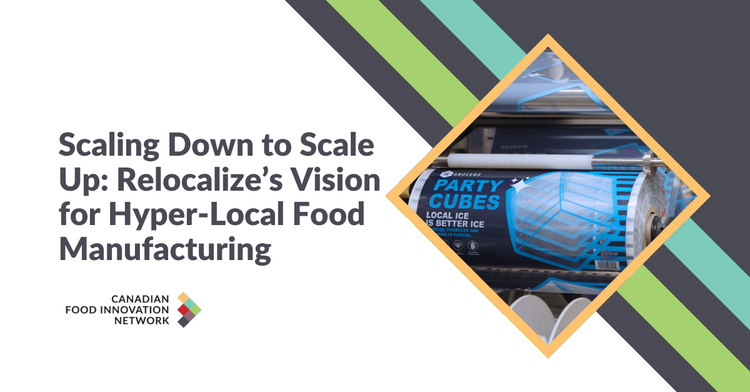
Relocalize is redefining how—and where—food and beverage processing can be done. The Montreal -based startup’s compact, autonomous units produce packaged ice—and , eventually , other F&B products —right inside grocery distribution hubs. That brings production from hundreds of kilometers away to the foot of the retail shelf, reducing miles, waste, emissions, and reliance on rigid supply chains. Why it Matters: Decentralizing Food Production Relocalize’s approach synchronizes with growing pressure to build resilient, low-carbon food systems. By shifting concentrated processing capabilities to local nodes, the company reduces long-haul trucking, slashes spoilage, and boosts supply reliability—especially when demand surges or infrastructure breaks down. It also aligns with bigger industry forces: rising freight costs, climate disruptions that test long-haul supply chains, and consumer interest in products made closer to home. To scale this vision, Relocalize is building the digital backbone needed to manage a distributed manufacturing network. In December 2024, the company received Innovation Booster funding from CFIN to advance the development of an “ a utonomous m anufacturing c ommand and c ontrol c ent re .” This system brings real-time visibility to their micro-factories by using industrial IoT, edge computing, and machine learning. IoT sensors track performance and quality, edge computing allows instant adjustments, and predictive algorithms anticipate maintenance needs before they slow production. The result is a platform that lets remote teams monitor and fine-tune operations—location by location—so scaling multiple micro-factories across communities becomes stable and efficient. What’s Next for Relocalize The company isn’t building in a vacuum. Its integrated micro-factories have already run ice production pilots in grocery environments and met quality benchmarks. Sector recognition followed : o ver the past year, Relocalize won both the Progressive Grocer Impact Award and Food Logistics Top Tech Award, along with a UNIDO manufacturing prize and inclusion in the Inc. Best in Business list. With their digital operations platform in development, Relocalize plans to expand deployments into new regions and products. They’re piloting additional micro-factory units and laying the groundwork for tech-enabled network of hyper-local local production. It is a model with the potential to redefine how manufactured foods get made and distributed —nearer, fresher, and greener.