

Articles & Reports
Featured

One Consumer, Dozens of Touchpoints, One Campaign
Every new touchpoint used to mean another campaign to build, budget, and measure. Brands pulling ahead in retail media reach consumers across all of them with one campaign and no extra workload.
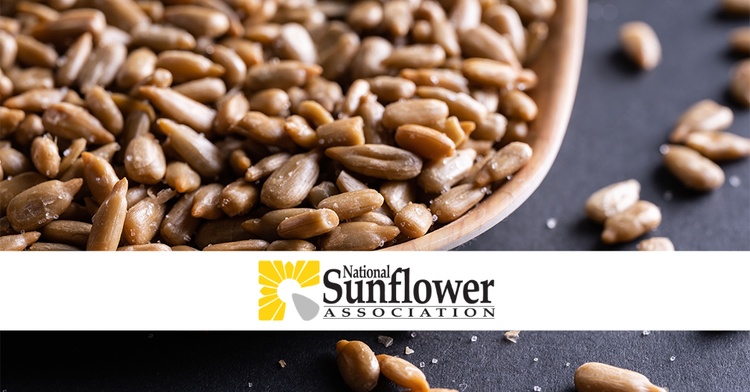
Where Crunch Meets Clean Label: Sunflower Kernels for the Next Generation of Better-for-You Snacks
Canada’s healthy snacks market is experiencing strong growth. According to Grand View Research, the market generated $3,713.6 million (USD) in 2025 and is projected to reach $7,282.5 million (USD) by 2033, growing at a compound annual growth rate (CAGR) of 8.8% from 2026 to 2033.¹ The research also identifies Canada as the fastest-growing regional market in North America, highlighting significant opportunities for food manufacturers looking to innovate in the category. For food scientists and product developers, this growth presents a complex formulation challenge. Consumers increasingly seek snacks that deliver nutritional value, convenience and recognizable ingredients, without sacraficing the taste,texture and overall eating experience they expect. Success depends on balancing these priorities to create better-for-you products that satisfy both nutritional goals and consumer expectations. Why Texture Matters in Snack Innovation Texture is a powerful influence on how consumers experience food, shaping everything from first impressions to repeat purchases. Puratos’s Taste Tomorrow research found that nearly half of consumers prioritize texture over ingredients when purchasing food, while 68% of millennials say texture directly influences their choices.² Ingredion research further indicates that 70% of global consumers would switch to a different product or brand if they were dissatisfied with its texture.³ For snack food manufacturers, these findings underscore the importance of getting texture right from the outset. Crunch, crispness and contrast can help distinguish a product in a competitive market, while combinations of complementary textures can create a more engaging and premium eating experience. Innova Market Insights’ Global Texture Trends 2026 report highlights the appeal of combining textures such as creamy, crunchy, and soft. Its research also revealed that one in four consumers globally is interested in trying snacks in formats that are new to them.⁴ Together, these insights point to opportunities for food manufacturers to explore fresh ingredient combinations and textural experiences that make better-for-you snacks stand out. Where Sunflower Kernels Fit In U.S.-grown sunflower kernels give food manufacturers a practical way to build that contrast. Their mild flavour and satisfying crunch add dimension to both sweet and savoury product innovations without overpowering other ingredients. They also bring plant-based protein, fibre and healthy fats, along with vitamin E, zinc, folate, iron and magnesium, so the texture upgrade comes with a nutritional one. Available raw, roasted and ready-to-eat, sunflower kernels can be used across a wide range of applications, including: • Better-for-you snack bars • Granola and trail mixes • Crackers and savoury snacks • Bakery products and breakfast cereals • Plant-based snacks and bites Clean Label and Allergen-Friendly by Design Consumers worldwide are increasingly prioritizing clean-label products made with recognizable ingredients and greater transparency. Innova Market Insights reports that more than two in three consumers globally say they are at least somewhat influenced by clean ingredient decks, and that nearly one in three new products now carries some type of clean label claim.⁵ Innova also notes that non-GMO claims are most established in North America.⁵ Sunflower kernels are naturally non-GMO and sustainably grown, which supports the transparency and recognizable-ingredient positioning shoppers respond to. They are also an allergen-friendly alternative to tree nuts, delivering the crunch consumers expect from nuts and seeds. Unlike tree nuts, sunflower kernels are not considered a priority allergen in Canada, making them a versatile option for manufacturers developing new products or reformulating existing ones. Turning Texture Trends into Product Opportunities As Canada's healthy snacks market continues to expand, food manufacturers have an opportunity to differentiate their products through thoughtful ingredient choices and more engaging eating experiences. Texture is an important part of that equation, influencing consumer appeal while creating opportunities to innovate across familiar snack formats. U.S.-grown sunflower kernels bring together satisfying crunch, plant-based nutrition and application versatility, making them a valuable ingredient to consider for the next generation of healthy snacks. From bars and granola to crackers and savoury mixes, they can help product developers create food innovations that balance texture, taste and nutritional value. Explore how U.S.-grown sunflower kernels can add texture, nutrition and versatility to your next snack innovation. Connect with a supplier today > {link to lead to the NSA Kernel suppliers page} References: 1. Grand View Research, Canada Healthy Snacks Market Size & Outlook, 2026–2033. https://www.grandviewresearch.com/horizon/outlook/healthy-snacks-market/canada 2. Puratos, “Why texture is important in food,” February 19, 2025. https://www.puratos.com/blog/why-texture-is-important-in-food 3. Ingredion research, as reported in “New approaches to texture innovation,” Food Business News, May 7, 2026. https://www.foodbusinessnews.net/articles/30275-new-approaches-to-texture-innovation

Inside SIAL Canada 2026: Driving Food Innovation Through Connection and Collaboration
CFIN had the honour of taking a bite out of SIAL Canada 2026 in Montréal 🍎—connecting with partners, members, and industry leaders shaping the future of food innovation across Canada and beyond. Representing CFIN on site were CEO @Dana McCauley and @Julie Daigle , Regional Innovation Director (Quebec), who engaged with the ecosystem throughout the event. Their presence reflected CFIN’s ongoing commitment to strengthening Canada’s food innovation ecosystem and supporting high-potential foodtech ventures. Attendees could also catch Julie as a Foodtech Focus expert at the SIAL Canada Expert Hub, where she connected directly with innovators and shared insights with the community. Dana also took the stage as part of the Dairy Talks program, contributing to a forward-looking discussion on innovation as a driver of market leadership in the Canadian dairy sector. Her session explored the shift from incremental product development toward a broader innovation mindset—highlighting next-generation ingredients, value-added dairy formats, new go-to-market strategies, and the role of Industry 4.0 technologies like AI, robotics, automation, and digital supply chains in strengthening productivity and global competitiveness. A key highlight of the week was CFIN’s involvement in the 7th edition of the Startup Pitch Competition, held on April 30 on the Food & Bev Connect stage. Julie Daigle participated as the President of the Foodtech jury, joining a panel of industry experts evaluating promising entrepreneurs from the Startup Village. Beyond the competition, the Startup Pitch stage served as a strategic platform connecting entrepreneurs with buyers, investors, and key decision-makers across the agri-food ecosystem. A standout moment for the CFIN community was the recognition of Maia Farms, a CFIN member and funding recipient, which earned the Gold Prize in the foodtec h competition 🍄🏆 CFIN’s presence at SIAL Canada underscored the momentum of Canada’s food innovation sector and the value of convening the ecosystem to accelerate ideas from concept to commercialization. 📖 Explore more from SIAL Canada 2026 R elive the stories, innovations, and key moments captured throughout the show in the official SIAL Canada Daily: SIAL Canada Daily – 2026 Edition (Photos Courtesy of SIAL)
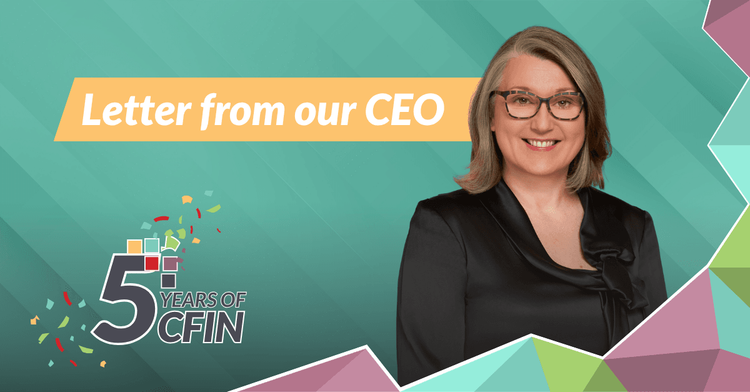
Five Years of CFIN: A Letter to the Network
Thirty years ago, I worked as a chef in the kitchen of one of Canada’s top restaurants standing should er to shoulder with people who ca red about the sensory experience of food above all else . Our tech stack was al most all analog and , to be honest, we didn’t give our ordering system or the way we did inventory a lot of thought. My career broadened over time , and I ’ ve also held roles where I developed recipes at Canadian Living and wrote about food trends; built innovation strategies and products for national brands, founded a business incubator, and ran a venture creation office at a prestigious Canadian u niversity . Food was always the thread , and technology was always present but in most of the food focused businesses I’ve worked for, it was taken for granted, and creativity and hard work were what drove the businesses forward. While smart people with great ideas are essential to food business success, it’s not enough to be competitive in today’s world. Old ways of running restaurants, innovation labs and food and beverage processi ng businesses can’t compete internationally or absorb the trade shocks that have become commonpla ce in recent history. That’s why I feel l ik e CFIN is the perfect place for me to be today and why we’re adding dozens of new members per week. When CFIN was created in 2021, the mandate was intentionally broad : cata lyze Canadian food innovation with funding , build community, connect an ecosystem that had been operating in silos for decades. The funding programs took shape quickly. Since 2022, we’ve awar ded $23.3 million to 133 projects across six program s. For every $1 CFIN invested, our members committed $7.65 of their own capital toward innovation. This leverage ratio of nearly 8-to-1 has unlocked over $140 m illion in private sector spending on R&D and capital infrastructure. The other work was harder to define . What do "build community" and "connect an ecosystem" mean in practice for a sector span ning startups, processors, researchers, investors, policymakers, and operators spread across this vast country ? Th at question didn't have a tidy answer. As a result , fostering and serving this network was (and remains ) an exercise in innovation itself : something new to be built , and then tested, adjusted, and iterated upon , ad infinitum . I’m immensely proud of what we’ve built so far . A team of Regional Innovation Directors who've supported more than 2,200 organizations, brokering the introductions that became commercial partnerships, strategic investments, leadership hires, and research collaborations. A digital platform , YODL, connecting Canada's food sector across industry silos and bridging interprovincial barriers . The first comprehensive analysis of Canadian foodtech . A network of 8,500 members from every province, every part of the food value chain, every stage of business . On any given week, our community is discussing topics ranging from precision fermentation bioreactor designs and funding stacks to food packaging labeling regulations and export strategies, all in the same space. Members benefit from purpose-built tools and resources — like our Funding Finder that aggregates food and beverage funding opportunities across the country and a growing library of original sector research and analysis — alongside direct access to our Regional Innovation Directors. Canada has strong regional funders, accelerators, trade associations, and tech transfer offices, each doing necessary work in a defined lane. What this sector didn't have was a place where the conversation s , the tools, and the connections all showed up at once — where the range of problems and the range of capabilities were dense enough that the right solutions could emerge . That's what CFIN has built. That foundation is important because the next five years will be even more dynamic, and often more challenging, than the last five . To keep pace and flourish in an increasingly volatile world, Canada's food sector needs to modernize faster and more strategic ally than ever before . Trade disruption is dramaticall y reshaping supply chains . L abour constraints are compounding a productivity gap that was widening long before tariffs became front-page news. Climate pressures are intensifying. Food 4.0 — a tech-enabled food s ector that's more collaborative, productive, resilient, and competitive — is the framework CFIN is building toward, and the case for it gets more urgent by the quarter. I ’m confident that we’re up to the task . Five years ago, Canada's food innovation ecosystem was fragmented, underleveraged, and often invisible to the investors, operators, policymakers, and media who needed to see it. That's no longer true. The capacity to respond to the challenges ahead is here. Not in any single program or policy, but in the breadth of this network — the founders , processors , researchers , and investo rs who are hungry to innovate and build a better Canadian food sector . My own wide-ranging path through the food sector taught me that no single role ever showed me the full picture. It took working across kitchens, labs, newsrooms, boardrooms, and startups to understand how innovation really moves through this industry — and where it get s stuck. CFIN was built on the same insight. A sector this complex, facing challenges this urgent, needs more than funding or advice or connections in isolation. It needs all of them in the same room. That's what we've spent five years building, and I'm betting the next five will prove its value at a scale none of us can yet imagine. Thank you for being part of it. Dana McCauley, CEO, Canadian Food Innovation Network

How BC is Becoming a National Foodtech Hub
Editor's Note: This article was o riginally published in the Vancouver Tech Journal on March 13, 2026 The province has a diverse food processing industry, world-class research facilities, and a deep bench of tech talent — everything a foodtech ecosystem needs to thrive. Foodtech builds the software, automation, and applied science for how food gets processed, manufactured, packaged, distributed, and sold. The industry behind it is enormous — food and beverage processing alone is Canada's largest manufacturing sub-sector , bigger than automotive, bigger than aerospace. It's a serious market, and in British Columbia, it's growing fast. But if you work in the province's broader tech ecosystem, you might not even know that. Foodtech hasn't traditionally drawn the same attention as sectors like cleantech or enterprise SaaS despite being a comparable market in scale and complexity — and one where demand for new technology is accelerating fast. What BC brings to the table BC's food processing sector is substantial — over 3,200 companies producing roughly $12.6 billion in value-added products annually. And it's being treated as a strategic priority. The province has funded a network of shared food processing hubs, UBC just opened a Food and Beverage Innovation Centre with pilot-scale production labs that processors and startups previously had to leave BC to access, and SFU's BC Centre for Agritech Innovation is partnering directly with SMEs on cost-shared R&D. At the same time, much of what the food industry needs is already being built in BC for other thriving tech sectors. Process automation, energy management, supply chain software, safety and traceability systems, data-driven quality control — these are cleantech and software problems applied to production floors and distribution networks. The talent, research base, and trade infrastructure to support a serious foodtech cluster are all here. A different kind of tech sector Foodtech doesn't work like enterprise SaaS or consumer tech. Processors and manufacturers adopt slowly and carefully, because failure is expensive in ways that go beyond lost revenue — a food safety issue, a botched line integration, a regulatory problem. Sales cycles run in quarters. The investor community that understands food is small and specialized. And the industry's own networks run through trade associations, existing supply relationships, and sector-specific events that sit well outside the broader tech community's orbit. None of this means foodtech is closed off. It means that if you want in — as a founder, investor, developer, or potential partner — you need a way to access the conversations, the deal flow, and the operating knowledge that don't surface through the usual channels. The Canadian Food Innovation Network The Canadian Food Innovation Network is a national not-for-profit, established in 2021 that functions as the operating infrastructure for Canada's foodtech sector. CFIN runs cost-shared funding programs that help companies de-risk R&D and move technology into commercial settings. Since launch , the organization has awarded over $22 million to 122 Canadian foodtech projects, matched by $25 million in industry co-investment. Those funded companies have generated $90 million in economic impact, created over 355 jobs and co-op placements, and attracted more than $82 million in follow-on investment. The network's 8,000-plus members include food processors, technology companies, ingredient suppliers, retailers, researchers, and investors — connected through YODL, CFIN's member platform, and supported by Regional Innovation Directors embedded across the country, who work directly with members to broker introductions, navigate funding, and connect emerging technology with the processors and buyers who need it. CFIN also produces the sector's most detailed intelligence . The Foodtech in Canada 2025 Ecosystem Report mapped investment flows, identified sector strengths, and gave both companies and investors a clearer picture of where the Canadian foodtech market stands. And then there's Foodtech Frontier , CFIN's annual program identifying the country's highest-potential foodtech companies. The inaugural cohort of 35 winners included eight BC companies. For investors, it works as curated, vetted deal flow in a sector where sourcing is otherwise hard. For the companies, it's structured national visibility. Plug into Canada’s foodtech ecosystem If you work in technology or investment and you've been curious about the food sector, then signing up for a free CFIN membership is the best place to start. Members get access to funding programs, sector intelligence, a national innovation community, and regional team members that know the BC landscape specifically.
Other Articles
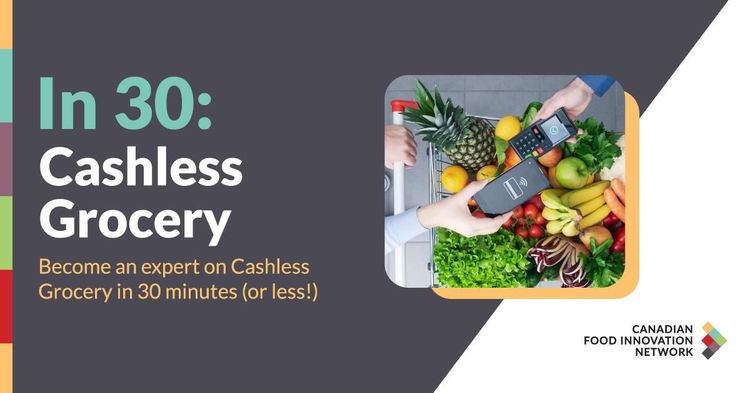
IN30: Cashless Grocery
Welcome to YODL! In addition to daily original content, YODL helps CFIN Members find new partners , resources , and funding opportunities to grow their food business. Learn more about this growing community and become a CFIN Member (for free!) today . Sometimes, all it takes is 30 minutes to learn the ins and outs of new food technologies and trends that are transforming the food and beverage industry. In this series, we’ll dig into a food innovation topic and link you to content and resources so you can become a master on the topic in 30 minutes (or less!). This week, we’re looking at cashless grocery transactions. The Overview YODL – Shop to the Future Grocers are blending convenience with smart technology to create a more seamless instore shopping experience that will keep customers coming back. Canadian Grocer – What Retail Payment Trends are Here to Stay? Contactless is in and cash is out as savvy retailers give shoppers new ways to pay . YODL - Consumer Demands, Technology and Changing Access to Food This executive roundtable looks at consumer demands and changing access to food, with input from Ken Keelor, CEO of Calgary Co-op , and Arjan Stephens, president of Que Pasa Mexican Foods and executive vice-president of Nature’s Path Foods . The Canadian Connection YODL - The Future of E-Commerce: Health Canada and CFIA Propose Changes to Online Requirements for the Sale of Food Glenford Jameson discusses Health Canada and the CFIA ’s consultation on the development of voluntary guidance for providing food information for foods sold to consumers for e - commerce. Global News - Cashless Canada: Why Canadians are L eaders in the C ashless T rend Whether you pay by debit, credit, mobile wallet or smartwatch, speed and convenience are driving the way Canadians are choosing to pay . YODL - Are Screens The New Stores? W hy are Canadians still so hesitant to purchase food products online, given that consumers are familiar with the technology and the majority of them have access to the Internet? Social Media @Instacart – (Twitter) Instacart is one of the world’s largest online grocery services. @googlepay – (Instagram) Google Pay is a mobile payment service , or mobile wallet , that allows consumers to make contactless payments for goods on an app, online and in person. @freshdirect – (Facebook) Another online grocery service, FreshDirect includes produce, prepared deli items and meal kits. Overtime If you’ve got more than 30 minutes, these are for you: YouTube - Aisle 24 in Concord Park Place
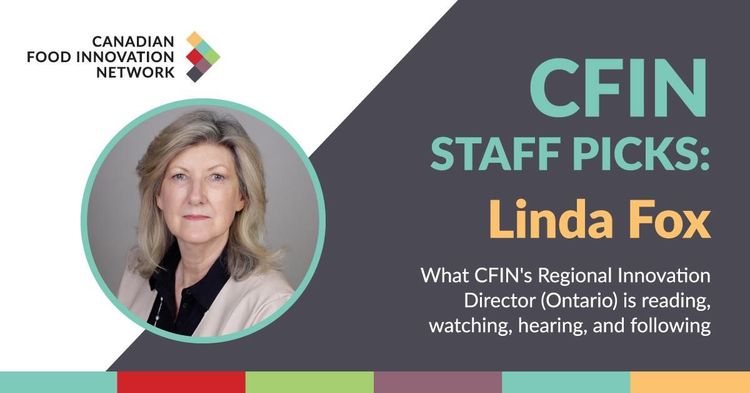
Staff Picks – Linda Fox
Welcome to YODL! In addition to daily original content, YODL helps CFIN Members find new partners , resources , and funding opportunities to grow their food business. Learn more about this growing community and become a CFIN Member (for free!) today . A lot of material comes across our desks at CFIN, and we love to share new information with YODLers ! This one in a series of articles highlighting what CFIN staff are reading, listening to, watching, and posting. This time we’re checking in with CFIN’s Regional Innovation Director for Ontario Linda Fox . What are you reading? I’m a big reader and will read almost anything (including the back of the cereal box). Mostly I tend toward Criminal Minds - type novels , and at the moment I’m diving deep into Nordic Noir – those are some very dark stories coming out of Scandinavia! On occasion I like to pick up a classic that I’ve not read and my last one was Anna Karenina , which I found surprisingly relevant and contemporary. Business-wise, I’m a fan of Malcolm Gladwell . And, no specific author, but I love to learn about the latest in marketing and consumer behaviour, so whatever comes across my desk or my feed (or as a recommendation, hint hint). Oh, and I LOVE travel books when trip planning. What are you listening to? Classic Rock for me, please. But , a friend recently introduced me to Twin Flames , an Indigenous duo that not only creates beautiful music, but also shares thought - provoking stories from their culture and experiences. I also recently discovered Chris Stapleton (listening to Tennessee Whiskey as I write ), and I do like me some Patsy Cline from time to time. Eclectic or weird , your call ! While I love the idea of p odcasts, I’m more of a reader (see above) and so haven’t really cultivated a lis t. I do think I’m missing out though, so that’s a project for me in the coming months. Who are you following? Several news channels, including CBC and BBC . Too many food and tech experts on LinkedIn to list ! What are you watching? Thrillers, Ted Lasso , Brit ish cop shows . I a lways keep my eye open for good documentaries. What are you posting about? I make a lot of use of LinkedIn to talk about the projects our members at CFIN have underway, and the programs we have in that realm. I remain amazed each day at the breadth of solutions our Canadian innovators are coming up with.
AI + Food – Gastronomous Technologies
Welcome to YODL! In addition to daily original content, YODL helps CFIN Members find new partners , resources , and funding opportunities to grow their food business. Learn more about this growing community and become a CFIN Member (for free!) today . This series showcases Canadian foodtech companies that are using AI to solve a wide variety of industry challenges, including improving efficiency, pricing analysis, inventory management, quality control, food safety assurance and more. In this installment, we’re featuring Oakville, ON-based Gastronomous Technologies . What They Do Gastronomous creates smart commercial kitchens using automation, interconnected robotics and software to solve foodservice challenges such as labour shortages, consistency, profitability , supply chain management and waste disposal. How They’re Using AI According to co-founder and COO Kristian Tazbazian, the company uses AI in its in software to analyze data in order to improve operational and user efficiency. In the Media YouT u be – The Dawn of a New Era - Gastronomous
50 Canadian FoodTech Resources - Innofibre
Welcome to YODL! In addition to daily original content, YODL helps CFIN Members find new partners , resources , and funding opportunities to grow their food business. Learn more about this growing community and become a CFIN Member (for free!) today . Canada has an extensive range of research centres, food incubators, accelerators and labs supporting food and beverage innovation through the research they do and/or the services they offer. Each week throughout 2023, we’ll be highlighting an organization that’s supporting food innovation in Canada. Name : Innofibre: Centre d’innovation des produits cellulosiques Location: Trois-Rivières, QC Mission: To c ontribute to the technological acceleration of bioprocesses and bioproducts in Quebec. Focus: Innofibre helps companies develop innovative cellulosic and biomass-based products . Services: The company works with clients in its analytical laboratories and pilot facilities to carry out applied research on cellulosic products , such as functional and bioactive papers and thermoformed products, as well as bioproducts such as biomass . For cellulosic products, Innofibre offers equipment and technical expertise for fibre functionalization, mechanical pulping, pulp treatment, surface treatment, and R&D in thermoformed cellulosic pulp eco-products. As well as R&D on biobased products, the centre also offers pretreatment and biorefining of biomass , biomass conditioning, thermochemical conversion, and the conversion of algal biomass into biocrude. What you need to know: Innofibre is a key player in the bioeconomy and in the recovery of biomass and waste material. Its mu ltidisciplinary team helps develop innovative solutions and products as alternatives to synthetic chemicals, for the reduction of residual material, and for the promotion of al ternatives to fossil fuels . Notable News: Innofibre hosts the NSERC College Industrial Research Chair in Ecodesign for a Circular Economy of Thermoformed Cellulose Packaging Materials. Innofibre researcher Tarik Jabrane is the chair . Get Involved: Contact Chlo ӫ Boulanger, administrative project manager at Innofibre , at chloe.boulanger@cegeptr.qc.ca or 819-995-2649 , or reach out to our Regional Innovation Director for Quebec Julie Daigle .
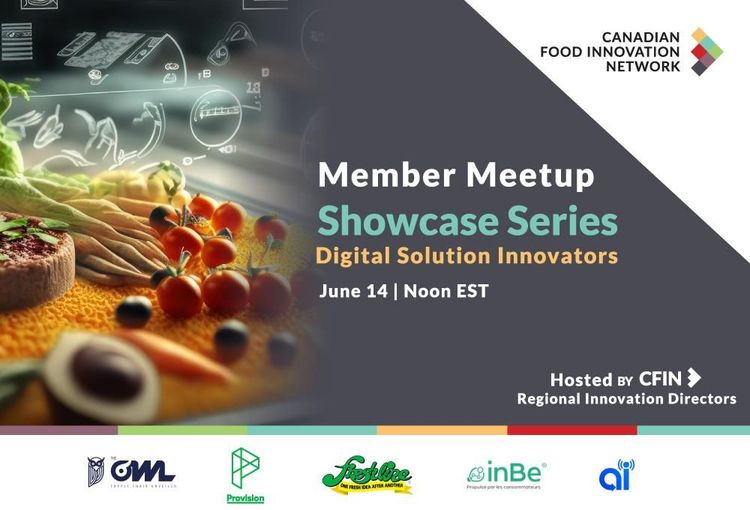
Member Meetup Showcase Series Preview
Welcome to YODL! In addition to daily original content, YODL helps CFIN Members find new partners , resources , and funding opportunities to grow their food business. Learn more about this growing community and become a CFIN Member (for free!) today . CFIN regularly holds bi-weekly virtual member meetups , where CFIN Members can connect with each other and our Regional Innovation Directors. We’re using this Wednesday’s virtual Meetup to highlight five digital solution innovators . On June 14, 2023 , we’re hosting a special Member Meetup focus ed on Digital Solutions Innovators . We’re featuring five digital innovators that are bringing new ideas , products, and solutions to the food sector. We ’l l hear from all five companies, learn more about their tech, and identify ways CFIN members can collaborate with these innovators. Here’s a sneak peak of our digital innovator s: Agyle Intelligence Mount Stewart, PE -based Agyle Intelligence offers digital transformation solutions for food producers, processors, packers and supply chains , with cloud-based technology that helps automate the delivery of insights, trends and reports in real-time through digitized forms and files. Developed in collaboration with industry partners, Agyle’s solutions fit seamlessly into a company’s processes without interruption. Freshline Vancouver, BC’s Freshline is a wholesale direct grocery marketplace for foodservice. The company provides a B2B e-commerce platform for food wholesalers, distributors and retailers that allows them order and complete fulfillment online. Freshline is developing its platform to automate and streamline sales and operations by including a turnkey integration management tool for suppliers that enables them to connect their ERP, accounting, inventory or operations management platform to the platform. InBe Based in Quebec City, QC, InBe works with innovative consumer brands from a variety of industries, including food and beverage manufacturing, t o provide consumer feedback on concepts, products and services in real-time to better guide decision making. InBe offers different methods of capturing consumer interests, including through testing based on client concepts, value propositions and products, as well as market research and validation. It also offers workshops on how to design, implement and optimize a front-end innovation system. The Owl Solutions Waterloo, ON-based The Owl Solutions offers businesses a data intelligence platform designed to identify inefficiencies within their supply chains. By providing real-time analytics on key performance indicators companies can monitor , detect and solve performance issues more quickly and efficiently. The Owl Solutions works with clients to identify areas of improvement, and to create and implement st rategic solutions. Provision Analytics Calgary, AB’s Provision Analytics features a digital platform that captures and analyzes food safety and quality data, allowing food and beverage businesses to create cloud-based records and policies, while streamlining supplier management, traceability and food safety culture. The platform ensures process data is easily accessible for audits and analytics, as well as for eliminating barriers to compliance and reducing certification risks through easy-to-access embedded schedules, rules and instructions. Click here to register for this event.
IN 30: Food Apps
Welcome to YODL! In addition to daily original content, YODL helps CFIN Members find new partners , resources , and funding opportunities to grow their food business. Learn more about this growing community and become a CFIN Member (for free!) today . Sometimes, all it takes is 30 minutes to learn the ins and outs of new food technologies and trends that are transforming the food and beverage industry. In this series, we’ll dig into a food innovation topic and link you to content and resources so you can become a master on the topic in 30 minutes (or less!). This week, we’re looking at food apps, including those for food ordering and delivery, grocery purchases, product reviews, restaurant reservations, nutrition tracking, purchasing deals, meal kit subscription services, food waste reducing, recipes and more. The Overview YODL - The Rise of Food Apps As well as the usual food apps that help people cook dishes, review restaurants, and order groceries, consumers are downloading apps that allow them to purchase discounted products that would otherwise become food waste or recover upcycled items destined for the dump. Businessofapps.com - Food Delivery App Revenue and Usage Statistics (2023) Food delivery has expanded from takeaways to anything and everything, adding billions of dollars in potential revenue capture. YODL - New Pathways to the Pantry – Top Five Takeaways Canadian consumers expect to access food conveniently, efficiently and safely. Thanks to the increase in online ordering, delivery and other cashless transactions they’re finding innovative options to meet their demands. And if one food business isn’t offering those options, they’ll quickly move to one that can. The Canadian Connection Genymoney.ca - 3 Food Waste Apps in Canada (That Save You Money) Canadian food apps that save consumers money while reducing food waste. Savvynewcanadians.com - Best Food Delivery Apps and Services in Canada 2023 Data on the most popular food delivery apps in Canada . YODL - 50 Canadian FoodTech Resources – Caddle Through its app, Caddle garners consumer data and insights for consumer packaging goods companies to use during decision making. Vividata – The Top Food Delivery Apps in Canada An estimated 4.8 million Canadian adults (or 16%) have a food delivery app downloaded on their mobile device. Social Media @skipthedishes – (Instagram) Skip the Dishes (part of food delivery marketplace Just Eat Takeaway) is one of the world’s most popular food ordering and delivery services. This year the company launched its AI-powered Inflation Cookbook as part of its Skip Express Lane service. @myfitnesspal – (Facebook) My Fitness Pal is a nutrition and fitness tracking app available globally. @McDonald’s – (Twitter) According to Similarweb , the McDonald’s app is the number-one food and beverage app used in Canada. Overtime If you’ve got more than 30 minutes, these are for you: YouTube - How Much Does It Cost to Build Food Delivery App in 2023

The Future of Food as Medicine in Canada
Welcome to YODL! In addition to daily original content, YODL helps CFIN Members find new partners , resources , and funding opportunities to grow their food business. Learn more about this growing community and become a CFIN Member (for free!) today . To conclude our week of food as medicine, we’re looking at the future of the sector in Canada. We asked CFIN’s Dana McCauley , CEO, Alex Barlow , Vice President of Programs, and Lavina Gully , Regional Innovation Director for BC and Yukon, for their views on the future of food as medicine. Here’s what they had to say: Q: What advances in personalized nutrition are we likely to see within the next decade? Alex: W e are likely to see more frequent and accessible options for consumers to get deep insights on their nutrition needs through DNA profiles, blood tests, or other tools. I am hopeful that it democratises access to our own health data, making it easier to assess our actual health metrics as we need it rather than having to convince a doctor to run a blood or other kind of test. How many times do you take a whack of Vitamin D in the winter as a Canadian – what if you could access your actual levels and supplement accordingly ? Other critical tests such as metabolic or lipid panels could give us deeper insights as we seek to live healthier – certainly more details than just stepping on the weight scale. Dana: The good news is that industry and consumers are more aware of how what we eat affects our health. The bad news is that this awareness hasn’t progressed in tandem with progress in health science that is extending lifespans. As a result, we have a lot of people living longer, but not necessarily better. In the next decade, there is an opportunity to make progress in lifelong nutrition science and education to ensure that people are not only living longer, but feel great every day . We see hints of this progress on the horizon with companies like Loblaws which have purchased gyms, drug stores and even medical device companies. Lavina: We’ll see w earable devices and sensors that will provide real time tracking and monitoring of an individual ’ s health and integration of this data into nutrition planning. By combining health data with AI technology, personalized insights can be generated to help people better manage their health. We’ll also see g reater focus on disease prevention vs treatment via continued research into nutrigenomics. More will be learned about gene-diet interactions , but funding is critical to provide high-quality evidence in the form of randomized clinical trials. Q: How will the trend toward personalized nutrition impact the Canadian food and beverage industry? Alex: Firstly, this is building on the existing trend for healthier food products and cleaner ingredient lists which is already impacting many brands and food manufacturers in North America. If we add in AI making personalized recommendations, providing recipes and shopping lists, and directing consumers on where to shop, it will be a big shift for the industry as retailers and brands seek to redirect their marketing efforts and get listed on these tools or platforms to be among the list of recommendations. We have already seen some of our meal kit members invest in these types of technologies. Even grocery e-commerce platforms are moving towards these types of branding and recommendation options, but to have it truly personalized based on your individual health needs will be an added level to consider and include in their growth strategies. Dana: I imagine that we will see new kinds of specialty aisles and perhaps even online stores emerge that specialize in food as medicine. I can imagine that food businesses will start to pay more attention to corporate insurance plans , and companies such as Manulife are already starting to work with companies who are developing foods that address this topic and may in the future offer reimbursement or lower premiums for people who adopt these kinds of foods into their diets. This change will require that food companies learn new things and have messaging for a new group of stakeholders. Lavina: To deliver effective personalized nutrition products and tools, the industry will need access to talent with specialized skillsets in nutrition, food science, data analysis and machine learning. Think bioinformatics with a food twist. Also, partnerships and collaborations with healthcare professionals will need to be developed as they play a crucial role in guiding individuals towards personalized nutrition plans. Q: What should food companies understand about the potential growth of this trend and how should they be responding? Alex: I think awareness is critical, and the understanding that this space is set to accelerate very quickly, with a lot of new tools and platforms launching to support consumers. Being aware of the top tools in this space and considering how you can integrate them into your growth strategies is my number one recommendation. Consumers will not be the only ones picking and choosing – food industry players will also be looking for their perfect match as they look to integrate this technology into their go - to - market strategies. For example, Walmart has already adopted a “Shop-by-Diet” tool, powered by Sifter. Sifter’s technology matches hundreds of diet , allergen, and medication attributes across every food and supplement product in their database , returning relevant foods in milliseconds for consumers. I expect to hear more and more about these kinds of partnerships in the near future . Dana: Interesting question. I think industry needs to rally together with their associations and ensure that government understands what regulatory and claims opportunities need to be made available and verifiable. Otherwise, consumers won’t be able to buy into the concept. Industry should be keeping abreast of nutrition science by working with groups such as Dietitians of Canada and u niversities to make sure they are developing credible and effective products. Lavina: The desire to eat healthy is ubiquitous , but food companies still need to earn the trust of consumers when it comes to new products or technologies. Given that personalized nutrition is so…… personal , expect less reliance on product reviews or testimonials and more emphasis on rock solid data that proves the association between a tailored diet and the characteristics of the individual consumers. The proof must be in the (personalized) pudding! For more content on the topic see IN 30 - Food as Medicine , Explained : Personalized Nutrition , 50 Canadian FoodTech Resources – Richardson Centre for Food Technology and Research and Company Profile - Nutrigenomix . CFIN’s latest Innovation Booster Program focuses on Personalized Nutrition and Improving Human Health Through Food . The funding call opened on May 29, 2023, with all applications due by June 26, 2023. Winners will be announced in September 2023.

Company Profile – Nutrigenomix
Welcome to YODL! In addition to daily original content, YODL helps CFIN Members find new partners , resources , and funding opportunities to grow their food business. Learn more about this growing community and become a CFIN Member (for free!) today . This week, we’re looking at food as medicine and personalized nutrition. Today, we’re highlighting Toronto, ON-based Nutrigenomix, a company that specializes in personalized nutrition through nutrigenomics , the study of genes and how they interact with diet. What They Do Nutrigenomix offers DNA tests (based on cheek or saliva swab samples ) consisting of 70 genetic markers for health and wellness, athletic performance and fertility, which the company says reveal how genes impact weight loss and body composition, nutrient metabolism, heart health, injury risk, physical performance, fertility, food intolerances, and eating habits. How They’re Featuring Food as Medicine The company provides the tests through more than 10,000 healthcare practitioners in over 40 countries. Based on the results of genetic testing, Nutrigenomix produces personalized recommendations that can be taken to a h ealthcare provider. The company also offers personalized nutrition and fitness reports based on a vegan or vegetarian diet. What You Need to Know The Nutrigenomix test kit was used in the first published, peer-reviewed randomized controlled trial of genetic information. According to the company, the research showed that DNA-based nutrition recommendations result in increased motivation , increased weight loss, a greater reduction in blood glucose levels, and greater dietary improvements than general advice and nutritional plans. Nutrigenomix also says that eating based on your DNA can also decrease the risk of developing chronic diseases and optimize health, sports performance , and fertility. The company is associated with the University of Toronto , and has an International Science Advisory Board featuring world - renowned researchers in the field of nutrigenomics and personalized nutrition. In the Media YouTube – Nutr i genomix for Practitioners
50 Canadian FoodTech Resources – Richardson Centre for Food Technology and Research
Welcome to YODL! In addition to daily original content, YODL helps CFIN Members find new partners , resources , and funding opportunities to grow their food business. Learn more about this growing community and become a CFIN Member (for free!) today . Canada has an extensive range of research centres, food incubators, accelerators and labs supporting food and beverage innovation through the research they do and/or the services they offer. Each week throughout 2023, we’ll be highlighting an organization that’s supporting food innovation in Canada. Name: Richardson Centre for Food Technology and Research , at the University of Manitoba . Location: Winnipeg, MB Mission: To advance food quality and human nutrition through traditional and innovative food processing techniques . Focus: The centre partners with the food and agri-food industries on collaborative research and pre-commercial development activities. Services: The Richardson Centre is housed in a 55,000-sq.-ft. building on the University of Manitoba Fort Garry campus. It connects researchers from the Faculty of Agricultural and Food Sciences with food and agriculture companies to conduct collaborative R&D. The centre offers: Human nutrition studies, with staff and equipment for controlled human studies looking at the effects of food products, extracts and specific nutrients on human nutrition and wellness. Food product development, from a 550-sq.-ft. provincially regulated commercial kitchen. The kitchen is also equipped to prepare fixed diets for nutritional trials. Milling and dry fractionation, with a HACCP-registered pilot-scale processing facility for debranning , milling and dry fractionation of grains. Analytical testing for ingredients, food products and grains. Tabletting and capsule filling equipment for pilot processing of dry ingredients or plant extracts for human nutrition. Lab-scale oil extraction. A dairy pilot plant, for the development and manufacture of dairy and plant-based food products. The centre leas es office, laboratory, test kitchen and pilot plant space to food research organizations . What you need to know: The centre collaborates with internationally-recognized researchers from the University of Manitoba ’s Department of Food and Human Nutritional Sciences . The department offers R&D services that include fully-equipped analytical, extraction, processing, cell and tissue culture and genomic laboratories. Notable News: The centre was formerly known as the Richardson Centre for Functional Foods and Nutraceuticals . The name was changed in July 2022 to reflect its focus on collaborating with the food and agri-food industry to advance food quality and human nutrition through research and pre-commercial product development. Get Involved: Contact Dr. Rotimi Aluko , director of the Richardson Centre, at ( 204 ) 474-8883 , or at rotimi.aluko@umanitoba.ca . Or reach out to our Regional Innovation Director for the Prairies, Hubba Khatoon.

Explained: Personalized Nutrition
Welcome to YODL! In addition to daily original content, YODL helps CFIN Members find new partners , resources , and funding opportunities to grow their food business. Learn more about this growing community and become a CFIN Member (for free!) today . This week, we’re looking at food as medicine , and today we’re highlighting personalized nutrition. What Is It? As consumers increasingly embrace the concept of food as medicine, many are looking for customized solutions, rather than a one-size-fits-all nutrition plan to treat or prevent illness and even injury . And while t he idea of personalized or precision nutrition isn’t new – think about the Low Glycemic index diet to lower blood sugar levels, or the heart-healthy Mediterranean diet – the ways in which companies are offering nutrition suggestions are. Today, integrated health and nutrition companies a re going beyond using health and lifestyle history to create personal nutrition plans. Many are combining wearable technology with software to analyze b lood biomarker s and microbiomes , measure metabolites, and monitor blood glucose levels or digestive health to determine how individuals will respond to specific nutrients. Practitioners say n utrigenomics, or genetic testing , can also offer DNA-based nutrition recommendations for health and wellness , athletic performance, fertility, weight loss and disease prevention. Why You Should Care With greater awareness of how nutrients affect them personally , customers will be increasingly looking for solutions tailored to their specific needs. That includes foods or supplements featuring functional ingredients , vitamins and minerals , natural health products with bioactive compounds, and products with ingredients designed to increase absorption or bioavailability, boost metabolism, or prevent nutrient degradation . What’s H appening in Canada? There are several nutrigenomics companies in Canada, including Toronto, ON-based Gini Health . The company analyzes customers’ DNA data to identify the optimal nutrition sources for their specific genetic profile. The company creates a personalized health tracker for customers that includes DNA-based nutrition and exercise goals. For more content on personalized nutrition see IN 30 – Food as Medicine. CFIN’s latest Innovation Booster Program focuses on Personalized Nutrition and Improving Human Health Through Food . The funding call opened on May 29, 2023, with all applications due by June 26, 2023. Winners will be announced in September 2023.
IN 30 – Food as Medicine
Welcome to YODL! In addition to daily original content, YODL helps CFIN Members find new partners , resources , and funding opportunities to grow their food business. Learn more about this growing community and become a CFIN Member (for free!) today . Sometimes, all it takes is 30 minutes to learn the ins and outs of new technologies and trends that are transforming the food and beverage industry. In this ser ies, we’ll dig into a food innovation topic and link you to content and resources so you can become a subject matter expert in 30 minutes (or less!). This week, we’re looking at food as medicine. Beyond its essential role in providing macronutrients, food can be a powerful tool in the prevention and treatment of human diseases and common health ailments. The concept of food as medicine is growing in popularity with consumers, leading innovators to develop software, ingredients, and products that aim to improve health and wellness. CFIN’s latest Innovation Booster Program focuses on Personalized Nutrition and Improving Human Health Through Food . The funding call opened on May 29, 2023, with all applications due by June 26, 2023. Winners will be announced in September 2023. The Overview Cleveland Clinic - How Nutrigenomics May Impact the Way You Eat The basics on what nutrigenomics is and how it works. Dal News – Ask an Expert: What is Functional Food and Why Should Canadians Care? Food is considered functional if it has benefits for human health beyond nutrition, for example it improves health or reduces the risk of disease. Forbes - This Diet Is Changing The Way We Think About Nutrition Artificial Intelligence and machine learning could offer consumers better control over t heir nutritional health. Techcrunch.com - Levels Raises $12M to Bring its Biowearable to M arket Level’s biowearable metabolic sensor constantly monitors glucose levels to create customized health and nutrition programs. Nestlé - Nestlé Health Science Expands into Personalized Nutrition In 2019 Nestle’s Health Science division acquired Persona, a company offering customized vitamins and supplements, and launched personalized vitamin packs through its Puritan’s Pride brand in June 2022 . The Canadian Connection Nutrigenomix – Nutrigenomix Inc. is based in Toronto, ON but is available in more than 40 countries . It provides DNA-based, customized nutrition recommendations for health and wellness, athletic performance and fertility, and includes plant-based nutrition. Medcan – Toronto’s Medcan is an integrated health and wellness company that uses up to 15 diagnostic tests covering cardiovascular health, cognition, hearing, vision, nutrition and fitness, to create a customized action plan to improve a customer’s lifestyle through food , exercise and supplements. Social Media @SPINSllc – (Twitter) SPINS, a wellness-focused data technology company based in Chicago , acquired Pinto, a product intelligence platform, in 2022. Pinto has a database of food, grocery and consumer products and creates personalized inventories for specific dietary needs. GUTXY – (LinkedIn) Denmark-based GUTXY tests customers’ gut microbiome to create a personal wellness plan. Atlas Biomed – (Facebook) Atlas Biomed Group is a London, UK-based company that uses both DNA and gut microbiome to establish a nutrition plan, and establish carrier status for hereditary conditions and risks for injuries due to sports. LSee – (YouTube) France’s LSee uses a metabolic tracker to create nutrition recommendations based on blood biomarkers. Overtime If you’ve got more than 30 minutes, these are for you : Spotify - The Doctor ’ s Kitchen Podcast The Doctor's Kitchen is a podcast about food, medicine, lifestyle and improving your health. YouTube – Viome’s Full Body Intelligence Test
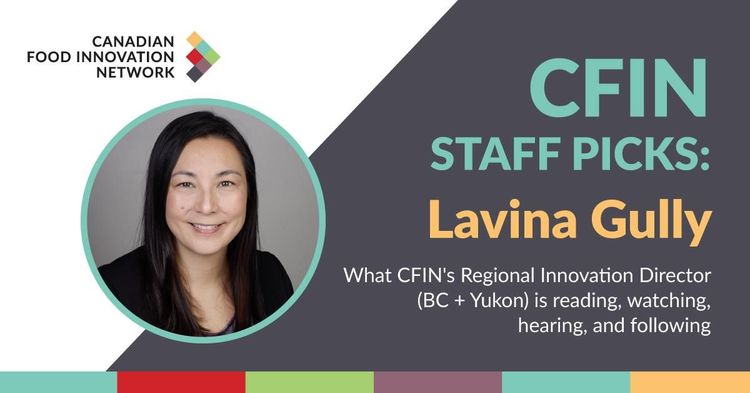
Staff Picks – Lavina Gully
Welcome to YODL! In addition to daily original content, YODL helps CFIN Members find new partners , resources , and funding opportunities to grow their food business. Learn more about this growing community and become a CFIN Member (for free!) today . A lot of material comes across our desks at CFIN, and we love to share new information with YODLers ! This one in a series of articles highlighting what CFIN staff are reading, listening to, watching, and posting. This time we’re checking in with CFIN’s Reginal Innovation Director for BC and Yukon, Lavina Gully . What are you reading? I love the Hannah Swensen mysteries by Joanne Fluke and have read almost each one – and there are over 30! The title character is an amateur sleuth and bakery owner who is constantly mixed up in a culinary caper. Americana cuisine plays a big part in the stories and there’s a full recipe at the end of each chapter. This is where I learned about Minnesota hotdish ! On the non-fiction side, I’m waiting for my turn at Peter Attia’s new book Outlive . He’s relentless in his pursuit of health and longevity and I’m a long time listener of his podcast . I’m still a public library user and 15 th in line so hopefully I’ll get it in time for summer reading. What are you listening to? My favourite podcast is Econtalk by Russ Roberts . H e’s been at it for over 10 years and has branched out to cover a wide range of topics including health, business and psychology. Who are you following? Youtube is my platform of choice and at last count I’m subscribed to over 150 channels. Mostly they fall into r unning/ s port, t ravel, f inance and q uirky. Check out Cecilia Blomdahl – Life on Svalbard, an island close to the North Pole Little Chinese Everywhere – Fascinating markets and food Cody Townsend – Skiing N orth America’ s top 50 lines Jeff Pelletier - Vancouver-based trail runner and filmmaker Leon the Lobster – Life as a lobster rescued from the grocery store. What are you watching? I love factories and have a stack of How Its Made episodes on my PVR. I’m fascinated by the automation and machinery used to make everyday products, especially food ! What are you posting about? Pitch events offer a unique experience to explore innovation and celebrate entrepreneurship. I generally post about cool start-ups with a connection to the food industry, follow me on LinkedIn to see some events I’ve attended recently.