

Articles & Reports
Featured

One Consumer, Dozens of Touchpoints, One Campaign
Every new touchpoint used to mean another campaign to build, budget, and measure. Brands pulling ahead in retail media reach consumers across all of them with one campaign and no extra workload.

Where Crunch Meets Clean Label: Sunflower Kernels for the Next Generation of Better-for-You Snacks
Canada’s healthy snacks market is experiencing strong growth. According to Grand View Research, the market generated $3,713.6 million (USD) in 2025 and is projected to reach $7,282.5 million (USD) by 2033, growing at a compound annual growth rate (CAGR) of 8.8% from 2026 to 2033.¹ The research also identifies Canada as the fastest-growing regional market in North America, highlighting significant opportunities for food manufacturers looking to innovate in the category. For food scientists and product developers, this growth presents a complex formulation challenge. Consumers increasingly seek snacks that deliver nutritional value, convenience and recognizable ingredients, without sacraficing the taste,texture and overall eating experience they expect. Success depends on balancing these priorities to create better-for-you products that satisfy both nutritional goals and consumer expectations. Why Texture Matters in Snack Innovation Texture is a powerful influence on how consumers experience food, shaping everything from first impressions to repeat purchases. Puratos’s Taste Tomorrow research found that nearly half of consumers prioritize texture over ingredients when purchasing food, while 68% of millennials say texture directly influences their choices.² Ingredion research further indicates that 70% of global consumers would switch to a different product or brand if they were dissatisfied with its texture.³ For snack food manufacturers, these findings underscore the importance of getting texture right from the outset. Crunch, crispness and contrast can help distinguish a product in a competitive market, while combinations of complementary textures can create a more engaging and premium eating experience. Innova Market Insights’ Global Texture Trends 2026 report highlights the appeal of combining textures such as creamy, crunchy, and soft. Its research also revealed that one in four consumers globally is interested in trying snacks in formats that are new to them.⁴ Together, these insights point to opportunities for food manufacturers to explore fresh ingredient combinations and textural experiences that make better-for-you snacks stand out. Where Sunflower Kernels Fit In U.S.-grown sunflower kernels give food manufacturers a practical way to build that contrast. Their mild flavour and satisfying crunch add dimension to both sweet and savoury product innovations without overpowering other ingredients. They also bring plant-based protein, fibre and healthy fats, along with vitamin E, zinc, folate, iron and magnesium, so the texture upgrade comes with a nutritional one. Available raw, roasted and ready-to-eat, sunflower kernels can be used across a wide range of applications, including: • Better-for-you snack bars • Granola and trail mixes • Crackers and savoury snacks • Bakery products and breakfast cereals • Plant-based snacks and bites Clean Label and Allergen-Friendly by Design Consumers worldwide are increasingly prioritizing clean-label products made with recognizable ingredients and greater transparency. Innova Market Insights reports that more than two in three consumers globally say they are at least somewhat influenced by clean ingredient decks, and that nearly one in three new products now carries some type of clean label claim.⁵ Innova also notes that non-GMO claims are most established in North America.⁵ Sunflower kernels are naturally non-GMO and sustainably grown, which supports the transparency and recognizable-ingredient positioning shoppers respond to. They are also an allergen-friendly alternative to tree nuts, delivering the crunch consumers expect from nuts and seeds. Unlike tree nuts, sunflower kernels are not considered a priority allergen in Canada, making them a versatile option for manufacturers developing new products or reformulating existing ones. Turning Texture Trends into Product Opportunities As Canada's healthy snacks market continues to expand, food manufacturers have an opportunity to differentiate their products through thoughtful ingredient choices and more engaging eating experiences. Texture is an important part of that equation, influencing consumer appeal while creating opportunities to innovate across familiar snack formats. U.S.-grown sunflower kernels bring together satisfying crunch, plant-based nutrition and application versatility, making them a valuable ingredient to consider for the next generation of healthy snacks. From bars and granola to crackers and savoury mixes, they can help product developers create food innovations that balance texture, taste and nutritional value. Explore how U.S.-grown sunflower kernels can add texture, nutrition and versatility to your next snack innovation. Connect with a supplier today > {link to lead to the NSA Kernel suppliers page} References: 1. Grand View Research, Canada Healthy Snacks Market Size & Outlook, 2026–2033. https://www.grandviewresearch.com/horizon/outlook/healthy-snacks-market/canada 2. Puratos, “Why texture is important in food,” February 19, 2025. https://www.puratos.com/blog/why-texture-is-important-in-food 3. Ingredion research, as reported in “New approaches to texture innovation,” Food Business News, May 7, 2026. https://www.foodbusinessnews.net/articles/30275-new-approaches-to-texture-innovation

Inside SIAL Canada 2026: Driving Food Innovation Through Connection and Collaboration
CFIN had the honour of taking a bite out of SIAL Canada 2026 in Montréal 🍎—connecting with partners, members, and industry leaders shaping the future of food innovation across Canada and beyond. Representing CFIN on site were CEO @Dana McCauley and @Julie Daigle , Regional Innovation Director (Quebec), who engaged with the ecosystem throughout the event. Their presence reflected CFIN’s ongoing commitment to strengthening Canada’s food innovation ecosystem and supporting high-potential foodtech ventures. Attendees could also catch Julie as a Foodtech Focus expert at the SIAL Canada Expert Hub, where she connected directly with innovators and shared insights with the community. Dana also took the stage as part of the Dairy Talks program, contributing to a forward-looking discussion on innovation as a driver of market leadership in the Canadian dairy sector. Her session explored the shift from incremental product development toward a broader innovation mindset—highlighting next-generation ingredients, value-added dairy formats, new go-to-market strategies, and the role of Industry 4.0 technologies like AI, robotics, automation, and digital supply chains in strengthening productivity and global competitiveness. A key highlight of the week was CFIN’s involvement in the 7th edition of the Startup Pitch Competition, held on April 30 on the Food & Bev Connect stage. Julie Daigle participated as the President of the Foodtech jury, joining a panel of industry experts evaluating promising entrepreneurs from the Startup Village. Beyond the competition, the Startup Pitch stage served as a strategic platform connecting entrepreneurs with buyers, investors, and key decision-makers across the agri-food ecosystem. A standout moment for the CFIN community was the recognition of Maia Farms, a CFIN member and funding recipient, which earned the Gold Prize in the foodtec h competition 🍄🏆 CFIN’s presence at SIAL Canada underscored the momentum of Canada’s food innovation sector and the value of convening the ecosystem to accelerate ideas from concept to commercialization. 📖 Explore more from SIAL Canada 2026 R elive the stories, innovations, and key moments captured throughout the show in the official SIAL Canada Daily: SIAL Canada Daily – 2026 Edition (Photos Courtesy of SIAL)
Five Years of CFIN: A Letter to the Network
Thirty years ago, I worked as a chef in the kitchen of one of Canada’s top restaurants standing should er to shoulder with people who ca red about the sensory experience of food above all else . Our tech stack was al most all analog and , to be honest, we didn’t give our ordering system or the way we did inventory a lot of thought. My career broadened over time , and I ’ ve also held roles where I developed recipes at Canadian Living and wrote about food trends; built innovation strategies and products for national brands, founded a business incubator, and ran a venture creation office at a prestigious Canadian u niversity . Food was always the thread , and technology was always present but in most of the food focused businesses I’ve worked for, it was taken for granted, and creativity and hard work were what drove the businesses forward. While smart people with great ideas are essential to food business success, it’s not enough to be competitive in today’s world. Old ways of running restaurants, innovation labs and food and beverage processi ng businesses can’t compete internationally or absorb the trade shocks that have become commonpla ce in recent history. That’s why I feel l ik e CFIN is the perfect place for me to be today and why we’re adding dozens of new members per week. When CFIN was created in 2021, the mandate was intentionally broad : cata lyze Canadian food innovation with funding , build community, connect an ecosystem that had been operating in silos for decades. The funding programs took shape quickly. Since 2022, we’ve awar ded $23.3 million to 133 projects across six program s. For every $1 CFIN invested, our members committed $7.65 of their own capital toward innovation. This leverage ratio of nearly 8-to-1 has unlocked over $140 m illion in private sector spending on R&D and capital infrastructure. The other work was harder to define . What do "build community" and "connect an ecosystem" mean in practice for a sector span ning startups, processors, researchers, investors, policymakers, and operators spread across this vast country ? Th at question didn't have a tidy answer. As a result , fostering and serving this network was (and remains ) an exercise in innovation itself : something new to be built , and then tested, adjusted, and iterated upon , ad infinitum . I’m immensely proud of what we’ve built so far . A team of Regional Innovation Directors who've supported more than 2,200 organizations, brokering the introductions that became commercial partnerships, strategic investments, leadership hires, and research collaborations. A digital platform , YODL, connecting Canada's food sector across industry silos and bridging interprovincial barriers . The first comprehensive analysis of Canadian foodtech . A network of 8,500 members from every province, every part of the food value chain, every stage of business . On any given week, our community is discussing topics ranging from precision fermentation bioreactor designs and funding stacks to food packaging labeling regulations and export strategies, all in the same space. Members benefit from purpose-built tools and resources — like our Funding Finder that aggregates food and beverage funding opportunities across the country and a growing library of original sector research and analysis — alongside direct access to our Regional Innovation Directors. Canada has strong regional funders, accelerators, trade associations, and tech transfer offices, each doing necessary work in a defined lane. What this sector didn't have was a place where the conversation s , the tools, and the connections all showed up at once — where the range of problems and the range of capabilities were dense enough that the right solutions could emerge . That's what CFIN has built. That foundation is important because the next five years will be even more dynamic, and often more challenging, than the last five . To keep pace and flourish in an increasingly volatile world, Canada's food sector needs to modernize faster and more strategic ally than ever before . Trade disruption is dramaticall y reshaping supply chains . L abour constraints are compounding a productivity gap that was widening long before tariffs became front-page news. Climate pressures are intensifying. Food 4.0 — a tech-enabled food s ector that's more collaborative, productive, resilient, and competitive — is the framework CFIN is building toward, and the case for it gets more urgent by the quarter. I ’m confident that we’re up to the task . Five years ago, Canada's food innovation ecosystem was fragmented, underleveraged, and often invisible to the investors, operators, policymakers, and media who needed to see it. That's no longer true. The capacity to respond to the challenges ahead is here. Not in any single program or policy, but in the breadth of this network — the founders , processors , researchers , and investo rs who are hungry to innovate and build a better Canadian food sector . My own wide-ranging path through the food sector taught me that no single role ever showed me the full picture. It took working across kitchens, labs, newsrooms, boardrooms, and startups to understand how innovation really moves through this industry — and where it get s stuck. CFIN was built on the same insight. A sector this complex, facing challenges this urgent, needs more than funding or advice or connections in isolation. It needs all of them in the same room. That's what we've spent five years building, and I'm betting the next five will prove its value at a scale none of us can yet imagine. Thank you for being part of it. Dana McCauley, CEO, Canadian Food Innovation Network

How BC is Becoming a National Foodtech Hub
Editor's Note: This article was o riginally published in the Vancouver Tech Journal on March 13, 2026 The province has a diverse food processing industry, world-class research facilities, and a deep bench of tech talent — everything a foodtech ecosystem needs to thrive. Foodtech builds the software, automation, and applied science for how food gets processed, manufactured, packaged, distributed, and sold. The industry behind it is enormous — food and beverage processing alone is Canada's largest manufacturing sub-sector , bigger than automotive, bigger than aerospace. It's a serious market, and in British Columbia, it's growing fast. But if you work in the province's broader tech ecosystem, you might not even know that. Foodtech hasn't traditionally drawn the same attention as sectors like cleantech or enterprise SaaS despite being a comparable market in scale and complexity — and one where demand for new technology is accelerating fast. What BC brings to the table BC's food processing sector is substantial — over 3,200 companies producing roughly $12.6 billion in value-added products annually. And it's being treated as a strategic priority. The province has funded a network of shared food processing hubs, UBC just opened a Food and Beverage Innovation Centre with pilot-scale production labs that processors and startups previously had to leave BC to access, and SFU's BC Centre for Agritech Innovation is partnering directly with SMEs on cost-shared R&D. At the same time, much of what the food industry needs is already being built in BC for other thriving tech sectors. Process automation, energy management, supply chain software, safety and traceability systems, data-driven quality control — these are cleantech and software problems applied to production floors and distribution networks. The talent, research base, and trade infrastructure to support a serious foodtech cluster are all here. A different kind of tech sector Foodtech doesn't work like enterprise SaaS or consumer tech. Processors and manufacturers adopt slowly and carefully, because failure is expensive in ways that go beyond lost revenue — a food safety issue, a botched line integration, a regulatory problem. Sales cycles run in quarters. The investor community that understands food is small and specialized. And the industry's own networks run through trade associations, existing supply relationships, and sector-specific events that sit well outside the broader tech community's orbit. None of this means foodtech is closed off. It means that if you want in — as a founder, investor, developer, or potential partner — you need a way to access the conversations, the deal flow, and the operating knowledge that don't surface through the usual channels. The Canadian Food Innovation Network The Canadian Food Innovation Network is a national not-for-profit, established in 2021 that functions as the operating infrastructure for Canada's foodtech sector. CFIN runs cost-shared funding programs that help companies de-risk R&D and move technology into commercial settings. Since launch , the organization has awarded over $22 million to 122 Canadian foodtech projects, matched by $25 million in industry co-investment. Those funded companies have generated $90 million in economic impact, created over 355 jobs and co-op placements, and attracted more than $82 million in follow-on investment. The network's 8,000-plus members include food processors, technology companies, ingredient suppliers, retailers, researchers, and investors — connected through YODL, CFIN's member platform, and supported by Regional Innovation Directors embedded across the country, who work directly with members to broker introductions, navigate funding, and connect emerging technology with the processors and buyers who need it. CFIN also produces the sector's most detailed intelligence . The Foodtech in Canada 2025 Ecosystem Report mapped investment flows, identified sector strengths, and gave both companies and investors a clearer picture of where the Canadian foodtech market stands. And then there's Foodtech Frontier , CFIN's annual program identifying the country's highest-potential foodtech companies. The inaugural cohort of 35 winners included eight BC companies. For investors, it works as curated, vetted deal flow in a sector where sourcing is otherwise hard. For the companies, it's structured national visibility. Plug into Canada’s foodtech ecosystem If you work in technology or investment and you've been curious about the food sector, then signing up for a free CFIN membership is the best place to start. Members get access to funding programs, sector intelligence, a national innovation community, and regional team members that know the BC landscape specifically.
Other Articles

News File – March 17, 2023
Each Friday we’ll bring you a roundup of news from CFIN, YODL and around the food world. As seen on YODL Check out this week’s most viewed discussions: CFIN Members ABOUND on NPC's Canada's Game Changers List! Special Report - What's Ahead for Plant-based Foods in 2023 New Ventures BC and 30 Under 30 comp Around the Food World CFIN has a new CEO . Read more about Dana McCauley and her plans for CFIN as we enter year two of the organization. Plant-based cheese maker Daiya has announced a multi-million-dollar investment in fermentation technology that it says will help the company create a product that is “ tastier, meltier, and stretchier .” Kraft Peanut Butter has launched limited-edition Welcome Home Jars of peanut butter featuring labels in five of the most commonly spoken languages by newcomers to Canada , as well as other information for immigrants. Did you Kno w? The Hartman Group has published a new white paper called Fermenti n g the Future: The Growing Opportunity for Products Made with Precision Fermentation , in coordination with Perfect Day and Cargill. The paper covers the results of a survey by the Hartman Group measuring consumer attitudes towards food and technology, as well as interest in precision fermentation. Here’s what the report found: 77% of people familiar with precision fermentation say they’re likely to purchase products made with ingredients created through the process. The U.S. precision fermentation market is projected to grow to more than 132 million adults by 2027. Three in five Americans believe science and technology can make food more sustainable , and 56% say it can make food healthier. 52% of consumers say they would significantly change their lifestyle to be more environmentally friendly . 60% of Millennials and 55% of Gen Z say they look for f ood and beverage products from companies that prioritize sustainability and animal welfare . After learning about precision fermentation, 85% of Millennials and 84% of Gen Z say they would likely try products containing ingredients made with the process.

Company Spotlight – Cyberworks Robotics
This is one in a series of interviews with CFIN member companies that have successfully applied for and received funding . Markham, ON-based Cyberw o rks Robotics provides autonomous self-driving technology for material handling forklifts and tow-tuggers as well as industrial floor scrubbers. This allows f ood and be verage producers and distributors to mitigate labour shortages, save labour costs, increase efficiency, redeploy labour to higher value-add roles , and increase plant safety. The company received $227,946 in funding to develop autonomous self-driving tow tugs for food distribution centre logistics. We spoke to Vivek Burhanpurkar, CEO of Cyberworks Robotics , to hear more about the company and its plans. Q: What is your company’s mission? A: Our mission is to reduce costs to the consumer. We enable this by reducing labour shortages and labour costs for f ood and b everage companies by providing self-driving solutions for common tasks like operation of forklifts and floor scrubbers. Q: Why did you apply for this funding and how will you use it? A: We want to work with early adopters within the f ood and b everage i ndustry to pilot test and optimize our technology for specific needs of the industry. Q: What excites you most about working in this area of the food industry? A: The food and b everage industry spends hundreds of millions annually on labour for mundane tasks that don’t add value to the bottom line and which ultimately contribute to food inflation. Our technology will help to increase efficiency and reduce the cost of essential foods to the consumer. Q: Why is collaboration so important for accelerating innovation in the food industry? Is it difficult to find good collaborating partners, and what would make the process easier? A: Collaboration is essential for us in order to optimize our technology for the nuances of the f ood and b everage industry. Q: Please comment on the importance of public funding to help companies clear innovation hurdles and access leveraged funds. A: Public funding is essential to companies like ours in order to bridge the gap between early adopters and new technologies to mitigate risks for both parties and accelerate the rollout of new technologies. Q: Looking ahead, what’s on the horizon for your company? A: We are deploying our technology to other applications , ranging from self-driving personal transport for people with disabilities to self-driving tractors , to continue to improve the deployment of labour and drive efficiency gains for Canadian companies. Q: What are your passions or hobbies outside of work? A: When I’m not working I enjoy hiking, travelling and catching up on the latest technology developments. Q: If you had to pick one person to make you a meal, who would you choose? A: Jacinda Ardern .
50 Canadian FoodTech Resources – The Centre of Seafood Innovation at Vancouver Island University
Canada has an extensive range of research centres, food incubators, accelerators and labs supporting food and beverage innovation through the research they do and/or the services they offer. Each week throughout 2023, we’ll be highlighting an organization that’s supporting food innovation in Canada. Name: Centre of Seafood Innovation at Vancouver Island University (CSI) Location: Bowser, BC Mission: CSI is an innovation hub that helps c ompanies to extract more value from sustainable seafood harvests. Focus: The centre s upports entrepreneurs with business development, public education, and workforce attraction projects to foster ongoing innovation. It focuses on companies producing value - added seafood products, and products that complement seafood products such as sauces, dips or seasonings. Services: CSI helps seafood entrepreneurs access applied research, i nfrastructure, equipment , and services. It offers businesses support with project development, coaching, workshops, and event space rentals , and has a provincially inspected commercial-grade kitchen suitable for creating i nstitutional products, preparing seafood-based meals and snacks, developing bench-top products , and demonstrating new recipes and culinary techniques in-person or virtually . The 2,000-sq.-ft. kitchen features: Two high-end culinary ovens A c ommercial induction range Five sinks (2 x 2-bay washing stations) Coolers and freezers (reach-in) Dry storage A c ommercial dishwasher Stainless countertops Prep stations Audio-visual equipment for training purposes What you need to know: T o help support BC food entrepreneurs , CSI regularly partner s on projects with Vancouver Island University’s culinary arts department as well as other faculties. The centre is based in the school’s Deep Bay Marine Field Station , and is part of the BC Food Hub Network. Notable News: Each month CSI hosts a public lunch-and-learn series called Let’s Talk Seafood…and eat it too! designed to highlight the impacts of food - based public education on citizens’ perceptions of shellfish farming. Past projects include the Oyster Challenge, which showcased the use of oysters processed with High Pressure Processing (HPP) ; a partnership with Omega Pacific Hatcheries to help capture maximum value for its farmed sturgeon harvest ; and a project to assess Modified Atmosphere Packaging (MAP) as a treatment to keep Japanese scallops alive for transportation. Get Involved : Contact Debra Hellbach , manager of the Centre of Seafood Innovation at Debra.Hellbach@viu.ca , or reach out to our Regional Innovation Director Lavina Gully .

Explained: New Harvest
What is it? New Harvest is a global non-profit research institute advancing the science of cellular agriculture . The organization raises funds from donors to develop the research ecosystem and cutting-edge technology needed to create a more sustainable food system. The organization ’s global headquarters is in Sacr amento, CA, while New Harvest Canada is based in Edmonton, AB. What it does New Harvest has helped launch companies working to develop and commercialize cellular food products , and works on a variety of initiatives surrounding cellular food, often in collaboration with industry , including applied research, group studies, and crowdfunding. New Harvest offers companies free resources such as the OpenCellAg Repositor y , an easily accessible repository of journal articles, book chapters, presentations, and more, and an image library featuring cellular agriculture visual resources. It also funds projects through a research fellowship, seed grant, and dissertation award. Since its establishment in 2002, New Harvest has funded 54 research grants, and helped create roughly 600 jobs through its support of new startups , and launched nine collaborative initiatives. Networking Conference New Harvest offers annual conference on cellular agriculture, covering scientific breakthroughs and commercial developments, and bringing together researchers in the industry from around the world. Click here to view coverage of the 2022 event. For more on New Harvest and the cellular agriculture process , here’s a discussion between Alex Barlow , director of programs for CFIN, and Yadira Tejeda Saladana , director of responsible research and innovation with New Harvest Canada .

The Tablesetter – March 13, 2023
Happy Monday CFIN members! Here’s your weekly heads up on what’s happening on YODL and around the food world this week. The YODL Menu Monday: The Tablesetter – March 13 , 2023 Tuesday: Explainer: New Harvest Wednesday: 50 Canadian FoodTech Resources – Centre of Seafood Innovation at Vancouver Island University Thursday: Company Spotlight – Cyberworks Robotics Friday: News File Something to Celebrate March 12 to 18 is National Bubble Gum W eek! Celebrated since 1975, the week has grown to include events around the world, including competitions to create unique new flavours. The first commercial bubble gum was Blibber-Blubber, produced in the U.S. in 1906 by Frank Fleer. Pink was the only food colouring available at the time, giving bubble gum its signature colour. Food Facts The Hot Plate from Tag has released its 2023 Flavor & Trend Forecast . According to the report, healthy snacks, nostalgic desserts , and traditional cooking techniques are back in style. Here’s Tag’s top 10 food and beverage trends for 2023 : 1. Plant-based 2. Crispy 3. Curry 4. Heritage pasta 5. Mindful snacking 6. Ube 7. Hybrid vegetables 8. Confit everything 9. Vintage desserts 10. Cultivated meat Happy YODLing!

News File – March 10, 2023
Each Friday we’ll bring you a roundup of news from CFIN, YODL and around the food world. As seen on YODL Check out this week’s most viewed discussions: CFIN Members ABOUND on NPC's Canada's Game Changers List! Happy International Women's Day! Organic Instant Coffee - Local to GTA / Southern Ontario Around the Food World Canadian Women in Food held its Full Tilt 2023 conference and marketplace celebrating International Women’s Day on March 8. A U.S. appeals court has ruled that the name “gruyère” can be used on cheese made outside of France and the G ruyère region of Switzerland. UK organization GenM says food and beverage brands should consider developing products that are menopause friendly, or that help ease the symptoms associated with menopause. Did you Kno w? According to Cult Food Science , the Royal Bank of Canada has identified cellular agriculture as one of the top technologies to help transform Canada into a low carbon agriculture producer. Canada’s agriculture and food industries currently produce approximately 10% of the annual national greenhouse gas emissions, which is roughly 93 megatonnes. Investing in new technologies could help reduce emissions from these sectors by up to 40%. However, the Royal Bank says investment by private equity and venture capital in Canada’s cellular agriculture and food industries is currently lower than it needs to be – US$91 million compared to more than $7 billion globally – if Canada is to be competitive worldwide in this market.
Company Spotlight – Liven Proteins
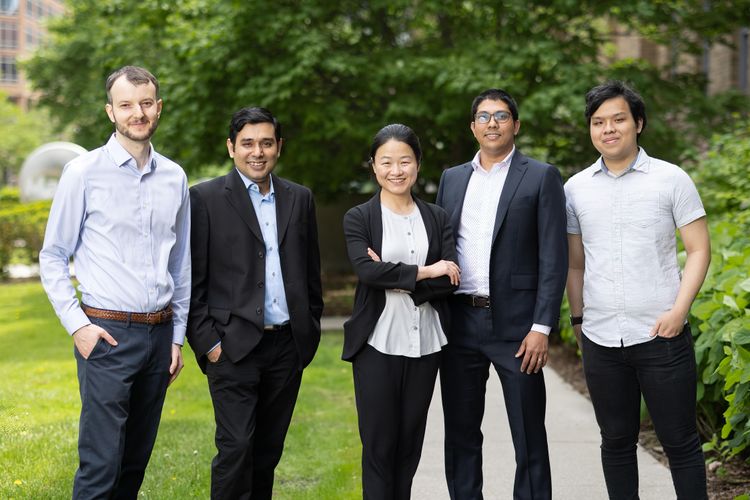
The Liven Protein team, with (centre) Fei Luo, company co-founder and CEO. This is one in a series of interviews with CFIN member companies that have successfully applied for and received funding. Toronto, ON-based Liven Proteins Corp. makes animal-free, functional and sustainable protein ingredients. The company’s first product is animal-free collagen to provide specialty nutrition such as skin and joint health in functional beverages, and a unique gelling texture to improve mouthfeel of alternative protein foods. These functionalities were previously only available through animal-derived collagen. By making collagen animal-free, more sustainable plant-based food and beverages have access to these key functionalities and therefore help them to reach parity to animal products. Liven Proteins is also working on using side stream from the plant-based food industry as raw materials, reducing cost and making its process more sustainable. The company received $99,926.00 in funding to optimize its bioprocess for upcycling starch streams and to test additional side streams in the food industry as a starting material to build a versatile fermentation platform for animal-free protein manufacturing. We spoke to Fei Luo, co- founder and CEO of Liven Proteins, to hear more about the company and its plans. Q: What is your company’s mission? A: Our mission is to enable a sustainable, nutritious and delicious future through animal-free protein ingredients with superior functionality. Q: W h y did you apply for this funding and how will you use it? A: We applied for this funding to test different food industry side stream s as raw materials for collagen production , develop a novel process to produce consistent input for fermentation from different feedstock, and thereby de-risk the technology. This funding will support Liven’s establishment of a bioprocess facility, expand the team to include a bioprocess engineer, and validate the use of multiple side streams in our collagen production (fermentation) process. Q: What excites you most about working in this area of the food industry? A: The potential sustainability impact of this innovation – craft design ed protein ingredients to enable functionality without animals, and a novel process to convert los t food to valuable protein ingredients – is massive. Q: Why is collaboration so important for accelerating innovation in the food industry? Is it difficult to find good collaborating partners, and what would make the process easier? A: I nnovation in the food industry requires the whole supply chain to be involved! There are many players so sometimes it is difficult to find the right fit. I hope there are more key connectors with domain expertise available to matchmake! Q: Please comment on the importance of public funding to help companies clear innovation hurdles and access leveraged funds. A: Public funding is instrumental for technologies at start up. Otherwise, it is challenging for companies such as Liven to secure funds from customers or investors to fund innovations that have not yet been validated . Q: Looking ahead, what’s on the horizon for your company? A: Scal ing up production so food and beverage compan ies will be able to test out our ingredients! Q: What are your passions or hobbies outside of work? A: Jogging, trekking, camping – spend ing time in the nature. Q: If you had to pick one person to make you a meal, who would you choose? A: Daniel Humm , owner of Eleven Madison Park in New York . I’m really curious about his three-Michelin star vegan restaurant, and the secret sauce! Ready to access funding for your innovative initiative? Click here to find out more about CFIN’s funding programs.
50 Canadian FoodTech Resources – Ag-West Bio
Canada has an extensive range of research centres, food incubators, accelerators and labs supporting food and beverage innovation through the research they do and/or the services they offer. Each week throughout 2023, we’ll be highlighting an organization that’s supporting food innovation in Canada. Name : Ag-We s t Bio Location: S askatoon, SK Mission: To help companies commercialize their research , and grow ag bio tech nology i n Saskatchewan. Focus: Ag-West Bio is a not-for-profit, membership-based company that supports businesses bringing research to market. It focuses on areas such as biological applications in nutrition and agriculture. Services: The company works with early stage companies to become investment ready. It also offers a technology commercialization fund for start ups and established companies looking to expand. It also assists companies in relocating to Saskatchewan. Its programs include the AW B StartUP Program, a web-based tool to help entrepreneurs develop their business ideas; the Global Agri-Food Advancement Partnership, an accelerator and incubator supporting early-stage companies; and the ABIC Beyond Entrepreneurs training program developed and managed through the Agricultural BioScience Innovation Centre (ABIC) Foundation . In addition, Ag-West B io offers commercialization seminars, n etworking events, conferences , and access to a range of online resources. What you need to know: The company’s members include governments, public agencies, private companies, research institutions, commodity groups and more. Notable News: One past initiative was the Bioscience Scorecard. Ag-West Bio established the scorecard as a benchmark to measure the size and scope of Saskatchewan’s ag-bioscience research and development efforts. Get Involved: Contact Kyle Adams, director of investment and commercialization at kyle.adams@agwest.sk.ca or 306-975-1939 , or reach out to our Regional Innovation Directo r Hubba Khatoon .
Funding for Cellular Food Research and Development
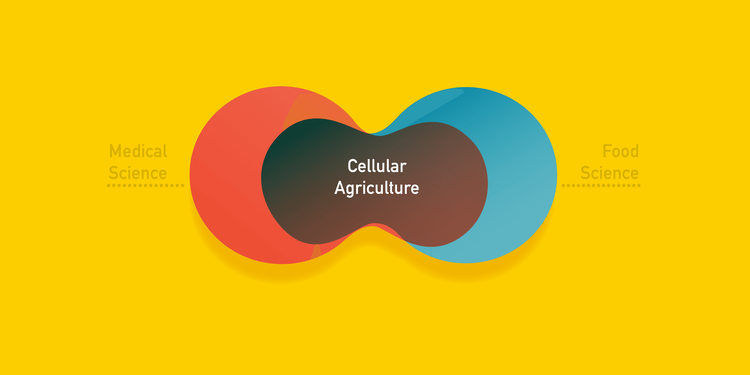
There are several sourcing of funding for companies working to develop new products, technology, and services for the emerging cellular agriculture industry in Canada. CFIN recently opened a new funding opportunity for food industry collaborators . CFIN’s fourth Food Innovation Challenge is Cultivating a resilient food future: Developing the end-to-end Cellular Food capacity for Canadian global leadership . Expression of Interest closes on March 27, 2023. Click here for more information. Other sources of funding for cellular food projects include: Genome Canada Genome Canada is a not-for-profit organization that works across sectors to invest and coordinate genomics research, innovation, data and skills and talent to help grow Canada’s genomics ecosystem and drive economic growth . The organization has a network of six Genome Centres across regions and provinces, and offers multiple funding opportunities for initiatives. Click here for more on funding from Genome Canada. N SERC NSERC offers funding to entrepreneurs and innovators researching and developing scientific and technical breakthroughs that will benefit Canada. The government agency works with universities and colleges, businesses , and not-for-profit organizations to remove barriers to innovation, and help develop new expertise in Canada’s research communit y. It also helps organizations access talent and technology at Canada’s universities and colleges, and forges international collaborat ion to help businesses connect with global opportunities and research. NSERC awards roughly 8,800 discovery grants, scholarships and fellowships each year for research initiatives. Click here for more on NSERC’s discovery grants. NRC IRAP The National Research Council of Canada Industrial Research Assistance Program (NRC IRAP) offers small- and medium-sized Canadian businesses advice, access to connections, and funding to help them innovate and bring products to market. NRC IRAP provides funding to eligible companies developing technology innovation projects, as well as for larger research and development initiatives by companies that have shown their ability to grow rapidly . Click here for more on financial support from NRC IRAP.

The Tablesetter – March 6, 2023
Happy Monday CFIN members! Here’s your weekly heads up on what’s happening on YODL and around the food world this week. The YODL Menu Monday: The Tablesetter – March 6 , 2023 Tuesday: Funding for Cellular Food Research and Development Wednesday: 50 Canadian FoodTech Resources – Ag-West BIO Thursday: Company Spotlight – Liven Proteins Friday: News File Something to Celebrate March 6, 2023 is National Frozen Food Day! Statista reports that 7% of Canadians eat frozen food every day, 35% of Canadians eat frozen food “a few times a week,” and 19% eat it once a week. In fact, only 4% of respondents said they never eat frozen food. Categories of frozen food that are expected to grow substantially include frozen desserts, bakery products, pizza, fruit, vegetables , and potatoes . Food Facts A survey conducted this year by Strategic Objectives behalf of Loacker revealed that Canadians love peanut butter. The survey found that: 71% of respondents said they feel satisfied when eating peanut butter , 28% said peanut butter makes them feel happy , and 15% said peanut butter makes them feel nostalgic. 46% of consumers said they enjoy peanut butter anytime of the day, while 37% say they prefer to eat peanut butter in the morning. 86% of consumers prefer to eat peanut butter on toast, and 50% of consumers say they enjoy peanut butter sandwich es . 31% of respondents like to eat peanut butter on its own, 45% say they like it in a dessert such as cookies, cakes or wafers, 19% use it as an ingredient in smoothies, 11% use it in meat marinades, and 10% use peanut butter in salad dressings. Happy YODLing!

News File – March 3, 2023
Each Friday we’ll bring you a roundup of news from CFIN, YODL and around the food world. As seen on YODL Check out this week’s most viewed discussions: Notre membre Laurent Dallaire du Québec, Leader émergeant de 2023 selon The Peak! Creating circular economy from food waste streams (Post farm produce and food scraps) Generation Next Thinking: Canada's food industry has an appetite for innovation! Around the Food World Dole recently announced that it experienced a cybersecurity incident that has been identified as ransomware. Product of the Year Canada has revealed its winning products for 2023. Second Harvest recently hosted its first Food Rescue Awards . Did you Kno w? The most rec ent Retail Report from RangeMe revealed the most searched food categories and products online from 2022 Q2. The survey of more than 15,000 retail buyers and 200,000 suppliers revealed: Mushrooms were among the top online food searches . Healthy food alternatives , including s alad dressings, pickles, okra and dried chickpeas , increased last year. Cat food, especially wet food, was a lso a top search, reflecting higher pet ownership and pet food shortages during the pandemic. CBD-related products have seen an increase in searches. Consumers are increasingly searching for diverse, minority and LGBTQ-certified businesses, as well as sustainable businesses, all of which RangeMe says are still going strong in 2023 Q1. More than 90% of Gen X consumers say they would be willing to pay more for sustainable products, up from 42% in 2019.

Company Spotlight – Rapid Aid Corp.
This is one in a series of interviews with CFIN member companies that have successfully applied for and received funding. Mississauga, ON -based Rapid Ai d Corp. has been the leading global developer and manufacturer of temperature-related solutions for the healthcare, transportation, food, and retail sectors since 1975. Rapid Aid’s TempAid division specializes in design and manufacturing of highly engineer ed packaging solutions for shipping temperature - sensitive goods. For the food industry the company’s focus has been on low - cost sustainable solutions using environmentally friendly materials. Rapid Aid Corp. has an ISTA certified Thermal Testing Laboratory where it qualifies its designs to show that they will protect the safety of food items when the packages are used to in the field , allowing them to optimize for cost and effectiveness. The company received $99,471 in funding to conduct experimental research to develop sustainable and smart packaging for the Canadian meal kit market . We spoke to Anthony Alleva, d irector of P ackaging Engineering and Validation for Rapid Aid, to learn more about the company and its plans. Q: What is your company’s mission? A: Our mission is to protect the health and well being of our customers by ensuring that their temperature - sensitive goods arrive with the most freshness possible in an environmentally responsible way. Q: W h y did you apply for this funding and how will you use it? A: TempAid has developed our Earthwise gel packs and biodegradable coolers to have components available to the Canadian food market that can protect products sustainably. The next step is to do laboratory studies to show how our materials can be used together to maximize food freshness while minimizing cost and carbon footprint. We are hiring additional staff in our laboratory and will be implementing computer mode l ling software to allow us to speed up the introduction of these sustainable materials into the industry. Q: What excites you most about working in this area of the food industry? A: My life’s work has been in helping food and pharmaceutical companies protect their goods thermally , and developing more eco - friendly solutions is a passion of mine. Q: Why is collaboration so important for accelerating innovation in the food industry? Is it difficult to find good collaborating partners, and what would make the process easier? A: Collaboration is critical for identifying requirements and industry trends to allow us to meet the needs of the future. Temperature control in the food industry is so important . M ore stakeholders providing input makes it easier to develop packages that work for the most applications possible. Standardization is really key to having long - term solutions , so the more input we get , the better our engineered designs will be. Q: Please comment on the importance of public funding to help companies clear innovation hurdles and access leveraged funds. A: We wouldn’t be able to embark on such an innovative project without the help of public funding. We’re attempting to really take the development of temperature controlled packaging for the food industry to the next level , which will require a lot of time and equipment that would be difficult to justify otherwise. Q: Looking ahead, what’s on the horizon for your company? A: TempAid is planning to scale up our production to meet the needs of our customers , as the need for temperature - controlled shipping solutions is exploding right now. Our goal is to increase our sustainable product offering and add even more highly engineered technologies , including biodegradable phase change materials. Q: What are your passions or hobbies outside of work? A: I entertain myself with all sorts of geeky things like Star Trek and Dungeons and Dragons. Q: If you had to pick one person to make you a meal, who would you choose? A: Of course my Mom . No matter how old you get there is never a better a cook. I’ll take her fettuccini alfredo over any restaurant. Ready to access funding for your innovative initiative? Click here to find out more about CFIN’s funding programs.