

Articles & Reports
Featured

One Consumer, Dozens of Touchpoints, One Campaign
Every new touchpoint used to mean another campaign to build, budget, and measure. Brands pulling ahead in retail media reach consumers across all of them with one campaign and no extra workload.

Where Crunch Meets Clean Label: Sunflower Kernels for the Next Generation of Better-for-You Snacks
Canada’s healthy snacks market is experiencing strong growth. According to Grand View Research, the market generated $3,713.6 million (USD) in 2025 and is projected to reach $7,282.5 million (USD) by 2033, growing at a compound annual growth rate (CAGR) of 8.8% from 2026 to 2033.¹ The research also identifies Canada as the fastest-growing regional market in North America, highlighting significant opportunities for food manufacturers looking to innovate in the category. For food scientists and product developers, this growth presents a complex formulation challenge. Consumers increasingly seek snacks that deliver nutritional value, convenience and recognizable ingredients, without sacraficing the taste,texture and overall eating experience they expect. Success depends on balancing these priorities to create better-for-you products that satisfy both nutritional goals and consumer expectations. Why Texture Matters in Snack Innovation Texture is a powerful influence on how consumers experience food, shaping everything from first impressions to repeat purchases. Puratos’s Taste Tomorrow research found that nearly half of consumers prioritize texture over ingredients when purchasing food, while 68% of millennials say texture directly influences their choices.² Ingredion research further indicates that 70% of global consumers would switch to a different product or brand if they were dissatisfied with its texture.³ For snack food manufacturers, these findings underscore the importance of getting texture right from the outset. Crunch, crispness and contrast can help distinguish a product in a competitive market, while combinations of complementary textures can create a more engaging and premium eating experience. Innova Market Insights’ Global Texture Trends 2026 report highlights the appeal of combining textures such as creamy, crunchy, and soft. Its research also revealed that one in four consumers globally is interested in trying snacks in formats that are new to them.⁴ Together, these insights point to opportunities for food manufacturers to explore fresh ingredient combinations and textural experiences that make better-for-you snacks stand out. Where Sunflower Kernels Fit In U.S.-grown sunflower kernels give food manufacturers a practical way to build that contrast. Their mild flavour and satisfying crunch add dimension to both sweet and savoury product innovations without overpowering other ingredients. They also bring plant-based protein, fibre and healthy fats, along with vitamin E, zinc, folate, iron and magnesium, so the texture upgrade comes with a nutritional one. Available raw, roasted and ready-to-eat, sunflower kernels can be used across a wide range of applications, including: • Better-for-you snack bars • Granola and trail mixes • Crackers and savoury snacks • Bakery products and breakfast cereals • Plant-based snacks and bites Clean Label and Allergen-Friendly by Design Consumers worldwide are increasingly prioritizing clean-label products made with recognizable ingredients and greater transparency. Innova Market Insights reports that more than two in three consumers globally say they are at least somewhat influenced by clean ingredient decks, and that nearly one in three new products now carries some type of clean label claim.⁵ Innova also notes that non-GMO claims are most established in North America.⁵ Sunflower kernels are naturally non-GMO and sustainably grown, which supports the transparency and recognizable-ingredient positioning shoppers respond to. They are also an allergen-friendly alternative to tree nuts, delivering the crunch consumers expect from nuts and seeds. Unlike tree nuts, sunflower kernels are not considered a priority allergen in Canada, making them a versatile option for manufacturers developing new products or reformulating existing ones. Turning Texture Trends into Product Opportunities As Canada's healthy snacks market continues to expand, food manufacturers have an opportunity to differentiate their products through thoughtful ingredient choices and more engaging eating experiences. Texture is an important part of that equation, influencing consumer appeal while creating opportunities to innovate across familiar snack formats. U.S.-grown sunflower kernels bring together satisfying crunch, plant-based nutrition and application versatility, making them a valuable ingredient to consider for the next generation of healthy snacks. From bars and granola to crackers and savoury mixes, they can help product developers create food innovations that balance texture, taste and nutritional value. Explore how U.S.-grown sunflower kernels can add texture, nutrition and versatility to your next snack innovation. Connect with a supplier today > {link to lead to the NSA Kernel suppliers page} References: 1. Grand View Research, Canada Healthy Snacks Market Size & Outlook, 2026–2033. https://www.grandviewresearch.com/horizon/outlook/healthy-snacks-market/canada 2. Puratos, “Why texture is important in food,” February 19, 2025. https://www.puratos.com/blog/why-texture-is-important-in-food 3. Ingredion research, as reported in “New approaches to texture innovation,” Food Business News, May 7, 2026. https://www.foodbusinessnews.net/articles/30275-new-approaches-to-texture-innovation

Inside SIAL Canada 2026: Driving Food Innovation Through Connection and Collaboration
CFIN had the honour of taking a bite out of SIAL Canada 2026 in Montréal 🍎—connecting with partners, members, and industry leaders shaping the future of food innovation across Canada and beyond. Representing CFIN on site were CEO @Dana McCauley and @Julie Daigle , Regional Innovation Director (Quebec), who engaged with the ecosystem throughout the event. Their presence reflected CFIN’s ongoing commitment to strengthening Canada’s food innovation ecosystem and supporting high-potential foodtech ventures. Attendees could also catch Julie as a Foodtech Focus expert at the SIAL Canada Expert Hub, where she connected directly with innovators and shared insights with the community. Dana also took the stage as part of the Dairy Talks program, contributing to a forward-looking discussion on innovation as a driver of market leadership in the Canadian dairy sector. Her session explored the shift from incremental product development toward a broader innovation mindset—highlighting next-generation ingredients, value-added dairy formats, new go-to-market strategies, and the role of Industry 4.0 technologies like AI, robotics, automation, and digital supply chains in strengthening productivity and global competitiveness. A key highlight of the week was CFIN’s involvement in the 7th edition of the Startup Pitch Competition, held on April 30 on the Food & Bev Connect stage. Julie Daigle participated as the President of the Foodtech jury, joining a panel of industry experts evaluating promising entrepreneurs from the Startup Village. Beyond the competition, the Startup Pitch stage served as a strategic platform connecting entrepreneurs with buyers, investors, and key decision-makers across the agri-food ecosystem. A standout moment for the CFIN community was the recognition of Maia Farms, a CFIN member and funding recipient, which earned the Gold Prize in the foodtec h competition 🍄🏆 CFIN’s presence at SIAL Canada underscored the momentum of Canada’s food innovation sector and the value of convening the ecosystem to accelerate ideas from concept to commercialization. 📖 Explore more from SIAL Canada 2026 R elive the stories, innovations, and key moments captured throughout the show in the official SIAL Canada Daily: SIAL Canada Daily – 2026 Edition (Photos Courtesy of SIAL)
Five Years of CFIN: A Letter to the Network
Thirty years ago, I worked as a chef in the kitchen of one of Canada’s top restaurants standing should er to shoulder with people who ca red about the sensory experience of food above all else . Our tech stack was al most all analog and , to be honest, we didn’t give our ordering system or the way we did inventory a lot of thought. My career broadened over time , and I ’ ve also held roles where I developed recipes at Canadian Living and wrote about food trends; built innovation strategies and products for national brands, founded a business incubator, and ran a venture creation office at a prestigious Canadian u niversity . Food was always the thread , and technology was always present but in most of the food focused businesses I’ve worked for, it was taken for granted, and creativity and hard work were what drove the businesses forward. While smart people with great ideas are essential to food business success, it’s not enough to be competitive in today’s world. Old ways of running restaurants, innovation labs and food and beverage processi ng businesses can’t compete internationally or absorb the trade shocks that have become commonpla ce in recent history. That’s why I feel l ik e CFIN is the perfect place for me to be today and why we’re adding dozens of new members per week. When CFIN was created in 2021, the mandate was intentionally broad : cata lyze Canadian food innovation with funding , build community, connect an ecosystem that had been operating in silos for decades. The funding programs took shape quickly. Since 2022, we’ve awar ded $23.3 million to 133 projects across six program s. For every $1 CFIN invested, our members committed $7.65 of their own capital toward innovation. This leverage ratio of nearly 8-to-1 has unlocked over $140 m illion in private sector spending on R&D and capital infrastructure. The other work was harder to define . What do "build community" and "connect an ecosystem" mean in practice for a sector span ning startups, processors, researchers, investors, policymakers, and operators spread across this vast country ? Th at question didn't have a tidy answer. As a result , fostering and serving this network was (and remains ) an exercise in innovation itself : something new to be built , and then tested, adjusted, and iterated upon , ad infinitum . I’m immensely proud of what we’ve built so far . A team of Regional Innovation Directors who've supported more than 2,200 organizations, brokering the introductions that became commercial partnerships, strategic investments, leadership hires, and research collaborations. A digital platform , YODL, connecting Canada's food sector across industry silos and bridging interprovincial barriers . The first comprehensive analysis of Canadian foodtech . A network of 8,500 members from every province, every part of the food value chain, every stage of business . On any given week, our community is discussing topics ranging from precision fermentation bioreactor designs and funding stacks to food packaging labeling regulations and export strategies, all in the same space. Members benefit from purpose-built tools and resources — like our Funding Finder that aggregates food and beverage funding opportunities across the country and a growing library of original sector research and analysis — alongside direct access to our Regional Innovation Directors. Canada has strong regional funders, accelerators, trade associations, and tech transfer offices, each doing necessary work in a defined lane. What this sector didn't have was a place where the conversation s , the tools, and the connections all showed up at once — where the range of problems and the range of capabilities were dense enough that the right solutions could emerge . That's what CFIN has built. That foundation is important because the next five years will be even more dynamic, and often more challenging, than the last five . To keep pace and flourish in an increasingly volatile world, Canada's food sector needs to modernize faster and more strategic ally than ever before . Trade disruption is dramaticall y reshaping supply chains . L abour constraints are compounding a productivity gap that was widening long before tariffs became front-page news. Climate pressures are intensifying. Food 4.0 — a tech-enabled food s ector that's more collaborative, productive, resilient, and competitive — is the framework CFIN is building toward, and the case for it gets more urgent by the quarter. I ’m confident that we’re up to the task . Five years ago, Canada's food innovation ecosystem was fragmented, underleveraged, and often invisible to the investors, operators, policymakers, and media who needed to see it. That's no longer true. The capacity to respond to the challenges ahead is here. Not in any single program or policy, but in the breadth of this network — the founders , processors , researchers , and investo rs who are hungry to innovate and build a better Canadian food sector . My own wide-ranging path through the food sector taught me that no single role ever showed me the full picture. It took working across kitchens, labs, newsrooms, boardrooms, and startups to understand how innovation really moves through this industry — and where it get s stuck. CFIN was built on the same insight. A sector this complex, facing challenges this urgent, needs more than funding or advice or connections in isolation. It needs all of them in the same room. That's what we've spent five years building, and I'm betting the next five will prove its value at a scale none of us can yet imagine. Thank you for being part of it. Dana McCauley, CEO, Canadian Food Innovation Network
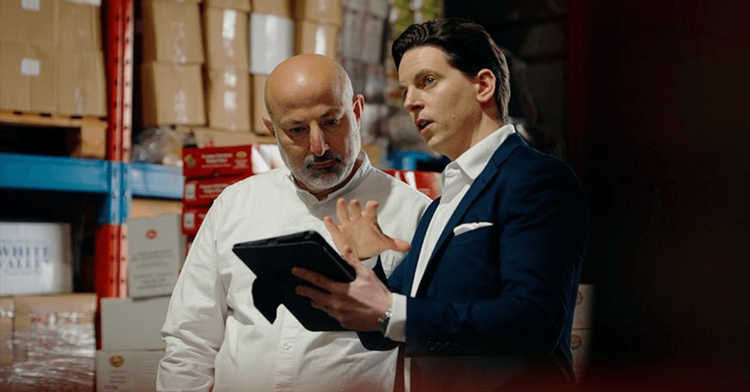
How BC is Becoming a National Foodtech Hub
Editor's Note: This article was o riginally published in the Vancouver Tech Journal on March 13, 2026 The province has a diverse food processing industry, world-class research facilities, and a deep bench of tech talent — everything a foodtech ecosystem needs to thrive. Foodtech builds the software, automation, and applied science for how food gets processed, manufactured, packaged, distributed, and sold. The industry behind it is enormous — food and beverage processing alone is Canada's largest manufacturing sub-sector , bigger than automotive, bigger than aerospace. It's a serious market, and in British Columbia, it's growing fast. But if you work in the province's broader tech ecosystem, you might not even know that. Foodtech hasn't traditionally drawn the same attention as sectors like cleantech or enterprise SaaS despite being a comparable market in scale and complexity — and one where demand for new technology is accelerating fast. What BC brings to the table BC's food processing sector is substantial — over 3,200 companies producing roughly $12.6 billion in value-added products annually. And it's being treated as a strategic priority. The province has funded a network of shared food processing hubs, UBC just opened a Food and Beverage Innovation Centre with pilot-scale production labs that processors and startups previously had to leave BC to access, and SFU's BC Centre for Agritech Innovation is partnering directly with SMEs on cost-shared R&D. At the same time, much of what the food industry needs is already being built in BC for other thriving tech sectors. Process automation, energy management, supply chain software, safety and traceability systems, data-driven quality control — these are cleantech and software problems applied to production floors and distribution networks. The talent, research base, and trade infrastructure to support a serious foodtech cluster are all here. A different kind of tech sector Foodtech doesn't work like enterprise SaaS or consumer tech. Processors and manufacturers adopt slowly and carefully, because failure is expensive in ways that go beyond lost revenue — a food safety issue, a botched line integration, a regulatory problem. Sales cycles run in quarters. The investor community that understands food is small and specialized. And the industry's own networks run through trade associations, existing supply relationships, and sector-specific events that sit well outside the broader tech community's orbit. None of this means foodtech is closed off. It means that if you want in — as a founder, investor, developer, or potential partner — you need a way to access the conversations, the deal flow, and the operating knowledge that don't surface through the usual channels. The Canadian Food Innovation Network The Canadian Food Innovation Network is a national not-for-profit, established in 2021 that functions as the operating infrastructure for Canada's foodtech sector. CFIN runs cost-shared funding programs that help companies de-risk R&D and move technology into commercial settings. Since launch , the organization has awarded over $22 million to 122 Canadian foodtech projects, matched by $25 million in industry co-investment. Those funded companies have generated $90 million in economic impact, created over 355 jobs and co-op placements, and attracted more than $82 million in follow-on investment. The network's 8,000-plus members include food processors, technology companies, ingredient suppliers, retailers, researchers, and investors — connected through YODL, CFIN's member platform, and supported by Regional Innovation Directors embedded across the country, who work directly with members to broker introductions, navigate funding, and connect emerging technology with the processors and buyers who need it. CFIN also produces the sector's most detailed intelligence . The Foodtech in Canada 2025 Ecosystem Report mapped investment flows, identified sector strengths, and gave both companies and investors a clearer picture of where the Canadian foodtech market stands. And then there's Foodtech Frontier , CFIN's annual program identifying the country's highest-potential foodtech companies. The inaugural cohort of 35 winners included eight BC companies. For investors, it works as curated, vetted deal flow in a sector where sourcing is otherwise hard. For the companies, it's structured national visibility. Plug into Canada’s foodtech ecosystem If you work in technology or investment and you've been curious about the food sector, then signing up for a free CFIN membership is the best place to start. Members get access to funding programs, sector intelligence, a national innovation community, and regional team members that know the BC landscape specifically.
Other Articles
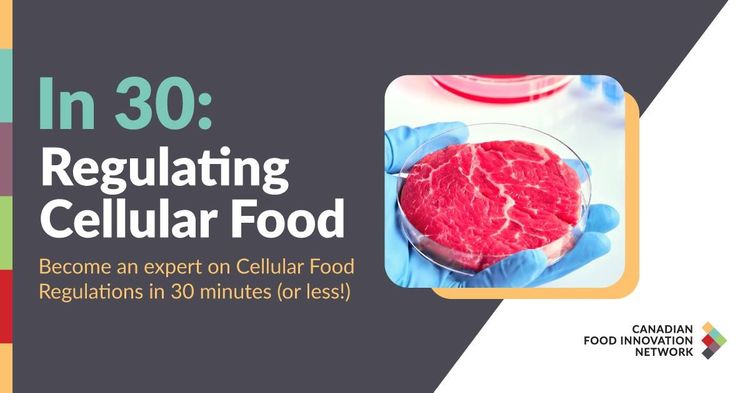
In 30: Regulating Cellular Food
Welcome to YODL! In addition to daily original content, YODL helps CFIN Members find new partners , resources , and funding opportunities to grow their food business. Learn more about this growing community and become a CFIN Member (for free!) today . Sometimes, all it takes is 30 minutes to learn the ins and outs of new food technologies and trends that are transforming the food and beverage industry. In this series, we’ll dig into a food innovation topic and link you to content and resources so you can become a master on the topic in 30 minutes (or less!). This week, we’re looking at how emerging cellular food technology is being regulated around the world, and some of the debate around how products will be regulated as they hit the market. The Overview Good Food Institute - Cultivated meat is gaining momentum—and pathways for regulatory approval The article gives a comprehensive overview of the nations working toward regulatory approval of cellular food. CNBC – Singapore issues first regulatory approval for lab-grown meat to Eat Just Singapore is the first country to approve the sale of cellular food, in this case lab-grown chicken. FAO UN – Food Safety Aspects of Cell-based Food The Food and Agriculture Organization of the United Nations in collaboration with the World Health Organization recently published a document to identify food safety considerations of cellular food, including a view of current regulatory frameworks for cell-based food. USDA – Human Food Made with Cultured Animal Cells The U.S. Department of Agriculture and the F ood and D rug A dministration have a formal agreement on regulating foods containing cultured animal cells in the U.S. The Canadian Connection YODL - Cellular Food Opportunities in Canada YODL - Regulations Governing Cellular Food in Canada with Glenford Jameson
Staff Picks – Hubba Khatoon
Welcome to YODL! In addition to daily original content, YODL helps CFIN Members find new partners , resources , and funding opportunities to grow their food business. Learn more about this growing community and become a CFIN Member (for free!) today . A lot of material comes across our desks at CFIN, and we love to share new information with YODLers ! This one in a series of articles highlighting what CFIN staff are reading, listening to, watching, and posting. Here ’ s CFIN ’ s Regional Innovation Director for the Prairies, Hubba Khatoon . What are you reading? Similar to Jamil, I also received a signed copy of Dinner on Mars by Lenore Newman and Evan Fraser…and I’m obsessed! The book offers a fascinating perspective on the potential of biomanufacturing and cellular agriculture to support human settlements on Mars and beyond. Highly recommend checking it out! What are you listening to? Currently, I’m really into Turkish instrumental music! I’ve been exploring some new artists and discovering some amazing music that I never knew existed before – it’s so soothing and works really well during focus time. Have you listened to any Turkish instrumental music before? Right now, my favourite is the O riental G uitar album on Spotify . Who are you following? I ’ m currently keeping tabs on all the winners of the CFIN funding programs. It ’ s so great to see all these innovators pushing the boundaries of food technology. I ’ ll definitely be following along closely to see them in action! Check them out here . What are you watching? Oh man, re-watching The Office . I can’t get enough of it! I’ve lost count of how many times I’ve watched it all the way through. And recently, I checked out season 4 of Y ou , but I’ve got to say, it just didn’t do it for me. I was really let down after how much I enjoyed the first three seasons. Also, I can’t wait to watch John Wick: Chapter 4 (this movie series has my heart forever and ever!) What are you posting about? Of course, I’m posting about the upcoming premiere of our next CFIN Live Experience: Cultivating Success: Canada ’ s Big Biomanufacturing Opportunity . I’m really pumped for this event and I think it’s going to be super exciting. You should definitely check it out! Anything else to add? It’s great to see the CFIN membership growing! I think there’s so much potential for us to work together to advance food innovation in Canada. I’m really looking forward to collaborating with everyone in the Prairies and doing some exciting things that push the boundaries of what’s possible. There’s no doubt in my mind that Canada has what it takes to be a major player in the global food industry.

Company Spotlight - CleanBands
Welcome to YODL! In addition to daily original content, YODL helps CFIN Members find new partners , resources , and funding opportunities to grow their food business. Learn more about this growing community and become a CFIN Member (for free!) today . This is one in a series of interviews with CFIN member companies that have successfully applied for and rec e i v ed funding . Charlottetown, PE-based CleanBands is building handwashing compliance systems that help workers ensure they are following handwashing policies. The company’s wearables visually indicate handwashing status, and allow for every single hand hygiene event to be tracked. By tracking the status of handwashing, we can create compliance ratings that can be used by operators and processors to ensure standards are met. CleanBands received $244,977 in funding to develop and commercialize an enterprise-ready hand hygiene solution. The company is piloting the project with various quick-service restaurants in PEI. We spoke with CEO Dave Iwankow to learn more about the company and its p lans. Q: What is your company’s mission? A: Our mission is to i mproving food safety, by building tools to help with handwashing controls. Q: W h y did you apply for this funding and how will you use it? A: We applied for the FoodTech Next funding program to help us bring our product to an early commercialization stage. Going through all the product development phases is expensive, and the funding will help us bridge the gaps . The funding will primarily be used to build out our development and engineering teams that are responsible for the software and physical components of our system. Q: What excites you most about working in this area of the food industry? A: We believe we can have a significant and lasting impact on food safety by being the first company to digiti ze handwashing in the food industry! Q: Why is collaboration so important for accelerating innovation in the food industry? Is it difficult to find good collaborating partners, and what would make the process easier? A: It’s all well and good to invent something that works in a lab, but in order to bring that invention into use, it needs collaboration partners to test, to evaluate, and to help refine. Tools such as YODL and industry networking events are very helpful in making the connections that lead to collaborations. In this spirit, I’d love to talk to anyone reading this about collaboration, so please reach out! Q: Please comment on the importance of public funding to help companies clear innovation hurdles and access leveraged funds. A: All innovation is very expensive . As a start up , m any times we end up in chicken - before - the - egg conversations with prospective investors , i.e. “ Can’t fund until you have customers .” B ut it’s difficult to get customers without having the product developed to a point that can be shown to prospective customers. I have heard this called the “ i nnovation g ap” and we have certainly experienced it. Public funding has and will continue to help us bridge this gap in commercializing our innovation. Q: Looking ahead, what’s on the horizon for your company? A: We are working hard to bring our systems into public use in 2023 . We’ve got a lot planned, and lots of ways and ideas that will be added to our system for the food and other industries! We are also excited to be bringing the system for more industry feedback to the Restaurant s Canada Show . Q: What are your passions or hobbies outside of work? A: Running, c amping, tr ave l ling, landscaping and tinkering with new technologies .
50 Canadian FoodTech Resources – EMILI
Welcome to YODL! In addition to daily original content, YODL helps CFIN Members find new partners , resources , and funding opportunities to grow their food business. Learn more about this growing community and become a CFIN Member (for free!) today . Canada has an extensive range of research centres, food incubators, accelerators and labs supporting food and beverage innovation through the research they do and/or the services they offer. Each week throughout 2023, we’ll be highlighting an organization that’s supporting food innovation in Canada. Name: EMILI (Enterprise Machine Intelligence and Learning Initiative) Location: Winnipeg, MB Mission: Advancing technology and developing skills to accelerate the growth of digital agriculture in the P rairies and across Canada. Focus: EMILI works with industry organizations and academic institutions from across the technology sector to increase integration of intelligent technologies, empower people with digital skills, support scale-ups to grow in the P rairies, and accelerate Canada ’ s growth as a leader in digital agriculture. Services: EMILI leads a variety of projects in partnership with industry and academics to provide the digital ag ecosystem with more skills, training and resources. Innovation Farms Powered by AgExpert provides innovators across industry and academia access to leading-edge equipment, technology, and production practices in order to develop viable solutions to the diverse agronomic and technological constraints and opportunities farmers face. EMILI does this by demonstrating the productivity and sustainability of commercialized technologies; testing and validating new technologies to bring them from pre-commercial to market; and sharing findings to increase understanding of and access to digital agriculture tools. The EMILI Data Initiative focuses on building capacity in Canada’s agrifood value chain through the use of intelligent technologies like AI and machine learning, providing an opportunity for optimization and greater productivity in industries across the ecosystem. Work is ongoing as far as meeting the growing need for enhanced technological skills in agriculture and recognizing that Canada must continue skill building from the ground up, and work to attract top talent globally. The Explore Project delivers programming to youth from Kindergarten through Grade 12, with a focus on STEM (Science, Technology, Engineering and Mathematics). Since the launch of the Explore Project, youth engagement has reached 58,000 students, including more than 11,000 Indigenous youth. EMILI established the Emergence Initiative in 2021 to help bridge the gap start - ups and emerging tech organizations experience when developing new digital agriculture technologies. This initiative provides vital support to increase the scale of ag-tech innovation in Manitoba and across the P rairies. Over the past two years, this initiative has funded more than $ 150 ,000 toward emerging technologies by Prairie innovators. What you need to know: EMILI’s next Agriculture Enlightened Conference will take place on October 26, 2023. This annual conference fosters connection between academia and industry to further advance the agri-food industry in the Canadian P rairie provinces. Subscribe to EMILI’s quarterly newsletter to learn about ongoing projects and partnership opportunities. Notable news: Digital agriculture is making strides, bringing innovative technology and data to farmers to make their operations run more efficiently. Hear what EMILI m anaging d irector Jacqueline Keena has to say about this and how Innovation Farms Powered by AgExpert is creating space for the integration and adoption of new technologies in Digital Farm i ng: The fu t ure is now . Get involved: Contact EMILI at info@emilicanada.com , or c ontact our Regional Innovation Director for the Prairies Hubba Khatoon .

One Year Check In: A Roundtable with CFIN and Ontario Genomic's AcCELLerate-ON Funding Recipients
Welcome to YODL! In addition to daily original content, YODL helps CFIN Members find new partners , resources , and funding opportunities to grow their food business. Learn more about this growing community and become a CFIN Member (for free!) today . In May 2022 the Canadian Food Innovation Network (CFIN) and Ontario Genomics announced the winners of AcCELLerate-ON , Canada’s first regional cellular agriculture competition. Together the four recipients received more than $900 ,000 in funding to support the research and development of novel, viable and sustainable food production methods. The AcCELLerate -ON funding recipients and their projects are: Ardra Inc.: The development of fermentation-based production of heme as a natural flavour ingredient. Cell Ag Tech: The manufacturing of fish muscle stem cells from a 2D to 3D culture system with proteomic assessments of the cells Evolved Meats (formerly Caro Meats ): Creating cultivated pork belly that is identical to conventional pork belly The University of Toronto ’s Dr. Michael Garton in collaboration with Myo Palate : Establishing the foundational tools for cultivated pork production. We checked in with the four companies to hear more about how their projects are progressing. Please give us an update on your project. How are things progressing? Ardra: The project is being carried out as per the plan and there has been significant improvement in terms of developing new strains for improvement of the heme titre. These new strains that are developed are being tested further in the fermentation trials to evaluate their performance in improving the final heme concentration. Along with the strain improvement, there is also development on the 30 L pilot scale fermentation trials. Several 30 L fermentation trails were carried out at the Lambton C ollege facility. The fermentation output was further concentrated and purified at Lambton C ollege and a novel precipitation method was developed to purify the heme and achieve the downstream processing. The heme that was produced at Lambton college was further tested analytically at Xerox Research Centre of Canada and University of Toronto, Biozone analytical testing facility. The analytical technique developed is used to identify heme and other heme - like compounds which are found in the final purified product. The next steps will be to continue testing the improved strains in the fermentation trails to evaluate the heme concentration and further testing these strains in the pilot scale, to confirm scale up and improved heme titre. Cell Ag Tech: We are pleased to report significant progress in our p roject to s cale- u p the m anufacturing of f ish m uscle s tem c ells from a 2D to 3D c ulture s ystem with p roteomic a ssessments of the c ells. The scale-up portion of the project has been successfully completed. In collaboration with the Centre for Commercialization of Regenerative Medicine (CCRM), we have managed to grow our fish muscle stem cells in small bioreactors with significant proliferation. We’re very happy with the outcome of this phase of the project and look forward to building upon this success. As we move forward, our focus will shift to completing the omics-related activities for this project. We anticipate that this phase will be finalized within the next few months. Evolve d Meats: Our project is progressing well. We were able to not only create the world’s first porcine tissue that was both scaffold- and biomaterial-free, but we were also able to prove that we could automate the process of muscle fib re creation for scale up. In addition to this, we are in the final stages of building out a proteomics database for pork. As promised, once the database is complete, we will share it with others s o that they can use the information to prove the similarity of their products against conventional pork products. Dr. Michael Garton: Our project is progressing well, approximately in line with what we anticipated . We have produced a synthetic pig gene that causes a fluorescent protein to be expressed in response to slight increase in temperature (37°C to 42°C). We inserted this gene into pig stem cells and showed that they fluoresce green in response to heat elevation. This technology is a proof of concept that we can control pig cell gene expression using temperature. Using temperature to control gene expression is of course vastly cheaper than using expensive biological reagents, and this is critical to the reduction of meat production costs. We have also designed and produced a version of the gene where fluorescence is replaced with a critical component driving muscle production from pig stem cells. Stay tuned! How has the funding impacted this project? Ardra: The funding has been crucial in helping us develop our process for heme production. We are now able to make samples of our product, and have started sending sample s for customer validation. Getting validation from customers is an important first step towards commercialization of the product, and is an important milestone before we start scaling-up the process further. Cell Ag Tech: The funding provided by CFIN has been instrumental in the success of our project. The financial support enabled us to move forward with a project that may have otherwise been untenable due to the high costs associated with cell-culture scale up. The funding also facilitated the establishment of a valuable relationship with a key partner, the Centre for Commercialization of Regenerative Medicine (CCRM) and allowed us to execute the project thoroughly. Evolve d Meat: The funding we received through this program allowed us to commit the necessary resources towards establishing a proteomics database for pork. Without the funding, we would not have been able to establish the underpinnings of that database. Garton: This project would certainly not have been possible without the funding provided by CFIN and Ontario genomics. It has enabled us to focus a highly experienced team including experts in gene cloning and stem cell differentiation and to deliver the key milestones on schedule. Our team is growing and we expect this to be the start of a very significant advancement in integrating synthetic biology and cell agriculture. What’s changed for the company in the past year? Ardra: Company has achieved several important milestones in the last year including successful fundraising from BioIndustrial Innovation Canada to support our technology pipeline, initiating scale-up studies (5,000 L fermentation) of our flavour ingredient leaf-aldehyde, and hiring a Business Development Lead, who brings in decades of experience in sales and marketing of food ingredients. Cell Ag Tech: The last year has been very exciting for C ell Ag Tech. In addition to developing a cooked white fish fillet prototype, we’ve made great technical progress with our immortalized cell lines, medium and cell manufacturing process. All these elements have come together to lay the foundation for commercial production. In addition, we’re proud to have been awarded non-dilutive funding from NRC-IRAP and have welcomed a few new members to our team. Evolve d Meats: A number of things have changed for the company over the last year. Namely : w e filed three new patents, one of which was granted ; w e ran proof of concepts with three leading, global cultivated meat companies , and we are signing a JDA with the first group now ; w e created multiple world’s firsts for scaffold- and biomaterial-free tissue, inclusive of samples using porcine, avian, ovine, and bovine cells ; w e created the world’s first automation testbed for turning cell sheets into muscle fib res; and w e spoke about alternative proteins at the 2022 APEC CEO Summit in Bangkok (we were on stage after U . S . vice president Kamala Harris; we presented alongside the CEO of CP Foods, a top five global food company, and the former CEO of Greenpeace) . Myo Palate: Myo Palate has been developing and expanding its embryonic cell lines for cultivated meat production. In the last year, we have created meatball prototypes using embryonic stem cells. Furthermore, our embryonic cell line and development method is patent pending. Myo Palate is also renovating a 16,000 - sq .- ft . facility in downtown Toronto to expand research capabilities and further foster academic collaborations. The new facility will include cleanrooms, dedicated bioreactor space, and a microbiology suite. What are your thoughts on the current state of the cellular food industry? Ardra: The cellular food industry allows for 1) sustainable production of food, 2) strengthens local supply-chains, and 3) offers ways to make novel food products and ingredients. Given these advantages it will inevitably be a part of our future food value-chain. Cell Ag Tech: The cellular agriculture industry is currently at a pivotal moment. With the concept of producing cell cultured meat and seafood now proven, the focus has shifted to optimization, manufacturing scale up, and reducing the cost of goods sold (COGS) to achieve commercial viability. In the interim, it’s imperative that companies concentrate on these aspects, as they will play a vital role in making cell cultured meat and seafood products competitive with traditional animal-derived products currently on the market. Additionally, we’re seeing rapid growth in the ecosystem of supportive technologies and vendors ( for example, growth factors, contract manufacturing facilities, commercialization partners, etc.). These developments are crucial for the industry ’ s advancement, as it enables companies to access the tools, resources, and expertise necessary to overcome the major challenges facing the industry. Unfortunately, at the same time it’s become more difficult to access capital due to the current macroeconomic environment. For the industry to move forward, it’s essential to ensure that adequate capital is available to fuel this phase of the industry ’ s development and growth. Capital from investors and non-dilutive sources is vital for the industry to fulfill its full potential. Evolve d Meats: The cellular food industry is in its very early days. A lot of progress is being made on proliferating cells using serum-free media, but the bioprocess itself has barely been innovated on. Significant advances will need to be made on that front in order for cell ag riculture to actually penetrate the broader consumer market. In addition to that, we think that grouping all cell ag products in the same bucket is going to be harmful over time. Most current products are not structurally or biochemically identical to conventional meat. Instead, they use a high proportion of plant proteins and other biomaterials within their end products. Based on proxies, consumers are not interested in hybrids. We think that the only way cultivated meat will succeed is to create products that are 100% cell-based . Garton: Cellular food answers an incredibly important environmental question and is rightly garnering huge interest from government and the general public . By far the biggest challenge is reducing cost to compete with conventional meat products , and the advances we are making in synthetic biology are poised to facilitate that very significantly. Are you looking for new partners or collaborators? If so, who would be the perfect partner? Ardra: We are looking for new partners and collaborators. Our ideal partners would be food processing companies that are seeking novel food ingredients (flavours, colours and nutritional ingredients), and natural ingredients for their formulations. The company is also seeking partners that have large scale flavour production equipment in Canada for contract manufacturing. Cell Ag Tech: We are always open to forming new partnerships and collaborations with like-minded organizations that share our goal of supplying the world with sustainable and delicious cell-cultured seafood. Ideal partners would include investors who are willing to provide financial support to help us complete development and finalize preparations for commercialization. Of course, we also welcome non-dilutive funding sources and would appreciate the opportunity to connect with government and other organizations supporting the industry. We’re also open to collaborating with strategic partners that align with our mission and can contribute valuable resources and expertise . Lastly, we are interested in collaborating with commercialization partners who can help us navigate the path to market, providing support in areas such as marketing, sales, and distribution in different markets around the world. Evolve d Meats: Our ideal partner profile is as follows: a c ultivated meat company that has an established, well characterized cell line (cells can be anything from pluripotent to unipotent) ; that has a consistent bioprocess to proliferate those cells ; that understand s how to differentiate those cells ; and that, t ypically, the company has raised >$50-100M and they are starting to consider tissue engineering . Myo Palate: Myo Palate is actively engaged in multiple academic and industrial partnerships and have found these collaborations to be extremely fruitful. At Myo Palate’s next stage, we hope to collaborate with downstream meat processors to start tailoring meat output for processing requirements. What’s next for the company? Ardra: The company’s current focus is on bringing its most developed products to market to reach revenues, along with pushing the development of novel ingredients such as heme further. Cell Ag Tech : We’re currently raising a round of financing to complete development and finalize preparations for regulatory approval, commercial production, and sales. Evolve d Meats: In terms of next steps, we plan to c reate a proprietary, small - size bioreactor to produce multiple cell sheets at the same time (proof of concept is complete , and the provisional patent will be filed in 2023 Q2) . We will also b egin work with our JDA partner on a world’s first sample , and c ontinue developing our IP moat around the use of cell sheets . Myo Palate: Myo Palate is getting ready to move to its new space and ramp up production at a laboratory scale. CFIN Members get exclusive access to funding opportunities , five Regional Innovation Directors , and YODL . Learn more about what it’s like to be a CFIN Member and how you can join our growing community of food professionals. #Funding #foodinnovationchallenge #financing #cellularfood #cellularagriculture #researchanddevelopment #R&D
In 30: Precision Fermentation
Welcome to YODL! In addition to daily original content, YODL helps CFIN Members find new partners , resources , and funding opportunities to grow their food business. Learn more about this growing community and become a CFIN Member (for free!) today . Sometimes, all it takes is 30 minutes to learn the ins and outs of new food technologies and trends that are transforming the food and beverage industry. In this series, we’ll dig into a food innovation topic and link you to content and resources so you can become a master on the topic in 30 minutes (or less!). This week, we’re looking at one of the key techniques being used to produce cellular food, precision fermentation. The Overview YODL – Explained: Precision Fermentation Precision fermentation, or acellular cultivation, has emerged as a specific kind of fermentation process to create lab-grown ingredients for use in a wide variety of products, including food. YODL – The Language of….Cellular Food This article includes a rundown of terms you may hear used when describing precision fermentation, including bioreactor and scaffolding. Hartman Group - Fermenting the Future: The Growing Opportunity for Products Made with Precision Fermentation This white paper, based on research conducted by The Hartman Group and sponsored by Perfect Day and Cargill, examines consumer perceptions , attitudes, and purchase drivers related to precision fermentation. The Canadian Connection Arrell Food Institute at the Uni versity of Guelph offers an overview of sustainable food production via technology such as cellular agriculture and precision fermentation. Biofect Innovation is a Toronto, ON-based biotech company using microbial fermentation to develop novel plant-based ingredients. Social Media @PFAlliance_Org on Twitte r. The new PFAlliance champions precision fermentation as a solution for a more resilient and sustainable food system. Perfect Day on LinkedIn . P roduces whey protein through precision fermentation. The Every Company on Facebook. The company uses precision fermentation to create protein. Overtime If you ’ve got more than 30 minutes, these are for you: YODL – Visualizing Cellular Food: A Conversation with Yadira Tejeda Saldana of New Harvest
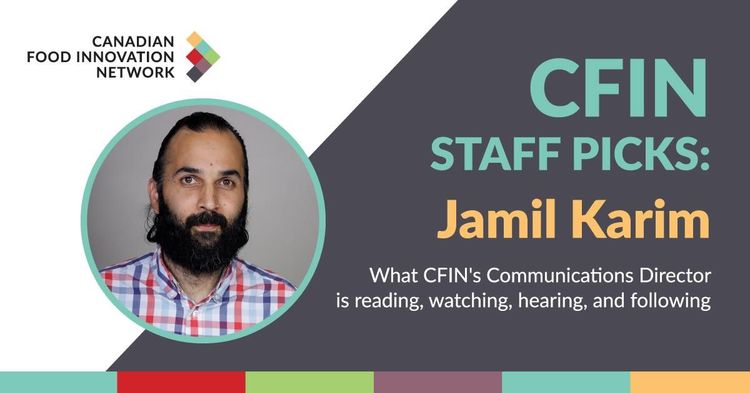
CFIN Staff Picks - Jamil Karim
Welcome to YODL! In addition to daily original content, YODL helps CFIN Members find new partners , resources , and funding opportunities to grow their food business. Learn more about this growing community and become a CFIN Member (for free!) today . A lot of material comes across our desks at CFIN, and we love to share new information with YODLers ! This is the first in a series of articles highlighting what CFIN staff are reading, listening to, watching , and posting . First up is CFIN’s Director of Communications , Jamil Karim . What are you reading ? I have my (signed!) copy of Dinner on Mars so I’m hoping to dig into that before our Experience on May 16 th . I’m also re-reading this great article from 2021 by the SPD Group about potential use cases for machine learning and AI in the food sector. The year is less tha n three months old, but it already feels like 2023 is the year AI pushes industries forward by leaps and bounds. Lastly, I’m a huge fan of newsletters and love reading DigitalFoodLab every time it hits my inbox. What are you listening to ? I don’t listen to a lot of podcasts (I’ m more of a reader), but I am enjoying listening to the commentary around SVB’s collapse and what that means for us here in Canada. On YODL, we have a ton of great video interview s with subject matter experts on plastics , cell food , robotics , etc. – so usually when I’m working, I’ll have one of these interviews on in the background . Who are you following ? I’m following anyone (or anything?) that shows off all the cool features of Chat-GP T . I’m also a sucker for tech news, so I'm constantly getting alerts from publications like Vancouver Tech Journal , The Logic , and BetaKit . Unrelated to foodtech , I also follow this twitter account that lets me know whether or not it is Ted Danson’s birthday. Spoiler alert – it's not today. What are you watching ? This Ted Talk from 2021 featuring New Harvest ’s Isha Dotar has been making the rounds on our CFIN Teams channel. It’s 12 minutes and you’ll leave with an above average understanding of what cellular agriculture is and why it’s got the potential to be a vital piece to solving food security. I’ll also use this opportunity to point out that the new season of Succession started recently and I simultaneously love and hate every character on that show. What are you posting about ? On YODL, I like to share posts about food news, events, and the great work our CFIN team is doing. On WhatsApp , my friends get posts about fantasy football and 00s R&B. On LinkedIn , I’m more of a private messenger but I use it to connect with old friends from the tech sector and check in (creep?) on former coworkers. So, depending on where you find me, you’re getting something completely different. Anything else to add? I’m excited to see what my fellow co-workers share in this series! Hopefully I can pick up a few new podcasts and newsletters to consume before bed.
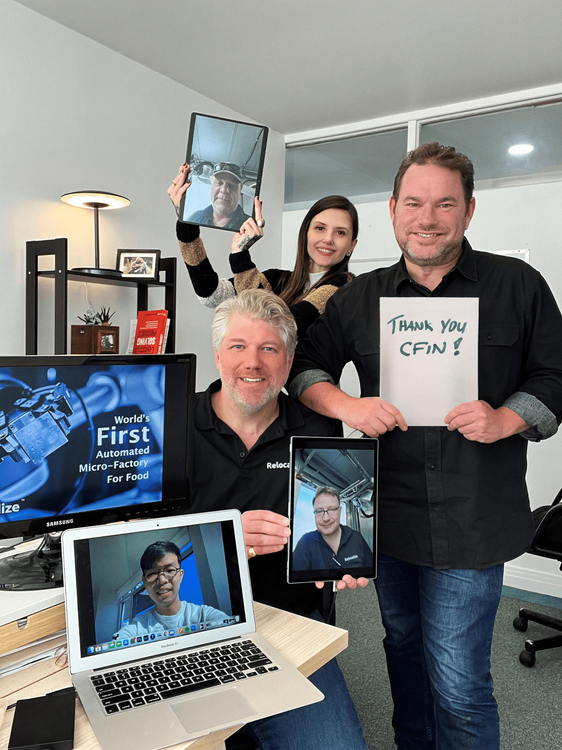
Company Spotlight – Relocalize Inc.
Welcome to YODL! In addition to daily original content, YODL helps CFIN Members find new partners , resources , and funding opportunities to grow their food business. Learn more about this growing community and become a CFIN Member (for free!) today . This is one in a series of interviews with CFIN member companies that have successfully applied for and received funding . Relocalize Inc. is a Montreal, QC- based company that hyper-localize s packaged food manufacturing with autonomous factories that eliminate middle mile logistics (and CO 2 emissions), reduce product costs and cut waste. The company received $246,618 in funding to demonstrate the world’s first autonomous micro-factory for food and beverage, in a pilot partnership with an unnamed U.S. retailer/distributor. We spoke to Wayne McIntyre, CEO and co-founder of Relocalize , to hear more about the company and its plans. Q: What is your company’s mission? A: Our mission is to make packaged food and beverage products better, greener and more affordable. Q: W h y did you apply for this funding and how will you use it? A: This funding ma d e it possible to deploy the world’s first autonomous micro-factory for food. With CFIN’s help, we are conducting a proof of concept in partnership with a major regional retailer to demonstrate the decarbonization, cost reduction and product improvement benefits of hyper-local food. Q: What excites you most about working in this area of the food industry? A: Nothing is more important to people that the nourishment and pleasure of food. At the same time, the food industry is a root cause of some of our biggest problems, including plastic pollution and greenhouse gas emissions. For a company looking to do right by people and the planet, the food industry could not be a more ideal sector to work in. Q: Why is collaboration so important for accelerating innovation in the food industry? Is it difficult to find good collaborating partners, and what would make the process easier? A: Our food system is extremely complex. Scaling innovation and solving big problems cannot be done alone. Fortunately, we have found amazing partners who are supporting us on our transformation journey. Creating platforms for exchanging ideas, building relationships , and collaborating with partners is critical to mak ing the process easier. CFIN is a great example of how to build such a platform. Continued funding and scaling of CFIN would be helpful to make the process easier for more companies. Q: Please comment on the importance of public funding to help companies clear innovation hurdles and access leveraged funds. A: Canada is home to some of the world’s best innovators and entrepreneurs. But they simply don’t have the same kind of access to capital as U . S . -based startups . Public funding helps close that gap and give companies like Relocalize the opportunity to become leaders in Canada and beyond. Q: Looking ahead, what’s on the horizon for your company? A: We are excited to be deploying the world’s first fully autonomous food factory in partnership with CFIN. The next step is to transform our food category – packaged ice – and disrupt the North American market with better, greener , and cheaper packaged ice. Q: What are your passions or hobbies outside of work? A: Long distance canoe tripping and trekking trips , and sailing (my newest hobby) . Q: If you had to pick one person to make you a meal, who would you choose? A: As a proud member of the Canadian food community, my pick needs to be a Canuck , so Michael Smith.

Meet a Member – Richard Baker
Welcome to YODL! In addition to daily original content, YODL helps CFIN Members find new partners , resources , and funding opportunities to grow their food business. Learn more about this growing community and become a CFIN Member (for free!) today . Since launching in 2022, CFIN has grown to more than 2, 8 00 members, which includes professionals from every sector of the food industry. This series highlights the many different CFIN members across Canada who visit YODL to learn, make connections, find funding, and discover new ways to grow their businesses. Richard Baker Founder and p resident of the Food Distribution Guy Greater Toronto Area, ON Tell us a bout your j ob I am a consultant in the food and beverage sector. Providing our clients with market insights and industry expertise , we champion the sales procurement process in which our principles break through the competitive landscape to “Getting and Staying” listed in Canada’s grocery sector. Our principles are of a global nature. We assist Canadian, U . S . , and International food manufacturers. How is YODL helping you do your job ? I use YODL to post my monthly blog and special reports ; to understand growing segments in the Canadian grocery sector, such as seaweed . I’ve also used YODL to get an article published , and to introduce a member to old principle that is B Corp certified. How often do I visit YODL ? Every time I receive an update I always open it t o understand what has been posted, and how can I learn from it. I also visit YODL for my blogs and special reports two to three times per month. What’s your f avourite a spect of YODL ? The ability to post my blogs and articles in order to bring increased exposure to my business ; to learn from others who have different roles in the food sector ; and to l earn about new trends in the food sector. Can y ou t ell u s s omething y ou l earned o n YODL? I learned of Canada’s Seaweed Association. A couple of years ago it was on trend, yet I have heard very little of it or seen this type of product at retail since. I remember Loblaws under their PC brand launched such a product. What t ype of c onnection p artners are you l ooking f or ? I am always open to talking to new Canadian - owned brands seeking to take the next step in the grocery ladder with a unique product that adds value to their respective category . In addition, we are open to talking with U . S . or global brands hoping to enter the Canadian market , as well as brokers and distributors working in the C-store and home improvement sector s . What a rea s of f ood in novation i nterests y ou the m ost ? 1. Plant-based. The areas of opportunity are endless. I just learned grass may become a plant-based ingredient. There is also a Swedish firm that manufactures a plant-based dairy alternative utilizing potatoes. 2. U p- c ycled f ood. This is a growing category in which firms up-cycle ingredients that would have gone to land-fill . It’s a n innovative approach to reducing food waste. 3. Sustainable p roducts or packaging that h ave a positive impact on the environment. A w omen-based Calgary brand I am working with is looking to introduce the first compostable, freezer compliant zip-loc bags, and compostable wrap. What has b een y our f avourite d iscussion p ost ? sus As a consultant who provides market insights to their clients, I am always looking to learn more about the food and beverage sector – Canadian, US, or Global. Due to YODL, I had an article published for the first time. Due to the pandemic, I am a strong supporter of mental health , which I feel we as a country do not give as much attention to as we should. I know there is a way food and beverage can play a part in consumers ’ emotional states. I want to write a blog on this subject matter. What’s your f avourite f ood ? BBQ Lamb Chops
50 Canadian FoodTech Resources – Caddle
Welcome to YODL! In addition to daily original content, YODL helps CFIN Members find new partners , resources , and funding opportunities to grow their food business. Learn more about this growing community and become a CFIN Member (for free!) today . Canada has an extensive range of research centres, food incubators, accelerators and labs supporting food and beverage innovation through the research they do and/or the services they offer. Each week throughout 2023, we’ll be highlighting an organization that’s supporting food innovation in Canada. Name: Caddle Location: St. Catharines, ON Mission: To create a transparent, friction-free marketplace for consumers and brands to exchange data for value. Focus: Through its app, Caddle garners consumer data and insights for consumer packaged goods companies to use during decision making. Services: Caddle offers companies full-service, end-to-end custom research based on a wide range of consumers across Canada. That includes research on trade marketing, consumer insights, brand marketing, category development, and eCommerce and digital growth. Caddle also gives companies access to webinars and articles on consumer trends, marketing, innovation and more. What you need to know: Consumers use the Caddle app to earn rewards, rebates and cash back by answering surveys, watching ads, writing reviews and engaging with brands during specific timeframes . Notable New s: Caddle says it has the largest daily and monthly active panel in Canada, with diversity validated through third-party providers. The company also offers panels of micro-niche audiences. Caddle works with CPG companies of all sizes, such as Nestlé and Conagra , grocery chains including Loblaws and Sobeys , and foodservice chains like Domino’s. Get Involved : Contact Caddle at (905) 321-5255 , or reach out to our Regional Innovation Directo r Linda Fox .

What’s for Dinner on Mars?
Welcome to YODL! In addition to daily original content, YODL helps CFIN Members find new partners , resources , and funding opportunities to grow their food business. Learn more about this growing community and become a CFIN Member (for free!) today . Dinner on Mars: The Technologies that Will Feed the Red Planet and Transform Agriculture on Earth by Lenore Newman and Evan Fraser explores the food science, technology, and production methods it will take to feed a settlement on Mars, while meeting the needs of the estimated 9 .8 billion people on Earth by 2050. Here’s an excerpt from the book (chapter six, pages 118 to 121) on the potential of cellular food. One Order of Milk, Hold the Cow! The question of producing decent cheese on Mars can be made simple: Can we take our cumulative understanding of cheese science, umami, and terroir and combine them together to produce good cheese there? After all, despite their tasty versatility, sometimes oats aren’t enough. We want mozzarella that melts and stretches. We want brie with bite. And when we reach for our Stilton, we want it blue. But without cows or millennia-old microbiomes, is that possible? Answering this means we need to dig into the space-age stuff, and this requires us to shift focus and meet the newest kid on the food block: cellular agriculture (cell-ag). This emerging technology proposes to produce meat and milk but without any animals . Cell-ag refers to a set of technologies that fall into two rough categories. The first is tissue farming, in which meat and other products are grown in an oversized petri dish called a bioreactor. 1 The second approach is more like brewing and involves using yeast (or fungus or bacteria) that is modified to convert sugars into animal protein (instead of alcohol or other more common products of fermentation). As we are writing, cell agriculture has exploded into the mainstream and every other day seems to bring new headlines that “yet another cell-ag start-up” had struck venture capital gold, raising hundreds of millions of dollars to bring chickenless chicken burgers, finless fish sticks, and cow-free milkshakes to the market. 2 With all this hype, one might assume that cellular agriculture has burst from nowhere, but the idea has been slowly brewing in bioreactors for some time. New Harvest, an NGO dedicated to the development of cellular agriculture, was founded in 2004. In 2013, p rofessor Mark Post of Maastricht University in the Netherlands trialed the world’s first cultured meat burger, and by 2014 the synthetic biology accelerator IndieBio had managed to launch several cellular agriculture start-ups. The first academic conference for cellular agriculture was hosted in July of 2016 at the Presidio in San Francisco. 3 And the company Perfect Day began selling cell-ag ice cream in the U.S. during the summer of 2020, followed by cream cheese in 2021. But the story of cell- ag reaches further back even than this. Fermentation using genetically enhanced yeasts and bacteria owes its origins to the gene-splicing techniques of Stanley Cohen and Herbert Boyer back in 1973. Cohen and Boyer’s work was initially ground-breaking for medicine, as it led directly to our ability to synthesize insulin using genetically altered bacteria. Synthetic insulin became commercially available in 1982 and causes fewer allergies, has a more consistent quality, and provides a more dependable supply for diabetics, thus saving millions of lives in the past few decades alone. Synthetic insulin was so successful that it launched the entire field of biopharmaceuticals. But let’s get back to Martian dairy. It seems almost certain that the future Martian milkshake won’t rely on cows, or even oats, but rather on yeast and bacteria to synthesize the kinds of proteins we normally find in milk. These proteins will then be added to plant fats, water, and trace elements to create the look and mouthfeel of animal-derived dairy. And this technology is already being used in North America today. For instance, when Perfect Day began selling cell-ag ice cream in 2020, they used a strain of yeast that digests particular sugars and produces milk proteins. In this way, Perfect Day uses a process more like brewing beer than milking bovines. This yeast-derived whey protein is then used as an ingredient in ice cream. Simply mix with water, fats, sweetener, and flavo u r and, voila: the perfect ingredients for the would-be Martian ice cream parlo u r where the nearest cow is 114 million kilometers away. Other companies are working on casein protein synthesis and the creation of animal fat through advanced fermentation. Our Martians might have to assemble their cheese like a jigsaw puzzle, but it is likely they will have all the needed pieces. These technologies will be useful on both Mars and Earth where they are already solving a very cheesy problem. For the past three decades, cheesemakers everywhere have faced a critical short age of the enzymes found in rennet, which come from the stomach lining of ruminant mammals. This is what makes milk separate into curds and whey, thus helping dairy on its journey from udder to cheeseboard. As the global demand for cheese has grown, the supply of stomach lining couldn’t keep up, so, years ago, some smart food scientists asked: could a supply of rennet be engineered? Thankfully the answer is yes. Rennet can be produced through a fermentation process very similar to the one Perfect Day uses to make their dairy proteins by employing bacteria, fungi, or yeast to convert sugars into rennet. Synthesized rennet has meant that the cheesemaking industry has been able to match demand. When fermentation-derived rennet was approved by the FDA on March 24, 1990, it was the first genetically engineered product approved for food production. And the economics work out too: synthetic rennet has become much cheaper than the animal-derived product, and the cheese it creates has been consumed by an entire generation of happy human cheese lovers without any health or environmental problems. This successful track record of using biotechnology to convince yeast to do the work of animals set the scene for numerous other such products including Perfect Day’s products that received approval from the FDA on April 15, 2020. Their ice cream started to be sold across America as a demonstration of the technology that summer. Footnotes 1. We will return to these technologies in the next chapter. 2. Even petfood is getting a rethink. Toronto-based Because Animals is busy culturing mouse meat for cats and rabbit meat for dogs. This is significant as pets in America consume up to 25 % of the country’s total calories from meat. 3. Lenore sat in the back whispering “wow” and slamming back complimentary Soylent . Excerpted in part from Dinner on Mars : The Technologies That Will Feed the Red Planet and Transform Agriculture on Earth by Lenore Newman and Evan D.G. Fraser . Copyright © by Lenore Newman and Evan D.G. Fraser , 2022 . Published by ECW Press Ltd. www.ecwpress.com Click here to purchase Dinner on Mars.
In 30: Cellular Food
Welcome to YODL! In addition to daily original content, YODL helps CFIN Members find new partners , resources , and funding opportunities to grow their food business. Learn more about this growing community and become a CFIN Member (for free!) today . Sometimes, all it takes is 30 minutes to learn the ins and outs of new food technologies and trends that are transforming the food and beverage industry. In this series, we’ll dig into a food innovation topic and link you to content and resources so you can become a master on the topic in 30 minutes (or less!). This week, we’re diving into cellular food and how it’s changing the way we produce, transport, and consume food . The Overview YODL - Introduction to Cellular Food YODL - A Timeline of Cellular Food Innovation Forbes - Understanding the Cellular Agriculture Industry’s Impact and Growth Dr. Hamid Noori of Cultivated B describes the basics of cellular agriculture and its transformative potential. The Canadian Connection YODL - Explained: Cellular Food in Canada C ellular agriculture has the potential to alleviate ch allenges facing the Canadian food and bev erage industry , while creating commercial opportunities and building a more sustainable, resilient food system. Ontario Genomics - Cellular Agriculture: Canada’s $12.5 Billion Opportunity in Food Innovation Cellular agriculture presents a significant opportunity to diversify food production in Canada, while complementing existing traditional production approaches. University of the Fraser Valley, Food and Agriculture Institute - Cellular Agriculture: What role will cellular agriculture play in the future of food for Canada? New technologies and techniques in cellular food mean these products will enter Canadian food markets and increase in prevalence over the next few years. Researchers New Harv e st is a global non-profit research institute advancing the science of cellular agriculture. Genome Canada is an independent, federally funded not-for-profit organization that invests in and coordinates genomics research, innovation, data and talent. Startups Liven Proteins makes animal-free, functional and sustainable protein ingredients. Myopalate ’s mission is to produce real meat without raising whole animals and facilitate a new era of protein consumption. Evolved Meats grows meat directly from animal cells. Funders Cult Foodscience invests in and commercializes cellular agriculture products. NSERC offers funding to entrepreneurs and innovators researching and developing scientific and technical breakthroughs that will b enefit Canada. NRC IRAP offers small- and medium-sized Canadian businesses advice, access to connections, and funding to help them innovate and bring products to market. Social Media @CellBasedNews on Twitter showcases scientific breakthroughs in cellular food. Cellagcanada on Instagram supports cellular agriculture developments in Canada. Perfect Day Foo ds on Facebook is one of the first U . S . companies approved to produce animal-free dairy. Overtime If you got more than 30 minutes, these are for you: YODL – Visualizing Cellular Food: A Conversation with Yadira Tejeda Saldana of New Harvest