Inside SIAL Canada 2026: Driving Food Innovation Through Connection and Collaboration
CFIN had the honour of taking a bite out of SIAL Canada 2026 in Montréal 🍎—connecting with partners, members, and industry leaders shaping the future of food innovation across Canada and beyond. Representing CFIN on site were CEO @Dana McCauley and @Julie Daigle , Regional Innovation Director (Quebec), who engaged with the ecosystem throughout the event. Their presence reflected CFIN’s ongoing commitment to strengthening Canada’s food innovation ecosystem and supporting high-potential foodtech ventures. Attendees could also catch Julie as a Foodtech Focus expert at the SIAL Canada Expert Hub, where she connected directly with innovators and shared insights with the community. Dana also took the stage as part of the Dairy Talks program, contributing to a forward-looking discussion on innovation as a driver of market leadership in the Canadian dairy sector. Her session explored the shift from incremental product development toward a broader innovation mindset—highlighting next-generation ingredients, value-added dairy formats, new go-to-market strategies, and the role of Industry 4.0 technologies like AI, robotics, automation, and digital supply chains in strengthening productivity and global competitiveness. A key highlight of the week was CFIN’s involvement in the 7th edition of the Startup Pitch Competition, held on April 30 on the Food & Bev Connect stage. Julie Daigle participated as the President of the Foodtech jury, joining a panel of industry experts evaluating promising entrepreneurs from the Startup Village. Beyond the competition, the Startup Pitch stage served as a strategic platform connecting entrepreneurs with buyers, investors, and key decision-makers across the agri-food ecosystem. A standout moment for the CFIN community was the recognition of Maia Farms, a CFIN member and funding recipient, which earned the Gold Prize in the foodtec h competition 🍄🏆 CFIN’s presence at SIAL Canada underscored the momentum of Canada’s food innovation sector and the value of convening the ecosystem to accelerate ideas from concept to commercialization. 📖 Explore more from SIAL Canada 2026 R elive the stories, innovations, and key moments captured throughout the show in the official SIAL Canada Daily: SIAL Canada Daily – 2026 Edition (Photos Courtesy of SIAL)
Community Manager-
Five Years of CFIN: A Letter to the Network
Thirty years ago, I worked as a chef in the kitchen of one of Canada’s top restaurants standing should er to shoulder with people who ca red about the sensory experience of food above all else . Our tech stack was al most all analog and , to be honest, we didn’t give our ordering system or the way we did inventory a lot of thought. My career broadened over time , and I ’ ve also held roles where I developed recipes at Canadian Living and wrote about food trends; built innovation strategies and products for national brands, founded a business incubator, and ran a venture creation office at a prestigious Canadian u niversity . Food was always the thread , and technology was always present but in most of the food focused businesses I’ve worked for, it was taken for granted, and creativity and hard work were what drove the businesses forward. While smart people with great ideas are essential to food business success, it’s not enough to be competitive in today’s world. Old ways of running restaurants, innovation labs and food and beverage processi ng businesses can’t compete internationally or absorb the trade shocks that have become commonpla ce in recent history. That’s why I feel l ik e CFIN is the perfect place for me to be today and why we’re adding dozens of new members per week. When CFIN was created in 2021, the mandate was intentionally broad : cata lyze Canadian food innovation with funding , build community, connect an ecosystem that had been operating in silos for decades. The funding programs took shape quickly. Since 2022, we’ve awar ded $23.3 million to 133 projects across six program s. For every $1 CFIN invested, our members committed $7.65 of their own capital toward innovation. This leverage ratio of nearly 8-to-1 has unlocked over $140 m illion in private sector spending on R&D and capital infrastructure. The other work was harder to define . What do "build community" and "connect an ecosystem" mean in practice for a sector span ning startups, processors, researchers, investors, policymakers, and operators spread across this vast country ? Th at question didn't have a tidy answer. As a result , fostering and serving this network was (and remains ) an exercise in innovation itself : something new to be built , and then tested, adjusted, and iterated upon , ad infinitum . I’m immensely proud of what we’ve built so far . A team of Regional Innovation Directors who've supported more than 2,200 organizations, brokering the introductions that became commercial partnerships, strategic investments, leadership hires, and research collaborations. A digital platform , YODL, connecting Canada's food sector across industry silos and bridging interprovincial barriers . The first comprehensive analysis of Canadian foodtech . A network of 8,500 members from every province, every part of the food value chain, every stage of business . On any given week, our community is discussing topics ranging from precision fermentation bioreactor designs and funding stacks to food packaging labeling regulations and export strategies, all in the same space. Members benefit from purpose-built tools and resources — like our Funding Finder that aggregates food and beverage funding opportunities across the country and a growing library of original sector research and analysis — alongside direct access to our Regional Innovation Directors. Canada has strong regional funders, accelerators, trade associations, and tech transfer offices, each doing necessary work in a defined lane. What this sector didn't have was a place where the conversation s , the tools, and the connections all showed up at once — where the range of problems and the range of capabilities were dense enough that the right solutions could emerge . That's what CFIN has built. That foundation is important because the next five years will be even more dynamic, and often more challenging, than the last five . To keep pace and flourish in an increasingly volatile world, Canada's food sector needs to modernize faster and more strategic ally than ever before . Trade disruption is dramaticall y reshaping supply chains . L abour constraints are compounding a productivity gap that was widening long before tariffs became front-page news. Climate pressures are intensifying. Food 4.0 — a tech-enabled food s ector that's more collaborative, productive, resilient, and competitive — is the framework CFIN is building toward, and the case for it gets more urgent by the quarter. I ’m confident that we’re up to the task . Five years ago, Canada's food innovation ecosystem was fragmented, underleveraged, and often invisible to the investors, operators, policymakers, and media who needed to see it. That's no longer true. The capacity to respond to the challenges ahead is here. Not in any single program or policy, but in the breadth of this network — the founders , processors , researchers , and investo rs who are hungry to innovate and build a better Canadian food sector . My own wide-ranging path through the food sector taught me that no single role ever showed me the full picture. It took working across kitchens, labs, newsrooms, boardrooms, and startups to understand how innovation really moves through this industry — and where it get s stuck. CFIN was built on the same insight. A sector this complex, facing challenges this urgent, needs more than funding or advice or connections in isolation. It needs all of them in the same room. That's what we've spent five years building, and I'm betting the next five will prove its value at a scale none of us can yet imagine. Thank you for being part of it. Dana McCauley, CEO, Canadian Food Innovation Network
Community Manager-
How BC is Becoming a National Foodtech Hub
Editor's Note: This article was o riginally published in the Vancouver Tech Journal on March 13, 2026 The province has a diverse food processing industry, world-class research facilities, and a deep bench of tech talent — everything a foodtech ecosystem needs to thrive. Foodtech builds the software, automation, and applied science for how food gets processed, manufactured, packaged, distributed, and sold. The industry behind it is enormous — food and beverage processing alone is Canada's largest manufacturing sub-sector , bigger than automotive, bigger than aerospace. It's a serious market, and in British Columbia, it's growing fast. But if you work in the province's broader tech ecosystem, you might not even know that. Foodtech hasn't traditionally drawn the same attention as sectors like cleantech or enterprise SaaS despite being a comparable market in scale and complexity — and one where demand for new technology is accelerating fast. What BC brings to the table BC's food processing sector is substantial — over 3,200 companies producing roughly $12.6 billion in value-added products annually. And it's being treated as a strategic priority. The province has funded a network of shared food processing hubs, UBC just opened a Food and Beverage Innovation Centre with pilot-scale production labs that processors and startups previously had to leave BC to access, and SFU's BC Centre for Agritech Innovation is partnering directly with SMEs on cost-shared R&D. At the same time, much of what the food industry needs is already being built in BC for other thriving tech sectors. Process automation, energy management, supply chain software, safety and traceability systems, data-driven quality control — these are cleantech and software problems applied to production floors and distribution networks. The talent, research base, and trade infrastructure to support a serious foodtech cluster are all here. A different kind of tech sector Foodtech doesn't work like enterprise SaaS or consumer tech. Processors and manufacturers adopt slowly and carefully, because failure is expensive in ways that go beyond lost revenue — a food safety issue, a botched line integration, a regulatory problem. Sales cycles run in quarters. The investor community that understands food is small and specialized. And the industry's own networks run through trade associations, existing supply relationships, and sector-specific events that sit well outside the broader tech community's orbit. None of this means foodtech is closed off. It means that if you want in — as a founder, investor, developer, or potential partner — you need a way to access the conversations, the deal flow, and the operating knowledge that don't surface through the usual channels. The Canadian Food Innovation Network The Canadian Food Innovation Network is a national not-for-profit, established in 2021 that functions as the operating infrastructure for Canada's foodtech sector. CFIN runs cost-shared funding programs that help companies de-risk R&D and move technology into commercial settings. Since launch , the organization has awarded over $22 million to 122 Canadian foodtech projects, matched by $25 million in industry co-investment. Those funded companies have generated $90 million in economic impact, created over 355 jobs and co-op placements, and attracted more than $82 million in follow-on investment. The network's 8,000-plus members include food processors, technology companies, ingredient suppliers, retailers, researchers, and investors — connected through YODL, CFIN's member platform, and supported by Regional Innovation Directors embedded across the country, who work directly with members to broker introductions, navigate funding, and connect emerging technology with the processors and buyers who need it. CFIN also produces the sector's most detailed intelligence . The Foodtech in Canada 2025 Ecosystem Report mapped investment flows, identified sector strengths, and gave both companies and investors a clearer picture of where the Canadian foodtech market stands. And then there's Foodtech Frontier , CFIN's annual program identifying the country's highest-potential foodtech companies. The inaugural cohort of 35 winners included eight BC companies. For investors, it works as curated, vetted deal flow in a sector where sourcing is otherwise hard. For the companies, it's structured national visibility. Plug into Canada’s foodtech ecosystem If you work in technology or investment and you've been curious about the food sector, then signing up for a free CFIN membership is the best place to start. Members get access to funding programs, sector intelligence, a national innovation community, and regional team members that know the BC landscape specifically.
Community Manager-
Other Articles
Company Profile – Nutrimeals
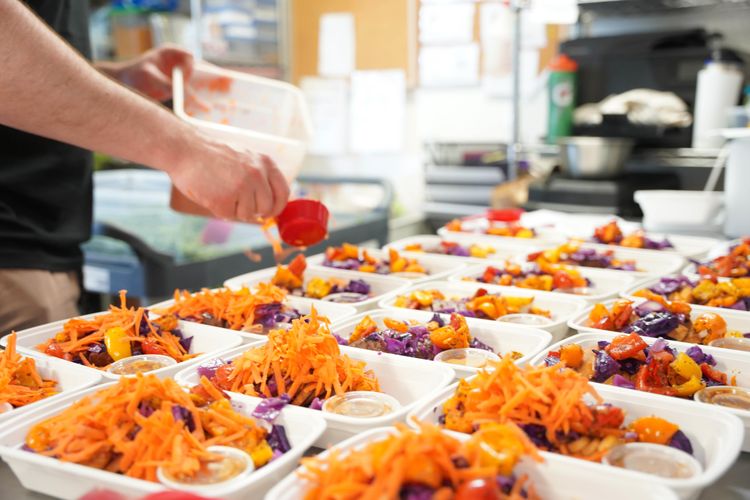
This is one in a series of interviews with CFIN member companies that have successfully applied for and received funding. Calgary, AB-based Nutrimeals Inc. offers healthy, ready-to-eat meals incorporating personalized nutrition and fitness requirements and delivers them to customers through a monthly subscription service. The company is receiving $98,206 in funding through CFIN’s Innovation Booster program to complete an initiative that aligns with CFIN’s smart product and process development priority. We sat down with co-founder Samuel Hale to find out more about the company’s plans. Q: What does Nutrimeals do and how are your products improving the food industry? A: We provide customers with healthy prepared meals that are delivered directly to the consumer. Our users order meals for the week, which cuts down on delivery frequency and packaging. We also analyze orders ahead of the delivery day. We plan our purchasing and production accordingly and have less than 0.5 per cent of production waste. All of our packaging materials are reusable and/or recyclable. Approximately 75 per cent of healthcare spending is to treat chronic disease, which can be linked back to a patient’s diet. We tackle this at the source and help our customers eat healthy. Q: What is Nutrimeals’ mission? A: To create a space where healthy eating and convenience co-exist. Q: Why did you apply for this funding and how will you use it? A: We applied to be a part of the CFIN community to meet other professionals that are innovating in the food space. We are using the funding to advance our Precision Nutrition program and develop our new online ordering platform. Q: What excites you most about working in this area of the food industry? A: The ecommerce industry is only 20 years young! The online food space is even younger at about 10. There’s still opportunity to change the way people purchase food online and we plan to be in the forefront. Q: Why do you think public funding is important in helping companies clear innovation hurdles and access leveraged funds? A: Programs such and CFIN’s booster help privately held companies like ours gain exposure to markets and opportunities. The reimbursable grants also offer monetary gain without giving up equity or paying interest. It helps boost cashflows and keep a clean cap table. Q: Looking ahead, what’s on the horizon for Nutrimeals? A: Nutrimeals is transforming into a food-tech company. Q: What are your passions or hobbies outside of work? A: Cars, technology, and finance. Q: If you had to pick one person to make you a meal, who would you choose? A: I would skip the celebrity chefs. Sometimes it’s better not to meet your heroes. Their food looks so good on screen, I wouldn’t want to be disappointed! I would love the opportunity to have a meal with my Great-great Aunt Freda, and eat her famous tapioca pudding one more time. Ready to access funding for your innovative initiative? Click here to find out more about CFIN’s funding programs.
Community Manager-
The Tablesetter – August 29
Happy Monday CFIN members! Here's your weekly heads up on what’s happening on YODL and around the food world this week. The YODL Menu Did you notice we added a YODL Menu widget to our homepage? Now you can easily access all of our articles and keep track of what’s coming up. This week we’re moving from plastic use in the food industry to take a deep dive into all things packaging. Over the next few weeks we’ll be exploring non-plastic packaging options for food and beverage companies, as well as how to find funding for packaging changes, and working with packaging partners to find the most affordable, safe and suitable alternative. Monday: The Tablesetter – August 29 Tuesday: Member profile – Nutrimeals Wednesday: Top YODL discussions from the past month Thursday: C hallenge – Finding and working with packaging partners for alternatives to plastics Friday: News File Something to Celebrate September 3 is International Bacon Day! Bacon is one of the world’s oldest preserved foods, and although it can be found in a wide range of recipes and products (including desserts, coffee and even gum) in the U.S. 70% of all bacon consumed is eaten for breakfast. Food Facts Research from Statista found that: 58.3% of Canadians eat breakfast every day, 17.2% ate it once or twice a week, 9.3% eat breakfast only on weekends, nine per cent ate it every other day, and 6.2% never ate breakfast. Respondents cited bagels, followed by croissants and English muffins as the top choice for breakfast breads. Almost 82% of Canadians eat breakfast at home, followed by at work, and on-the-go. Happy YODLing!
Community Manager-
News File – August 26
Each Friday we’ll bring you a roundup of news from CFIN, YODL and around the food world. As seen on YODL Check out this week’s most viewed discussions: 10 QUESTIONS WITH CFIN: Melanie Morrison (CEO) @ BetterCart Analytics | Open Forum (cfin-rcia.ca) Functional mushrooms are helping this tennis icon recover | Open Forum (cfin-rcia.ca) Does Our Faith Influence Our Receptiveness to Alternative Protein? | Open Forum (cfin-rcia.ca) Around the Food World Mintel’s 2022 Consulting Sustainability Barometer reveals that consumer fears about climate chain, and water and food shortages has increased significantly in the past two years. Food and Beverage Ontario’s study on labour shortages and the food industry shows that 82 per cent of Ontario processors need or are looking for a skilled trades professional. Natural Trace , a company based in Singapore, has produced traceability technology based on DNA markers integrated directly in a food or beverage product. Did you know? The 2022 Canadian National Exhibition (CNE or the Ex), the largest fair in Canada, launched this week in Toronto, after closing for two years during the pandemic. Founded in 1879, the Ex began as the Toronto Industrial Exhibition, showcasing technology, innovation and agriculture. Over the years the Ex expanded to include animal and vegetable displays, competitions, rides, entertainment, and of course, a wide variety of fabulous food. The Ex’s current food building opened in 1954 (replacing the 1922 pure food building) and was designed to showcase Canada’s food industry, with booths from companies such as Maple Leaf, Laura Secord and Donlands Dairy. Vendors often come up with creative new food concoctions during the Ex, and this year some of the innovative dishes you’ll find include: Bacon ice cream sandwich at Waffles & Cream. A two ft.-long taco at Machette. Ketchup & mustard ice cream at So Cute Ice Cream. Flaming hot Cheetos burrito at Burrito Co. Korean squid ink corndog at Saltspring Concessions. Mac & cheese lemonade at Real Fruit Drinks. Churro-wrapped deep-fried pickle at Cornehcopia. Deep-fried coffee at Deep Fried. Click here to check out some vintage food photos from the CNE.
Community Manager-
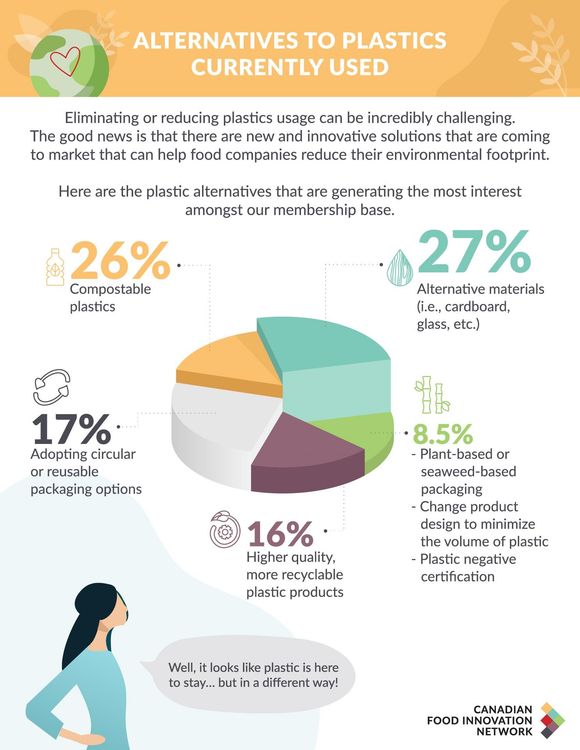
Infographic: Alternatives to plastics currently used
CFIN's recent plastics use survey asked members what alternatives to plastics they're using or considering using in their company. Here's what they told us:
Community Manager-
CFIN Member Spotlight – Trendi Tech
This is one in a series of interviews with CFIN member companies that have successfully applied for and received funding . Burnaby, BC-based TrendiTech Inc. upcycles food waste to produce nutrient-dense products. The company is receiving $85,667 in funding through CFIN’s Innovation Booster program to create technology that aligns with CFIN’s smart product and process development priority. We sat down with co-founder and CEO Craig McIntosh to find out more about the company’s plans. Q: What does TrendiTech do and how are your services improving the food industry? A: Trendi uses robotics and automation to upcycle otherwise wasted food at the farm and food processor level, fractioning fruits and vegetables into a variety of nutrient-dense products, a fraction of its original size and weight and shelf-stable output. We offer flexible terms for farmers and reduce volumes without sacrificing nutrition, making it more cost-effective for transportation and for inclusion in other food products. Q: What is TrendiTech’s mission? A: Our mission is to stop the cycle of food waste by using our advanced technological innovations, impactful partnerships, and a suite of products that enable food waste reduction across the supply chain. Q: Why did you apply for this funding and how will you use it? A: Saving and upcycling misfit fruits and vegetables is only the first step. We want to create a circular economy by designing a new generation of our Smoothie Machine to convert our powders to hot soup. Q: What excites you most about working in this area of the food industry? A: So many things. Farmers are at the riskiest end of food production, and they’re at the whim of weather and markets. We help them maximize their return by rescuing the perfectly good food that wouldn’t otherwise get to market. Where consumers are concerned, snack foods are often junk foods. We want to make it as convenient as possible to choose healthy alternatives with no sacrifice of flavour or convenience. Q: Why do you think public funding is important in helping companies clear innovation hurdles and access leveraged funds? A: Canadian investors are notoriously conservative, much more willing to invest in a technology once it has proven itself in the marketplace. Public funding helps companies like ours accelerate to that level so we can create jobs and expand to export markets much more quickly. The funding from CFIN means we can jump start the design for a hot soup kiosk, which will use our own freeze-dried products. While making it easy for people to get nutritious food on the fly, we will begin to create a circular economy. Q: Looking ahead, what’s on the horizon for TrendiTech? A: Our goals are to scale production of our vending kiosk innovations and maximize their use of recycled food waste, position our one-of-a-kind farm food waste fractionation units (BioTrim) to address the enormity of food waste globally, and source markets for all the potential uses of the unit output (BioFlakes). Q: What are your passions or hobbies outside of work? A: Cooking, sharing food, and travelling to eat. Q: If you had to pick one person to make you a meal, who would you choose? A: Definitely my mom. She’s a great cook and loves to eat food she wouldn’t normally be comfortable cooking. Our shared love for soups was part of the soup machine inspiration. Ready to access funding for your innovative initiative? Click here to find out more about CFIN’s funding programs.
Community Manager-
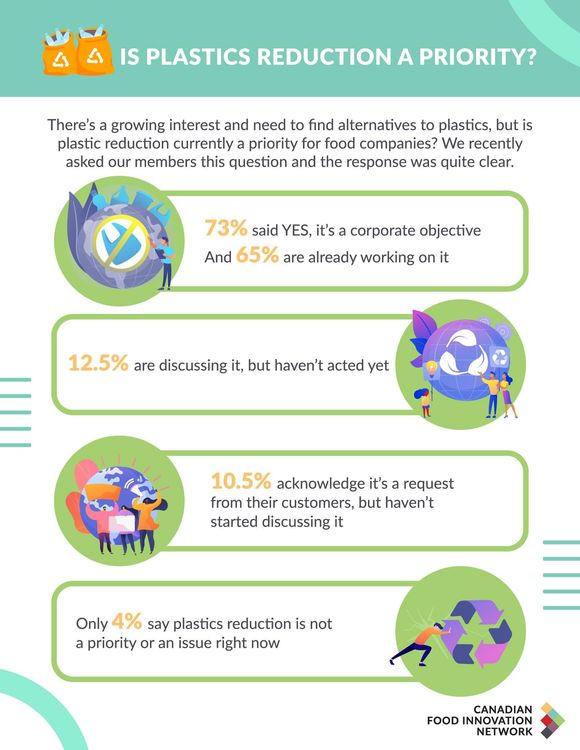
Infographic: Is plastics reduction a priority?
Community Manager-
The Tablesetter – August 22
Happy Monday CFIN members! Here’s your weekly heads up on what’s happening on YODL and around the food world this week. The YODL Menu Did you notice we added a YODL Menu widget to our homepage? Now you can easily access all of our articles and keep track of what’s coming up. This week watch for articles and videos on: Monday: The Tablesetter – August 22 Tuesday: Survey highlights – Is plastics reduction a priority for food businesses? Wednesday: Member profile – Trendi Tech Thursday: Challenge – Accessing funds for alternative packaging solutions Friday: News File Something to Celebrate August 23 is National Eat a Peach Day! Peaches are actually part of the rose family, and are native to China. Canada produces a multitude of peach varieties, primarily in BC’s Okanagan (were the town of Peachland is located), Southern Ontario, and Nova Scotia. Food Facts According to a 2020 survey by market researcher Leger 360, 85 per cent of Canadians say buying local vegetables is important to them, while 84 per cent say they prefer to buy local fruit. Leger 360 also asked Canadians what vegetables and fruit they’ve consumed in the past year. Here’s what they found: Vegetables: Potatoes 91% Carrots 89% Onions 87% Lettuce 87% Tomatoes 86% Broccoli 82% Cucumbers 80% Peppers 79% Celery 74% Beans 74% Fruit: Apples 85% Strawberries 82% Grapes 79% Blueberries 76% Raspberries 69% Melons 59% Peaches 56% Cherries 55% Pears 51% Summer Reading List Got time on your hands this week? Check out what we’re reading these days: ‘Consumers don’t want to take another pill’: Nutrisure fills gap in 50+ nutrition with UK’s ‘first’ dedicated superfood brand (foodnavigator.com) https://www.theglobeandmail.com/business/article-food-producers-move-to-make-just-the-basics/ Happy YODLing!
Community Manager-
News File – August 19
Each Friday we’ll bring you a roundup of news from CFIN, YODL and around the food world. As seen on YODL Check out this week’s most viewed discussions: Private Label: An Inflationary Inevitability? | Open Forum (cfin-rcia.ca) The 100 best business meeting spots in Canada | Open Forum (cfin-rcia.ca) CFIN Food Innovation Challenge : Plastics Solutions for Foods: Reduction, Replacement, and Recyclability | Open Forum (cfin-rcia.ca) Around the Food World A new study reveals the environmental impact of meat and meat alternative proteins. Experts suggest 3D printing could help consumers in the Western world overcome their aversion to alternative protein like insects. Leaked data from the Canadian Dairy Commission raises questions about the rapidly rising cost of dairy products. Did you know? Statistics Canada figures show that Canadians are consuming roughly 20 per cent less dairy than they were a decade ago, replacing it with plant-based alternatives. Between 2018 and 2019, the Nielsen Company reports that sales of oat milk rose 244 per cent, while soy milk declined by one per cent, coconut milk dropped three per cent, and rice milk fell a whopping 48 per cent.
Community Manager-
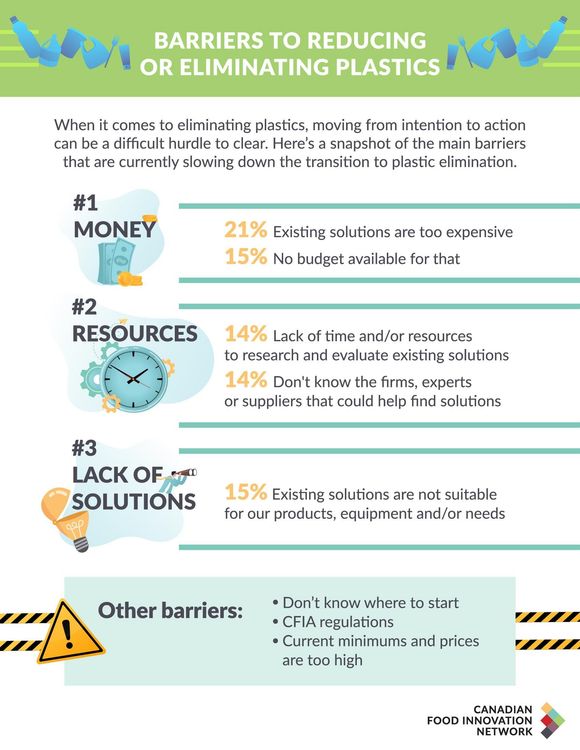
Barriers to reducing or eliminating plastics use - Infographic
CFIN's recent plastics use survey asked members what barriers they experience to reducing or eliminating plastics use in their operations. Here's what they told us:
Community Manager-
CFIN Member Spotlight – Henry’s Tempeh
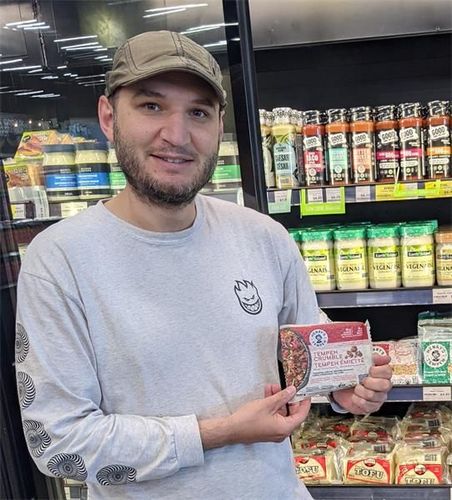
This is one in a series of interviews with CFIN member companies that have successfully applied for and received funding . Kitchener, ON-based Henry’s Tempeh Inc. produces organic, sustainable tempeh. The company is receiving $61,051 in funding through CFIN’s Innovation Booster program to create technology that aligns with CFIN’s smart product and process development priority. We sat down with president Jason Jurchuk to find out more about the company’s plans. Q: What does Henry’s Tempeh do and how are your products improving the food industry? A: Henry’s Tempeh produces organic tempeh, a fermented plant protein with Indonesian roots. We use organic Canadian soybeans to produce our flagship line of soy-based tempeh products. We are part of Canada’s sustainable food system; we buy from growers close to our production facility that use organic farming principles, and turn these beans into a minimally processed and delicious nutrient-dense product. Q: What’s the mission of Henry’s Tempeh? A: Our mission is to produce accessible, fermented plant-based foods using ethically sourced ingredients. Q: Why did you apply for this funding and how will you use it? A: We’re working to develop a new fermentation system that will significantly reduce waste and produce a better product. We applied for the CFIN Innovation Booster funding to support the development of this innovative technology and to kickstart the development of a new non-soy product line. Q: What excites you most about working in this area of the food industry? A: The fact that what our team does every day grows Canada’s sustainable food system and puts high-quality, nutritious, and delicious foods on Canadians’ plates. Q: Why do you think public funding is important in helping companies clear innovation hurdles and access leveraged funds? A: Public funding accelerates innovation and growth. Without it, we would certainly not be where we are today. Funding through organizations like the CFIN enables us to innovate, scale up, and get technology and products to market quickly and effectively while creating jobs and strengthening Canada’s domestic food system. Q: Looking ahead, what’s on the horizon for Henry’s Tempeh? A: We operate with a growth mindset. We’re working to expand our product line, expand our production facility and develop world-class fermentation technology that will position us as a leader, not only in the fermented food space but in the Canadian food economy, all while operating transparently and sustainably. Q: What are your passions or hobbies outside of work? A: Mycology, fermentation, spending time with family. Q: If you had to pick one person to make you a meal, who would you choose? A: Peter Pan Ready to access funding for your innovative initiative? Click here to find out more about CFIN’s funding programs.
Community Manager-
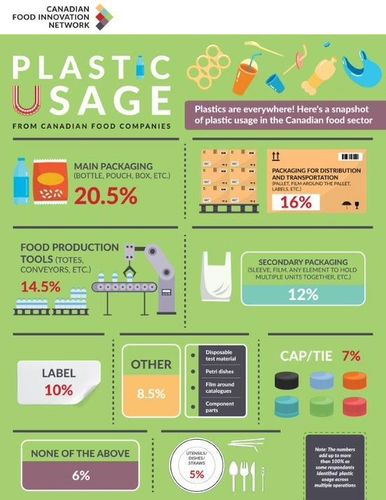
Use of plastics in Canada's food industry
CFIN's recent plastics use survey asked members how they use plastics in their operations. Here's what they told us:
Community Manager-
The Tablesetter – August 15
Happy Monday CFIN members! Here's your weekly heads up on what’s happening on YODL and around the food world this week. The YODL Menu Did you notice we added a YODL Menu widget to our homepage? Now you can easily access all of our articles and keep track of what’s coming up. This week watch for articles and videos on: Monday: The Tablesetter – August 15 Tuesday: Survey highlights – Plastic use in the food industry Wednesday: Member profile – Henry’s Tempeh Thursday: C hallenge - Auditing your operations and moving towards a circular economy, Part 2 Friday: News File Something to Celebrate August 19 is national potato day! First cultivated in Peru in approximately 8,000 BC, there are more than 4,000 potato varieties, including Canada’s famous Yukon Gold. The first Canadian-bred potato variety marketed by name, the Yukon Gold potato was developed in 1966 by Gary Johnston and Geoff Rowberry at the University of Guelph in Guelph, ON, and made it to market in 1980. Food Facts According to National Today , potato chips are consumers’ favourite snack food (with Lay’s preferred by 32.4% of consumers), while french fries are the preferred way to enjoy potatoes in a recipe. In a survey which asked consumers “which potato recipes do you enjoy the most?” respondents cited: French fries (16.23%) Mashed potatoes (15.23%) Baked potato (11.68%) Hash browns (10.64%) Tater tots (8.44%) Potato salad (8.35%) Potato wedges (8.18%) Twice baked potato (6.97%) Potato skins (6.10%) Potato soup (5.24%) Classic potato gratin (2.94%) Surprisingly, simply boiling and adding butter didn’t make the cut in this survey! What’s your favourite way to enjoy potatoes? Summer Reading List Got time on your hands this week? Check out what we’re reading these days: Create long-term value in a reimagined food system | EY Canada https://www.forbes.com/sites/garyocchiogrosso/2022/02/14/continued-supply-chain-issues-in-the-restaurant-industry/?sh=ca5de1e5bbdd Comment: Pushing back on paper packaging (foodservicefootprint.com) Happy YODLing!