Inside SIAL Canada 2026: Driving Food Innovation Through Connection and Collaboration
CFIN had the honour of taking a bite out of SIAL Canada 2026 in Montréal 🍎—connecting with partners, members, and industry leaders shaping the future of food innovation across Canada and beyond. Representing CFIN on site were CEO @Dana McCauley and @Julie Daigle , Regional Innovation Director (Quebec), who engaged with the ecosystem throughout the event. Their presence reflected CFIN’s ongoing commitment to strengthening Canada’s food innovation ecosystem and supporting high-potential foodtech ventures. Attendees could also catch Julie as a Foodtech Focus expert at the SIAL Canada Expert Hub, where she connected directly with innovators and shared insights with the community. Dana also took the stage as part of the Dairy Talks program, contributing to a forward-looking discussion on innovation as a driver of market leadership in the Canadian dairy sector. Her session explored the shift from incremental product development toward a broader innovation mindset—highlighting next-generation ingredients, value-added dairy formats, new go-to-market strategies, and the role of Industry 4.0 technologies like AI, robotics, automation, and digital supply chains in strengthening productivity and global competitiveness. A key highlight of the week was CFIN’s involvement in the 7th edition of the Startup Pitch Competition, held on April 30 on the Food & Bev Connect stage. Julie Daigle participated as the President of the Foodtech jury, joining a panel of industry experts evaluating promising entrepreneurs from the Startup Village. Beyond the competition, the Startup Pitch stage served as a strategic platform connecting entrepreneurs with buyers, investors, and key decision-makers across the agri-food ecosystem. A standout moment for the CFIN community was the recognition of Maia Farms, a CFIN member and funding recipient, which earned the Gold Prize in the foodtec h competition 🍄🏆 CFIN’s presence at SIAL Canada underscored the momentum of Canada’s food innovation sector and the value of convening the ecosystem to accelerate ideas from concept to commercialization. 📖 Explore more from SIAL Canada 2026 R elive the stories, innovations, and key moments captured throughout the show in the official SIAL Canada Daily: SIAL Canada Daily – 2026 Edition (Photos Courtesy of SIAL)
Community Manager-
Five Years of CFIN: A Letter to the Network
Thirty years ago, I worked as a chef in the kitchen of one of Canada’s top restaurants standing should er to shoulder with people who ca red about the sensory experience of food above all else . Our tech stack was al most all analog and , to be honest, we didn’t give our ordering system or the way we did inventory a lot of thought. My career broadened over time , and I ’ ve also held roles where I developed recipes at Canadian Living and wrote about food trends; built innovation strategies and products for national brands, founded a business incubator, and ran a venture creation office at a prestigious Canadian u niversity . Food was always the thread , and technology was always present but in most of the food focused businesses I’ve worked for, it was taken for granted, and creativity and hard work were what drove the businesses forward. While smart people with great ideas are essential to food business success, it’s not enough to be competitive in today’s world. Old ways of running restaurants, innovation labs and food and beverage processi ng businesses can’t compete internationally or absorb the trade shocks that have become commonpla ce in recent history. That’s why I feel l ik e CFIN is the perfect place for me to be today and why we’re adding dozens of new members per week. When CFIN was created in 2021, the mandate was intentionally broad : cata lyze Canadian food innovation with funding , build community, connect an ecosystem that had been operating in silos for decades. The funding programs took shape quickly. Since 2022, we’ve awar ded $23.3 million to 133 projects across six program s. For every $1 CFIN invested, our members committed $7.65 of their own capital toward innovation. This leverage ratio of nearly 8-to-1 has unlocked over $140 m illion in private sector spending on R&D and capital infrastructure. The other work was harder to define . What do "build community" and "connect an ecosystem" mean in practice for a sector span ning startups, processors, researchers, investors, policymakers, and operators spread across this vast country ? Th at question didn't have a tidy answer. As a result , fostering and serving this network was (and remains ) an exercise in innovation itself : something new to be built , and then tested, adjusted, and iterated upon , ad infinitum . I’m immensely proud of what we’ve built so far . A team of Regional Innovation Directors who've supported more than 2,200 organizations, brokering the introductions that became commercial partnerships, strategic investments, leadership hires, and research collaborations. A digital platform , YODL, connecting Canada's food sector across industry silos and bridging interprovincial barriers . The first comprehensive analysis of Canadian foodtech . A network of 8,500 members from every province, every part of the food value chain, every stage of business . On any given week, our community is discussing topics ranging from precision fermentation bioreactor designs and funding stacks to food packaging labeling regulations and export strategies, all in the same space. Members benefit from purpose-built tools and resources — like our Funding Finder that aggregates food and beverage funding opportunities across the country and a growing library of original sector research and analysis — alongside direct access to our Regional Innovation Directors. Canada has strong regional funders, accelerators, trade associations, and tech transfer offices, each doing necessary work in a defined lane. What this sector didn't have was a place where the conversation s , the tools, and the connections all showed up at once — where the range of problems and the range of capabilities were dense enough that the right solutions could emerge . That's what CFIN has built. That foundation is important because the next five years will be even more dynamic, and often more challenging, than the last five . To keep pace and flourish in an increasingly volatile world, Canada's food sector needs to modernize faster and more strategic ally than ever before . Trade disruption is dramaticall y reshaping supply chains . L abour constraints are compounding a productivity gap that was widening long before tariffs became front-page news. Climate pressures are intensifying. Food 4.0 — a tech-enabled food s ector that's more collaborative, productive, resilient, and competitive — is the framework CFIN is building toward, and the case for it gets more urgent by the quarter. I ’m confident that we’re up to the task . Five years ago, Canada's food innovation ecosystem was fragmented, underleveraged, and often invisible to the investors, operators, policymakers, and media who needed to see it. That's no longer true. The capacity to respond to the challenges ahead is here. Not in any single program or policy, but in the breadth of this network — the founders , processors , researchers , and investo rs who are hungry to innovate and build a better Canadian food sector . My own wide-ranging path through the food sector taught me that no single role ever showed me the full picture. It took working across kitchens, labs, newsrooms, boardrooms, and startups to understand how innovation really moves through this industry — and where it get s stuck. CFIN was built on the same insight. A sector this complex, facing challenges this urgent, needs more than funding or advice or connections in isolation. It needs all of them in the same room. That's what we've spent five years building, and I'm betting the next five will prove its value at a scale none of us can yet imagine. Thank you for being part of it. Dana McCauley, CEO, Canadian Food Innovation Network
Community Manager-
How BC is Becoming a National Foodtech Hub
Editor's Note: This article was o riginally published in the Vancouver Tech Journal on March 13, 2026 The province has a diverse food processing industry, world-class research facilities, and a deep bench of tech talent — everything a foodtech ecosystem needs to thrive. Foodtech builds the software, automation, and applied science for how food gets processed, manufactured, packaged, distributed, and sold. The industry behind it is enormous — food and beverage processing alone is Canada's largest manufacturing sub-sector , bigger than automotive, bigger than aerospace. It's a serious market, and in British Columbia, it's growing fast. But if you work in the province's broader tech ecosystem, you might not even know that. Foodtech hasn't traditionally drawn the same attention as sectors like cleantech or enterprise SaaS despite being a comparable market in scale and complexity — and one where demand for new technology is accelerating fast. What BC brings to the table BC's food processing sector is substantial — over 3,200 companies producing roughly $12.6 billion in value-added products annually. And it's being treated as a strategic priority. The province has funded a network of shared food processing hubs, UBC just opened a Food and Beverage Innovation Centre with pilot-scale production labs that processors and startups previously had to leave BC to access, and SFU's BC Centre for Agritech Innovation is partnering directly with SMEs on cost-shared R&D. At the same time, much of what the food industry needs is already being built in BC for other thriving tech sectors. Process automation, energy management, supply chain software, safety and traceability systems, data-driven quality control — these are cleantech and software problems applied to production floors and distribution networks. The talent, research base, and trade infrastructure to support a serious foodtech cluster are all here. A different kind of tech sector Foodtech doesn't work like enterprise SaaS or consumer tech. Processors and manufacturers adopt slowly and carefully, because failure is expensive in ways that go beyond lost revenue — a food safety issue, a botched line integration, a regulatory problem. Sales cycles run in quarters. The investor community that understands food is small and specialized. And the industry's own networks run through trade associations, existing supply relationships, and sector-specific events that sit well outside the broader tech community's orbit. None of this means foodtech is closed off. It means that if you want in — as a founder, investor, developer, or potential partner — you need a way to access the conversations, the deal flow, and the operating knowledge that don't surface through the usual channels. The Canadian Food Innovation Network The Canadian Food Innovation Network is a national not-for-profit, established in 2021 that functions as the operating infrastructure for Canada's foodtech sector. CFIN runs cost-shared funding programs that help companies de-risk R&D and move technology into commercial settings. Since launch , the organization has awarded over $22 million to 122 Canadian foodtech projects, matched by $25 million in industry co-investment. Those funded companies have generated $90 million in economic impact, created over 355 jobs and co-op placements, and attracted more than $82 million in follow-on investment. The network's 8,000-plus members include food processors, technology companies, ingredient suppliers, retailers, researchers, and investors — connected through YODL, CFIN's member platform, and supported by Regional Innovation Directors embedded across the country, who work directly with members to broker introductions, navigate funding, and connect emerging technology with the processors and buyers who need it. CFIN also produces the sector's most detailed intelligence . The Foodtech in Canada 2025 Ecosystem Report mapped investment flows, identified sector strengths, and gave both companies and investors a clearer picture of where the Canadian foodtech market stands. And then there's Foodtech Frontier , CFIN's annual program identifying the country's highest-potential foodtech companies. The inaugural cohort of 35 winners included eight BC companies. For investors, it works as curated, vetted deal flow in a sector where sourcing is otherwise hard. For the companies, it's structured national visibility. Plug into Canada’s foodtech ecosystem If you work in technology or investment and you've been curious about the food sector, then signing up for a free CFIN membership is the best place to start. Members get access to funding programs, sector intelligence, a national innovation community, and regional team members that know the BC landscape specifically.
Community Manager-
Other Articles
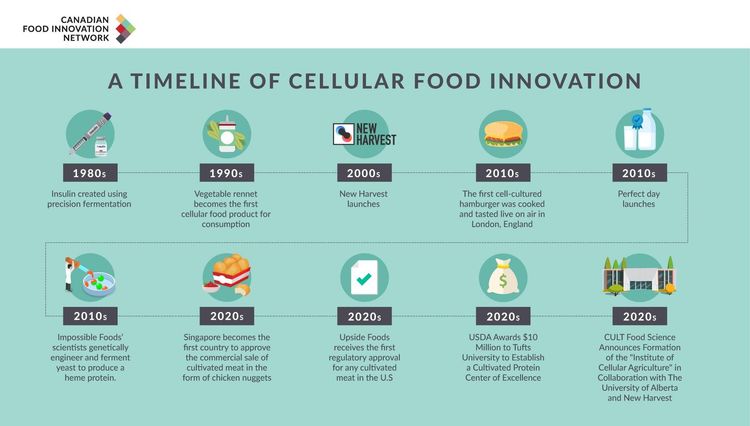
INFOGRAPHIC: A Timeline of Cellular Food Innovation
Research and development of cellular food has been ongoing for more than four decades. In coming weeks we'll be discussing more recent developments in cellular food innovation in Canada and around the world. On February 9, 2023 CFIN is presenting an information session on its fourth Food Innovation Challenge - Cultivating a Resilient Food Future: Developing the End-to-End Cellular Food Capacity for Canadian Global Leadership. Click here for more information and to register for the session.
Community Manager-
Company Spotlight - Saltwinds Coffee Company Ltd.
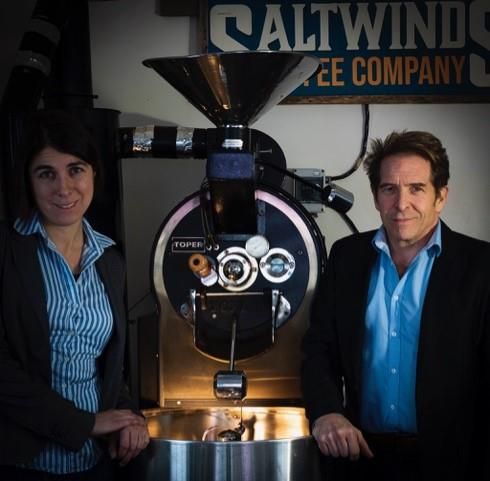
This is one in a series of interviews with CFIN member companies that have successfully applied for and received funding . Douglas, NB-based Saltwinds Coffee Company’s aim is to offer a carbon neutral cup of coffee, something the company began by re-inventing coffee roasting itself to turn it into a zero-emission process. Saltwinds is rooted in a strong sense of place and history, and all of its coffees have a unique Maritime flavour. Co-founders Brad Rideout (CEO) and Laura Richard (COO) are Maritimers with family ties to the ocean industries of Canada's East Coast, and grew up in New Brunswick hearing tales on how coffee used to “taste better” when it arrived in wooden sailing ships. The company rediscovered this lost taste by infusing coffee beans with sea air, leading to its best-selling Ocean Fresh line of coffee beans. This unique Atlantic taste and the compelling environmental benefits of Saltwinds Coffee have created an irresistible brand, and although it only launched in early 2022, Saltwinds has already attracted an enormous amount of interest. The company received $57,681 in funding from CFIN to complete a process to reduce carbon emissions in coffee roasting. We talked to Rideout and Richard to learn more about the company and its plans. Q: What is your company’s mission? A: We’re on a mission to make people feel better every day, by producing great coffee, elevated to provide unique flavours and positive environmental impacts. Q: Why did you apply for this funding and how will you use it? A: To bring Saltwinds’ carbon reduced coffee to even more consumers, we needed help to scale up our reduced emissions roasting technology and demonstrate it on large industrial machinery. We applied for this funding so that we can show the industry that it is possible to change behaviours and processes for the better, and help more people convert their daily cup of coffee into one that is better for the planet. Q: What excites you most about working in this area of the food industry? A: It is a privilege to be producing a product that brings so much pleasure into people’s lives. We are making coffee that is better for the planet, and which tastes better, too – the happy smile on our customers’ faces as they walk away with a bag tells us that they get that, and are excited to get home and experience it as they savour a cup of coffee. Q: Why is collaboration so important for accelerating innovation in the food industry? Is it difficult to find good collaborating partners, and what would make the process easier? A: Innovation, by definition, suggests that we are doing something new, different, unfamiliar. Collaborating with partners outside of our niche domain of coffee roasting allows us to tap into different expertise and experiences that can inform our own innovation pathway. That’s why we applied to join Foresight, Canada’s cleantech accelerator. While no-one else in Foresight is doing anything related to coffee, there are lots of companies exploring how technology can reduce emissions, which is aiding us tremendously. Q: Please comment on the importance of public funding to help companies clear innovation hurdles and access leveraged funds. A: The kind of revolution we are trying to engender in coffee roasting takes a lot of time and money. Without the support of government funding, it’s difficult for a small company to allocate enough resources for that revolution to succeed. Thanks to CFIN’s support, we are optimistic that we can create a substantive change in the carbon footprint associated with coffee drinking here in Canada and around the world. Q: Looking ahead, what’s on the horizon for your company? A: In 2023 and 2024 we will be focused on bringing Saltwinds to even more consumers. Key to doing this is increasing our manufacturing capabilities and growing our distribution channels. There are lots of logistical and operational hurdles involved in this, but we are confident that you’ll be seeing Saltwinds on a store shelf near you soon! Q: What are your passions or hobbies outside of work? A: We are both keen triathletes and have competed in numerous half Ironmans and Ironmans. As triathlon races take place all over the world, this dovetails nicely with a passion for travel. Fortunately, coffee is grown in very interesting places, too! Q: If you had to pick one person to make you a meal, who would you choose? A: (Laura) Ferran Adrià, the chef at the former el Bulli restaurant, and one of the first to pioneer cuisine focused on chemical transformations, i.e., molecular gastronomy. Ready to access funding for your innovative initiative? Click here to find out more about CFIN’s funding programs.
Community Manager-
50 Canadian FoodTech Resources - The University of Guelph Meat Science Laboratory
Canada has an extensive range of research centres, food incubators, accelerators and labs supporting food and beverage innovation through the research they do and/or the services they offer. Each week throughout 2023, we’ll be highlighting an organization that’s supporting food innovation in Canada. Name: The Meat Science Laboratory at the University of Guelph. Location: Guelph, ON. Focus: The Meat Science Lab is a small-scale meat packing plant operating under federal meat inspection regulations with the capability to slaughter, cut, and process red meat species. Mission: To provide student training and perform research in meat science. The lab also harvests tissue and organ samples for research programs in other University of Guelph departments. Services: The Meat Science Lab’s abattoir offers students experience in slaughter operations. As well as research and teaching, the lab offers services to companies requiring specialized facilities and expertise, as well as meat product workshops in cooperation with the meat industry. What you need to know: The lab’s cutting room is equipped to process carcasses into wholesale or retail cuts, or to carry out complete carcass dissections. Other features include: A smokehouse; Basic equipment necessary for manufacturing processed meat products; A blast freezer operating at -30 °C and an adjacent storage freezer kept at -20 °C for long-term storage of meat products; A texture profile analyzer; A fully equipped kitchen to cook and evaluate meat products. Teaching areas include: The carcass dissection classroom; A glass-fronted display cooler for carcasses or meat cuts; A 99-seat lecture theatre for lectures or where carcass and meat cutting demonstrations are offered through use of the lab’s monorail system for meat. Notable news: Each spring the Meat Science Lab helps the local Mennonite community prepare meat for canning through a mobile canning facility run by the Mennonite Central Committee . The canned meat is distributed to hungry people worldwide. Get involved: Contact the Meat Lab manager Gino Giansante at ggiansan@uoguelph.ca, or reach out to our Regional Innovation Director for Ontario, Linda Fox.
Community Manager-
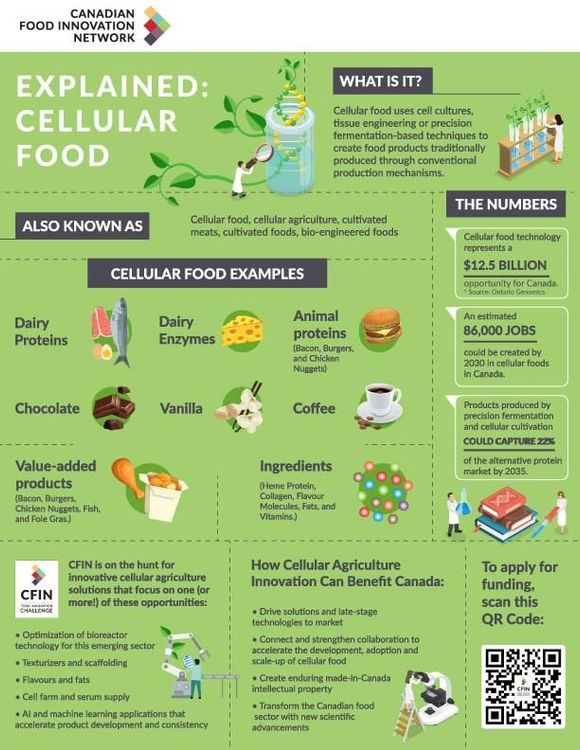
INFOGRAPHIC: Introduction to Cellular Food
Starting today, we're doing a deep dive into cellular food. Over the next two months look for articles, infographics and videos on YODL explaining everything you need to know about cellular food and its potential in Canada, including regulations, ongoing research, product development, funding opportunities, and much more. On February 9, 2023 CFIN is presenting an information session on its fourth Food Innovation Challenge - Cultivating a Resilient Food Future: Developing the End-to-End Cellular Food Capacity for Canadian Global Leadership. Click here for more information and to register for the session.
Community Manager-
The Tablesetter – January 23, 2023
Happy Monday CFIN members! Here’s your weekly heads up on what’s happening on YODL and around the food world this week. The YODL Menu Monday: The Tablesetter – January 23, 2022 Tuesday: Introduction to cellular food (infographic) Wednesday: 50 Canadian FoodTech Resources – University of Guelph Meat Lab Thursday: Member Spotlight – Saltwinds Coffee Company Friday: News File Something to Celebrate January 27, 2023 is National Chocolate Cake Day! According to a survey by NYC Marketing Agency, 58% of 1,000 people surveyed prefer chocolate cake over vanilla. In fact, 32% of people said chocolate was their favourite flavour, and 4% said they won’t eat a cake unless it’s chocolate. Food Facts Barry Callebaut’s Top Chocolate Trends for 2023 and Beyond report says consumers are now looking for three things when they choose chocolate: Intense indulgence – Chocolate that is a feast for the eyes and for the taste buds, with 71% of consumers saying they when they want to celebrate they choose chocolate. Mindful indulgence – Chocolate that is tasty but at the same time good for the consumer and the planet. That includes treats that are plant-based, sugar reduced, and sustainably sourced with traceable ingredients. Healthy indulgence – Chocolate that is fortified and functional, with 65% of consumers saying they would enjoy a health-boosting chocolate featuring macro/micronutrients. The company says consumers are also looking for innovative chocolate products which include vitamins, minerals, fibres, and flavanols. Happy YODLing!
Community Manager-
News File – January 20, 2023
Each Friday we’ll bring you a roundup of news from CFIN, YODL and around the food world. As seen on YODL Check out this week’s most viewed discussions: Confused about HACCP, GMP, GFSI, SQF and more? | Open Forum (cfin-rcia.ca) New SDTC Round of funding announced | Open Forum (cfin-rcia.ca) Bluebird Hardwater : une eau alcoolisée sans bulles (prêt-à-boire) | Hard Water | Open Forum (cfin-rcia.ca) Around the Food World Acosta has released its insights into what shoppers will be looking for they shop in store for groceries or dine out this year. Danone is the first food company to set a methane reduction target and align with the Global Methane Pledge. A study in Nature Food journal on production metrics at Israel’s Believer Meats shows that cell-cultured meat can be scalable. Did you Know? A new survey by Steritech reveals what consumers want and don’t want when they visit a retail brand. The survey of more than 3,000 North American consumers found: 74% expect a brand to provide the same experience in every store. 25% said they would visit a brand less frequently after one negative experience, while; 59% said they would visit a location more often after one positive experience. 52% said online reviews provide an accurate representation of a brand. 29% said they were more likely to post a review about a good experience, vs. a bad experience (23%). The most valued grocery store features cited by respondents are food (60%), value (57%), product availability (56%), customer service/staff disposition (40%), and store appearance (35%). The least valued features of a brand cited were app and mobile ordering (10%), bathroom cleanliness (13%), store design or organization (22%), physical safety (25%) and food taste (25%).
Community Manager-
Company Spotlight - Vivid Machines Inc.
This is one in a series of interviews with CFIN member companies that have successfully applied for and received funding . Toronto, ON-based Vivid Machines developed a multispectral computer vision platform to digitize fruit production. The shoe-box size device mounts onto an ATV or tractor to capture plant-level data below the canopy and across the farm, providing real-time insights to help fruit growers produce more fruit on existing acreage and reduce food waste. The company started with apples but will be moving into other fruits such as grapes and kiwifruit. Vivid Machines received $810,920 in funding for a project to scale fruit volumes and transparency across the fruit supply chain. We talked to Jenny Lemieux, founder and CEO of Vivid Machines, to learn more about the company and its plans. Q: What is your company’s mission? A: Our mission is to revolutionize fruit production and the entire supply chain to help farmers solve food security globally. Q: Why did you apply for this funding and how will you use it? A: We applied for this funding so that we can extend the application of our orchard yield predictions and insights to different fruit supply chain partners to help reduce food waste and ensure more fresh fruit gets to market. Q What excites you most about working in this area of the food industry? A: My co-founder and I are passionate about food and agriculture, and also have backgrounds in physical, machine learning, and software products. We talked to hundreds of farmers, agronomists, and fruit and vegetable growers, and discovered this interesting problem in permanent crops that we thought we were particularly suited to solve. Q: Why is collaboration so important for accelerating innovation in the food industry? Is it difficult to find good collaborating partners, and what would make the process easier? A: We’ve been fortunate to meet and work with industry experts in the fruit industry and in the machine learning space. These collaborations have accelerated our milestones and growth. We are very excited to be collaborating with CFIN and with the connections we will make. Q: Please comment on the importance of public funding to help companies clear innovation hurdles and access leveraged funds. A: Public funding has helped us develop prototypes of our technology and have given us runway to test and validate our results before it was commercially viable. Without public funding, we would not be where we are today. Q: Looking ahead, what’s on the horizon for your company? A: We plan on extending our technology to other tender fruit such as grapes, kiwifruit and pears. Q: What are your passions or hobbies outside of work? A: I’m a proud soccer mom! Q: If you had to pick one person to make you a meal, who would you choose? A: My dad. Ready to access funding for your innovative initiative? Click here to find out more about CFIN’s funding programs.
Community Manager-
50 Canadian FoodTech Resources – The Verschuren Centre
Canada has an extensive range of research centres, food incubators, accelerators and labs supporting food and beverage innovation through the research they do and/or the services they offer. Each week throughout 2023, we’ll be highlighting an organization that’s supporting food innovation in Canada. Name: The Verschuren Centre for Sustainability in Energy and the Environment Location: Sydney, NS. Focus: The Verschuren Centre is an independent, not-for-profit clean technology development and deployment facility offering a collaborative space that allows clients to advance technology cost-effectively, while having the support required on the path to commercialization. Mission: To improve food security, provide measurable economic development, and reduce greenhouse gas emissions in order to meet transition by 2030 goals. Services: The centre covers the areas of bio manufacturing, bio marine, bio agriculture, energy systems, carbon transformation, bio polymer, and aquaculture. Services include rapid process and media optimization, process control and parameter identification, process characterization, analytical testing and process development, energy net-zero mapping, polymer extrusion and processing, material/product characterization, and training in lab equipment, fermentation, and extraction. What you need to know: The facility includes biosafety level 1 and level 2 labs, fully equipped analytical suite, pilot plant facility with scale up to 1,000 L with downstream processing, marine extraction facility with scale up to 6,000 L with extraction, a plant growth room with controlled environment for agricultural trails, and a 30 x 60-ft. pilot greenhouse with 900 sq. ft. of automatic drip irrigation. The centre is also home to one of only three bioreactors in Canada. Notable news: The centre received $2 million in funding last year through the Canada Coal Transition Initiative – Infrastructure Fund, which together with other financing will go towards expanding its lab facility and increasing its bioreactor capacity by 10 times. The facility currently works with more than 40 companies to develop bioeconomy and green energy innovations. Notable clients include Ardra Inc., New Dawn Enterprises, Reazent, and alterBiota. Get involved: Contact the Verschuren Centre at info@verschurencentre.ca , or reach out to our Regional Innovation Director for Atlantic Canada, @TysonMacInnis.
Community Manager-
Let’s Talk Innovation: Using Whole Legumes as Functional Ingredients
Today, we are launching a new series, Let’s Talk Innovation with Isabelle Marquis, a French-language video series covering every area of food innovation. In the first instalment of the series, Isabelle speaks with Sylvie Turgeon, Professor of Food Science at Université Laval, researcher at INAF and co-director of GastronomiQc Lab, about the use of whole legumes as functional ingredients.
Community Manager-
The Tablesetter – January 16, 2023
Happy Monday CFIN members! Here’s your weekly heads up on what’s happening on YODL and around the food world this week. The YODL Menu Monday: The Tablesetter – January 16, 2022 Tuesday: Utilisation de légumineuses entières comme ingrédients fonctionnels (video) Wednesday: 50 Canadian FoodTech Resources – Verschuren Centre Thursday: Member Spotlight – Vivid Machines Friday: News File Something to Celebrate January 19, 2023 is National Popcorn Day! According to Popcorn.org, there are four types of corn – sweet, field, popcorn and flint – but only popcorn pops. Unlike other corn, popcorn has a thicker hull (pericarp), which when heated allows pressure to build inside until it bursts open to reveal the gelatinous starch inside. The whole grain bursts into two shapes: butterfly and mushroom. Food Facts Dalhousie University’s Canada’s Food Price Report 2023 is forecasting grocery costs to jump between five and seven per cent this year, with some differences between categories, sectors and region. Vegetables are expected to see the largest price increase, up to 8%, while fruits will see the smallest increase, between 3 and 5%. Food prices will also continue to differ by region, with BC likely to experience the smallest change in food prices from 2022 (9.2%), and Quebec expected to see the greatest change (11%). On average, the total annual food expenditure for a family of four is expected to be more than $16,000 for 2023, compared to 2022’s $15,222.80. Happy YODLing!
Community Manager-
News File – January 13, 2023
Each Friday we’ll bring you a roundup of news from CFIN, YODL and around the food world. As seen on YODL Check out this week’s most viewed discussions: Upcycled food waste. | Open Forum (cfin-rcia.ca) Circular Sandwich - How is rework used in your industry? | Open Forum (cfin-rcia.ca) National Food Days | Open Forum (cfin-rcia.ca) Around the Food World A survey from the Netherlands reveals consumer concerns about cultivated meat. Cult Food Science has opened a new division called Cult Food Division to develop and commercialize cell-based products. Vgarden Ltd. has developed a plant-based canned “tuna.” Did you Know? A new report from Second Harvest shows that reliance on food banks and food charities will increase by 60 per cent in 2023. The report also revealed that: Dependency on food banks or charities grew a whopping 134% in 2022. The report cites the end of COVID supports, food inflation, and flat wages for contributing to increased reliance on food charity in 2022. The more than 1,300 Canadian food charities surveyed for the report anticipated a $94-million shortfall in meeting demand this year, working out to approximately $70,000 per organization. Up to 70% of the organizations surveyed said they will require both increased amounts of food and funding to meet expected demand for 2023.
Community Manager-
CFIN Podcasts: Farm to Fork + The Bruce Singer Podcast
The CFIN team routinely appears on podcasts covering the Canadian food and beverage industry. Here are two recent podcasts featuring CFIN's CEO @JoeLake and chief experience officer @DanaMcCauley. Click here to listen to Joe speaking on the Farm to Fork Podcast about how CFIN supports the food industry; and click here to hear Dana on the Bruce Singer Podcast discussing the future of the food and beverage industry, innovation, biotechnology, funding, and nutrition science.