Inside SIAL Canada 2026: Driving Food Innovation Through Connection and Collaboration
CFIN had the honour of taking a bite out of SIAL Canada 2026 in Montréal 🍎—connecting with partners, members, and industry leaders shaping the future of food innovation across Canada and beyond. Representing CFIN on site were CEO @Dana McCauley and @Julie Daigle , Regional Innovation Director (Quebec), who engaged with the ecosystem throughout the event. Their presence reflected CFIN’s ongoing commitment to strengthening Canada’s food innovation ecosystem and supporting high-potential foodtech ventures. Attendees could also catch Julie as a Foodtech Focus expert at the SIAL Canada Expert Hub, where she connected directly with innovators and shared insights with the community. Dana also took the stage as part of the Dairy Talks program, contributing to a forward-looking discussion on innovation as a driver of market leadership in the Canadian dairy sector. Her session explored the shift from incremental product development toward a broader innovation mindset—highlighting next-generation ingredients, value-added dairy formats, new go-to-market strategies, and the role of Industry 4.0 technologies like AI, robotics, automation, and digital supply chains in strengthening productivity and global competitiveness. A key highlight of the week was CFIN’s involvement in the 7th edition of the Startup Pitch Competition, held on April 30 on the Food & Bev Connect stage. Julie Daigle participated as the President of the Foodtech jury, joining a panel of industry experts evaluating promising entrepreneurs from the Startup Village. Beyond the competition, the Startup Pitch stage served as a strategic platform connecting entrepreneurs with buyers, investors, and key decision-makers across the agri-food ecosystem. A standout moment for the CFIN community was the recognition of Maia Farms, a CFIN member and funding recipient, which earned the Gold Prize in the foodtec h competition 🍄🏆 CFIN’s presence at SIAL Canada underscored the momentum of Canada’s food innovation sector and the value of convening the ecosystem to accelerate ideas from concept to commercialization. 📖 Explore more from SIAL Canada 2026 R elive the stories, innovations, and key moments captured throughout the show in the official SIAL Canada Daily: SIAL Canada Daily – 2026 Edition (Photos Courtesy of SIAL)
Community Manager-
Five Years of CFIN: A Letter to the Network
Thirty years ago, I worked as a chef in the kitchen of one of Canada’s top restaurants standing should er to shoulder with people who ca red about the sensory experience of food above all else . Our tech stack was al most all analog and , to be honest, we didn’t give our ordering system or the way we did inventory a lot of thought. My career broadened over time , and I ’ ve also held roles where I developed recipes at Canadian Living and wrote about food trends; built innovation strategies and products for national brands, founded a business incubator, and ran a venture creation office at a prestigious Canadian u niversity . Food was always the thread , and technology was always present but in most of the food focused businesses I’ve worked for, it was taken for granted, and creativity and hard work were what drove the businesses forward. While smart people with great ideas are essential to food business success, it’s not enough to be competitive in today’s world. Old ways of running restaurants, innovation labs and food and beverage processi ng businesses can’t compete internationally or absorb the trade shocks that have become commonpla ce in recent history. That’s why I feel l ik e CFIN is the perfect place for me to be today and why we’re adding dozens of new members per week. When CFIN was created in 2021, the mandate was intentionally broad : cata lyze Canadian food innovation with funding , build community, connect an ecosystem that had been operating in silos for decades. The funding programs took shape quickly. Since 2022, we’ve awar ded $23.3 million to 133 projects across six program s. For every $1 CFIN invested, our members committed $7.65 of their own capital toward innovation. This leverage ratio of nearly 8-to-1 has unlocked over $140 m illion in private sector spending on R&D and capital infrastructure. The other work was harder to define . What do "build community" and "connect an ecosystem" mean in practice for a sector span ning startups, processors, researchers, investors, policymakers, and operators spread across this vast country ? Th at question didn't have a tidy answer. As a result , fostering and serving this network was (and remains ) an exercise in innovation itself : something new to be built , and then tested, adjusted, and iterated upon , ad infinitum . I’m immensely proud of what we’ve built so far . A team of Regional Innovation Directors who've supported more than 2,200 organizations, brokering the introductions that became commercial partnerships, strategic investments, leadership hires, and research collaborations. A digital platform , YODL, connecting Canada's food sector across industry silos and bridging interprovincial barriers . The first comprehensive analysis of Canadian foodtech . A network of 8,500 members from every province, every part of the food value chain, every stage of business . On any given week, our community is discussing topics ranging from precision fermentation bioreactor designs and funding stacks to food packaging labeling regulations and export strategies, all in the same space. Members benefit from purpose-built tools and resources — like our Funding Finder that aggregates food and beverage funding opportunities across the country and a growing library of original sector research and analysis — alongside direct access to our Regional Innovation Directors. Canada has strong regional funders, accelerators, trade associations, and tech transfer offices, each doing necessary work in a defined lane. What this sector didn't have was a place where the conversation s , the tools, and the connections all showed up at once — where the range of problems and the range of capabilities were dense enough that the right solutions could emerge . That's what CFIN has built. That foundation is important because the next five years will be even more dynamic, and often more challenging, than the last five . To keep pace and flourish in an increasingly volatile world, Canada's food sector needs to modernize faster and more strategic ally than ever before . Trade disruption is dramaticall y reshaping supply chains . L abour constraints are compounding a productivity gap that was widening long before tariffs became front-page news. Climate pressures are intensifying. Food 4.0 — a tech-enabled food s ector that's more collaborative, productive, resilient, and competitive — is the framework CFIN is building toward, and the case for it gets more urgent by the quarter. I ’m confident that we’re up to the task . Five years ago, Canada's food innovation ecosystem was fragmented, underleveraged, and often invisible to the investors, operators, policymakers, and media who needed to see it. That's no longer true. The capacity to respond to the challenges ahead is here. Not in any single program or policy, but in the breadth of this network — the founders , processors , researchers , and investo rs who are hungry to innovate and build a better Canadian food sector . My own wide-ranging path through the food sector taught me that no single role ever showed me the full picture. It took working across kitchens, labs, newsrooms, boardrooms, and startups to understand how innovation really moves through this industry — and where it get s stuck. CFIN was built on the same insight. A sector this complex, facing challenges this urgent, needs more than funding or advice or connections in isolation. It needs all of them in the same room. That's what we've spent five years building, and I'm betting the next five will prove its value at a scale none of us can yet imagine. Thank you for being part of it. Dana McCauley, CEO, Canadian Food Innovation Network
Community Manager-
How BC is Becoming a National Foodtech Hub
Editor's Note: This article was o riginally published in the Vancouver Tech Journal on March 13, 2026 The province has a diverse food processing industry, world-class research facilities, and a deep bench of tech talent — everything a foodtech ecosystem needs to thrive. Foodtech builds the software, automation, and applied science for how food gets processed, manufactured, packaged, distributed, and sold. The industry behind it is enormous — food and beverage processing alone is Canada's largest manufacturing sub-sector , bigger than automotive, bigger than aerospace. It's a serious market, and in British Columbia, it's growing fast. But if you work in the province's broader tech ecosystem, you might not even know that. Foodtech hasn't traditionally drawn the same attention as sectors like cleantech or enterprise SaaS despite being a comparable market in scale and complexity — and one where demand for new technology is accelerating fast. What BC brings to the table BC's food processing sector is substantial — over 3,200 companies producing roughly $12.6 billion in value-added products annually. And it's being treated as a strategic priority. The province has funded a network of shared food processing hubs, UBC just opened a Food and Beverage Innovation Centre with pilot-scale production labs that processors and startups previously had to leave BC to access, and SFU's BC Centre for Agritech Innovation is partnering directly with SMEs on cost-shared R&D. At the same time, much of what the food industry needs is already being built in BC for other thriving tech sectors. Process automation, energy management, supply chain software, safety and traceability systems, data-driven quality control — these are cleantech and software problems applied to production floors and distribution networks. The talent, research base, and trade infrastructure to support a serious foodtech cluster are all here. A different kind of tech sector Foodtech doesn't work like enterprise SaaS or consumer tech. Processors and manufacturers adopt slowly and carefully, because failure is expensive in ways that go beyond lost revenue — a food safety issue, a botched line integration, a regulatory problem. Sales cycles run in quarters. The investor community that understands food is small and specialized. And the industry's own networks run through trade associations, existing supply relationships, and sector-specific events that sit well outside the broader tech community's orbit. None of this means foodtech is closed off. It means that if you want in — as a founder, investor, developer, or potential partner — you need a way to access the conversations, the deal flow, and the operating knowledge that don't surface through the usual channels. The Canadian Food Innovation Network The Canadian Food Innovation Network is a national not-for-profit, established in 2021 that functions as the operating infrastructure for Canada's foodtech sector. CFIN runs cost-shared funding programs that help companies de-risk R&D and move technology into commercial settings. Since launch , the organization has awarded over $22 million to 122 Canadian foodtech projects, matched by $25 million in industry co-investment. Those funded companies have generated $90 million in economic impact, created over 355 jobs and co-op placements, and attracted more than $82 million in follow-on investment. The network's 8,000-plus members include food processors, technology companies, ingredient suppliers, retailers, researchers, and investors — connected through YODL, CFIN's member platform, and supported by Regional Innovation Directors embedded across the country, who work directly with members to broker introductions, navigate funding, and connect emerging technology with the processors and buyers who need it. CFIN also produces the sector's most detailed intelligence . The Foodtech in Canada 2025 Ecosystem Report mapped investment flows, identified sector strengths, and gave both companies and investors a clearer picture of where the Canadian foodtech market stands. And then there's Foodtech Frontier , CFIN's annual program identifying the country's highest-potential foodtech companies. The inaugural cohort of 35 winners included eight BC companies. For investors, it works as curated, vetted deal flow in a sector where sourcing is otherwise hard. For the companies, it's structured national visibility. Plug into Canada’s foodtech ecosystem If you work in technology or investment and you've been curious about the food sector, then signing up for a free CFIN membership is the best place to start. Members get access to funding programs, sector intelligence, a national innovation community, and regional team members that know the BC landscape specifically.
Community Manager-
Other Articles
50 Canadian FoodTech Resources – Technology Access Centre in Bio-Innovation (TAC-B)
Canada has an extensive range of research centres, food incubators, accelerators and labs supporting food and beverage innovation through the research they do and/or the services they offer. Each week throughout 2023, we’ll be highlighting an organization that’s supporting food innovation in Canada. Name : Technology Access Centre in Bio-Innovation (TAC-B) at La Cit é collégiale Location: Ottawa, ON Mission: To develop or improve products or processes in biotechnology for the food industry, agriculture, agri- food and bio-pharmaceutical industries. Focus: The centre is comprised of a team with expertise in biophysics, bioprocesses, biotechnology, analytical chemistry and genetic engineering that c ollaborate s with businesses and institutions to offer solutions to specific challenges . Services: TAC-B offers businesses and research institutes a ccess to scientific and technical personnel and high-level equipment , while supporting training, innovation and development to commercialize new processes and products. Research services available for agriculture, animal science and food include: Chemical and biochemical analyses Cell and microbial culture Genetic engineering and bioinformatics Engineering and recombinant protein production What you need to know: The centre also offers specialized labs and equip m ent for chemical element analysis, particle analysis, nutritional analysis, analytical chemistry, and tissue culture. Notable News: TAC-B has worked with private and public sector research partners, including Agrinova , deltaDNA , Cell Reserve , RD Legault Seeds , Agrisoma Biosciences , Pommes de Terre Laurentionnes , Artenga , an d Siniazo Biotech . Get Involved: Contact Julien Le Roy , research centre manager at TAC-B , at JLeroy@collegelacite.ca , or reach out to our Regional Innovation Director for Ontario, L i nda Fox or Julie Daigle , our Regional Innovation Director for Quebec.
Community Manager-
The Language of….Cellular Food
Each sector of the food and beverage industry has its own on-the-job jargon and vocabulary . Here’s some of the terminology you may be questioning when it comes to the cellular food and agriculture sector. Acellular : Containing no cells. Precision fermentation is an acellular process. Biomass: Biomass is renewable organic material that comes from plants and animals. Biopsy: A sample of tissue taken in order to examine it more closely. Bioreactor: A large stainless - steel tank which provides a constant, stable environment for the cells to flourish. Cellular: Material consisting of cells. Cultivated proteins : Another name for cellular protein. Fractionating: D ividing a substance into its parts. For example , food processors take pulses, extract the protein , and leave high - quality starch which could have other applications. Heme: A n essential molecule that contains iron . Immortalized cells: C ells that have been manipulated to multiply indefinitely and be cultured for long periods of time. Genome Canada : An independent, federally funded not-for-profit organization that invests in and coordinate s genomics research, innovation, data and talent . Net zero: A n economy that doesn’t create greenhouse gas emissions. New Harvest: A global non-profit research institute advancing the science of cellular agriculture. NRC IRAP : NRC IRAP offers small- and medium-sized Canadian businesses advice, access to connections, and funding to help them innovate and bring products to market. NSERC : NSERC offers funding to entrepreneurs and innovators researching and developing scientific and technical breakthrough s that will benefit Canada. Precision fermentation: This process uses cells from micro-organisms like yeast and bacteria to produce specific enzymes, fat, collagen, flavour molecules, vitamins or protein ingredients that are identical to animal proteins but which do not contain any living material in the final product. Scaffolding: A material that provides the structural support for cell attachment and tissue development. Serum: L iquid medium that provides all the nutrients needed to thrive. Any terms or explanations we’ve missed? Click here to let us know!
Community Manager-
The Tablesetter – March 27, 2023
Happy Monday CFIN members! Here’s your weekly heads up on what’s happening on YODL and around the food world this week. The YODL Menu Monday: The Tablesetter – March 2 7 , 2023 Tuesday: The Language of Cellular Food Wednesday: 50 Canadian FoodTech Resources – Technology Access Centre in Bio-Innovation (TAC-B) Thursday: Company Spotlight – Better C art Analytics Friday: News File , and the Top YODL discussions and articles for March Something to Celebrate March 27 is National Spanish Paella Day! The dish originated in Valencia, Spain, and is considered the national dish of Spain. The traditional dish is made for sharing with friends and family, and includes short-grain rice, saffron, chicken, rabbit and white beans. Food Facts According to Taste Atlas , the 10 most popular Canadian dishes are: 1. Poutine 2. Chicken pot pie 3. Hawaiian pizza 4. Pancakes with maple syrup 5. Uramaki 6. Butter tarts 7. Kraft Dinner 8. Smoked salmon 9. Montreal smoked meat 10. Garlic fingers Happy YODLing!
Community Manager-
News File – March 24, 2023
Each Friday we’ll bring you a roundup of news from CFIN, YODL and around the food world. As seen on YODL Check out this week’s most viewed discussions: New YODL Feature: The Resource Finder FOODAROM Innovative flavors Leveraging Lean Manufacturing in 2023 Around the Food World Research from Mintel shows that 83% of Canadian s believe grocers and food producers are using inflation as an excuse to price gouge . Lantic Sugar Ltd. is joining Canada Plastics Pact as a signatory partner. Sweden’s Millow is producing novel protein made of mycelium and oats. Did you Kno w? The Future Menu s Trend Report 2023 from Unilever Food Solutions offers insights from more than 1,600 international chefs on the top menu trends for the year. The report identifies eight foodservice trends it says will be top of mind with consumers in 2023 , and offers recipes, ingredient advice and techniques for chefs and restaurant operators. The trends (in no particular order) are : 1. Modern comfort food 2. Irresistible vegetables 3. Wild and pure 4. Flavour contrasts 5. Feel-good food 6. The new sharing 7. Mindful proteins 8. Low-waste menus
Community Manager-
The Future of Cellular Food Regulations in Canada
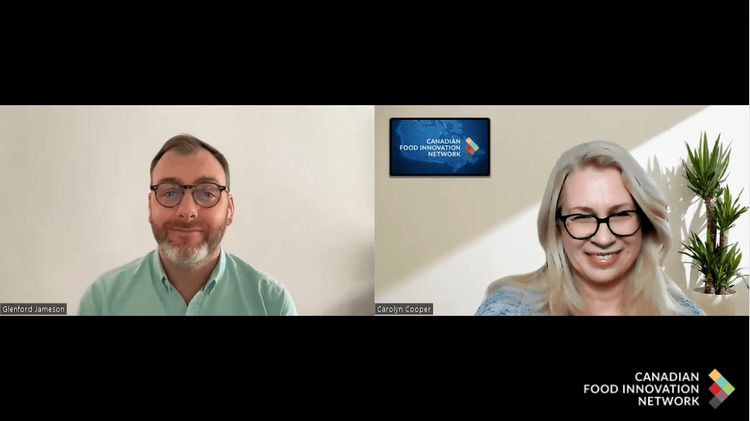
Carolyn Cooper and food lawyer Glenford Jameson of G.S. Jameson & Co. discuss some of the future regulations around cellular food in Canada, as well as what we can learn from international regulations and experience.
Community Manager-
Company Spotlight – App8 Incorporated
This is one in a series of interviews with CFIN member companies that have successfully applied for and received funding . App8’s innovative technology allows foodservice brands to delight customers with digital ordering experiences, while reducing operational bottlenecks and improving the bottom line . Ottawa-based App8 aims to revolutionize the foodservice industry through its mobile ordering solution. With App8 , the customers of foodservice brands can easily browse menus, place orders, and make payments using their own devices. The company is currently working with national foodservice brands such as Boston Pizza and Bowlero. App8 ’s innovative back end and integration logic enables seamless integration with various operational components like point of sales, notifications, reporting, robotics, and membership programs. The implementation of App8 will bring numerous benefits to both foodservice operators and customers. It will not only remove friction from the guest ordering experience but will also allow foodservice brands to increase the efficiency of their operations by streamlining processes, reduc ing errors, and eliminating redundancies. The company received $249,998 in funding for its supply chain automation enablement project. We spoke to CEO Elias Hage to learn more about the company and its plans. Q: What is your company’s mission? A: Our mission is to unlock the full potential of foodservice brands using technology. Q: W h y did you apply for this funding and how will you use it? A: We applied for this funding to automate the purchasing experience for consumers while streamlining foodservice operations that leverage AI and robotics technology. The investment will be used for research and development, team expansion and implementation to bring a scalable solution to market quickly and effectively. Q: What excites you most about working in this area of the food industry? A: The most exciting aspect of working in digital transformation and automation is unlocking new ways to delight guests, while solving major long-standing operational challenges faced by foodservice brands . Q: Why is collaboration so important for accelerating innovation in the food industry? Is it difficult to find good collaborating partners, and what would make the process easier? A: Collaboration is crucial for driving innovation in the food industry. By partnering with other best-in-class organizations , we can innovate beyond a single specialized area and collectively deliver integrated and streamlined operating environments powered by digital and automation technology. Q: Please comment on the importance of public funding to help companies clear innovation hurdles and access leveraged funds. A: Public funding has been a critical factor in allowing companies like ours to take calculated risks, innovate, connect with collaborators, and realize new opportunities. With access to public financing, we can invest in the development of new technologies and products, engage with experts and partners from diverse industries, and explore untapped markets. Furthermore, the support from public funding sources provides a safety net to pursue bold ideas. The result is a thriving foodservice industry that is driving innovation and creating new solutions for a sustainable future. Q: Looking ahead, what’s on the horizon for your company? A: App8 is innovating towards a fully connected end-to-end digital solution which puts digital guest experiences at the cent re of a robust and fully connected technology suite for foodservice brands. Q: What are your passions or hobbies outside of work? A: I’m a father, and an outdoors enthusiast. When time permits, I’m camping under the stars, diving into a lake, or snowboarding down a slope. Q: If you had to pick one person to make you a meal, who would you choose? A: My mom. She’s a great cook, and despite generations of Mediterranean recipes passed down to her, she’s constantly trying new things.
Community Manager-
50 Canadian FoodTech Resources - Canada's Smartest Kitchen
Canada has an extensive range of research centres, food incubators, accelerators and labs supporting food and beverage innovation through the research they do and/or the services they offer. Each week throughout 2023, we’ll be highlighting an organization that’s supporting food innovation in Canada. Name : Canada's Smartest Kitchen at Holland College. Location: Charlottetown, PEI Mission: To support food and beverage companies with customizable services that add value at any stage of a product’s path to market. Focus: Canada’s Smartest Kitchen is a food product development centre specializing in moving projects from concept to commercialization. It is also the research division of the Culinary Institute of Canada and an NSERC Technology Access Centre. Services: The centre offers food product development services, market insights, sensory and consumer studies of products, food styling, quality control and product analysis, and corporate chef services. The facilities offerings include a demonstration kitchen, smart boardroom, sensory lab, research and development kitchen, and photo studio. What you need to know: The centre’s proprietary “Smart” process for food development includes a strategic business review, market assessment, accelerated concept ideation, research and development, and technical scale up. Notable News: Chef Jennifer Bryant, a food product developer at Canada’s Smartest Kitchen, was named Chef of the Year in 2022 by the PEI Canadian Culinary Federation. Get Involved: Contact Tim McRoberts , director of Canada’s Smartest Kitchen, at CSK@hollandcollege.com , or 902-566-9674 , or reach out to our Regional Innovation Director for Atlantic Canada Tyson M acInnis .
Community Manager-
Let’s talk innovation: New labelling initiatives on the environmental impact of food
Welcome to Let’s Talk Innovation with Isabelle Marquis, a French-language video covering every area of food innovation. Today, Isabelle speaks with Antoine Mercier, Director of the French firm Protéines XTC, about Eco-score and Planet-score.
Community Manager-
The Tablesetter – March 20, 2023
Happy Monday CFIN members! Here’s your weekly heads up on what’s happening on YODL and around the food world this week. The YODL Menu Monday: The Tablesetter – March 20 , 2023 Tuesday: Parlons d ’ innovation: Nouvelles initiatives d’étiquetage sur l’impact environnemental des aliments Wednesday: 50 Canadian FoodTech Resources – Canada ’ s Smartest Kitchen Thursday: Company Spotlight – App8 Incorporated Friday: News File Something to Celebrate March 20 is World Flour Day! Established in 2019 by Germany’s FlourWorld Museum , World Flour Day celebrates the importance of flour in our diets and in feeding people worldwide. The theme of World Flour Day 2023 is the future of flour in terms processing, sustainability, research and new food development, technology, education, and careers. Food Facts Grocery Dive recently released its forecast for plant-based products, prepared for CII Foods. The new report , From Trend to Lifestyle, What’s Next for Plant-Based Foods in 2023? , reveals that North Americans are trying to eat more fruits and vegetables, as well as more plant-based meat alternatives. Here’s what else it found: Plant-based foods are a $7.4 billion market in the U.S. 36% of Gen Z limit the amount of meat they consume. 22% of consumers surveyed say they are flexitarians – they eat meat but focus on eating less of it – 3% say they are vegetarian, 2% say they are pescatarians, and 2% say they’re vegan. 44% of consumers say they don’t like the taste of plant-based foods, and 67% say they would be willing to eat more plant-based products if they tasted better. Happy YODLing!
Community Manager-
News File – March 17, 2023
Each Friday we’ll bring you a roundup of news from CFIN, YODL and around the food world. As seen on YODL Check out this week’s most viewed discussions: CFIN Members ABOUND on NPC's Canada's Game Changers List! Special Report - What's Ahead for Plant-based Foods in 2023 New Ventures BC and 30 Under 30 comp Around the Food World CFIN has a new CEO . Read more about Dana McCauley and her plans for CFIN as we enter year two of the organization. Plant-based cheese maker Daiya has announced a multi-million-dollar investment in fermentation technology that it says will help the company create a product that is “ tastier, meltier, and stretchier .” Kraft Peanut Butter has launched limited-edition Welcome Home Jars of peanut butter featuring labels in five of the most commonly spoken languages by newcomers to Canada , as well as other information for immigrants. Did you Kno w? The Hartman Group has published a new white paper called Fermenti n g the Future: The Growing Opportunity for Products Made with Precision Fermentation , in coordination with Perfect Day and Cargill. The paper covers the results of a survey by the Hartman Group measuring consumer attitudes towards food and technology, as well as interest in precision fermentation. Here’s what the report found: 77% of people familiar with precision fermentation say they’re likely to purchase products made with ingredients created through the process. The U.S. precision fermentation market is projected to grow to more than 132 million adults by 2027. Three in five Americans believe science and technology can make food more sustainable , and 56% say it can make food healthier. 52% of consumers say they would significantly change their lifestyle to be more environmentally friendly . 60% of Millennials and 55% of Gen Z say they look for f ood and beverage products from companies that prioritize sustainability and animal welfare . After learning about precision fermentation, 85% of Millennials and 84% of Gen Z say they would likely try products containing ingredients made with the process.
Community Manager-
Company Spotlight – Cyberworks Robotics
This is one in a series of interviews with CFIN member companies that have successfully applied for and received funding . Markham, ON-based Cyberw o rks Robotics provides autonomous self-driving technology for material handling forklifts and tow-tuggers as well as industrial floor scrubbers. This allows f ood and be verage producers and distributors to mitigate labour shortages, save labour costs, increase efficiency, redeploy labour to higher value-add roles , and increase plant safety. The company received $227,946 in funding to develop autonomous self-driving tow tugs for food distribution centre logistics. We spoke to Vivek Burhanpurkar, CEO of Cyberworks Robotics , to hear more about the company and its plans. Q: What is your company’s mission? A: Our mission is to reduce costs to the consumer. We enable this by reducing labour shortages and labour costs for f ood and b everage companies by providing self-driving solutions for common tasks like operation of forklifts and floor scrubbers. Q: Why did you apply for this funding and how will you use it? A: We want to work with early adopters within the f ood and b everage i ndustry to pilot test and optimize our technology for specific needs of the industry. Q: What excites you most about working in this area of the food industry? A: The food and b everage industry spends hundreds of millions annually on labour for mundane tasks that don’t add value to the bottom line and which ultimately contribute to food inflation. Our technology will help to increase efficiency and reduce the cost of essential foods to the consumer. Q: Why is collaboration so important for accelerating innovation in the food industry? Is it difficult to find good collaborating partners, and what would make the process easier? A: Collaboration is essential for us in order to optimize our technology for the nuances of the f ood and b everage industry. Q: Please comment on the importance of public funding to help companies clear innovation hurdles and access leveraged funds. A: Public funding is essential to companies like ours in order to bridge the gap between early adopters and new technologies to mitigate risks for both parties and accelerate the rollout of new technologies. Q: Looking ahead, what’s on the horizon for your company? A: We are deploying our technology to other applications , ranging from self-driving personal transport for people with disabilities to self-driving tractors , to continue to improve the deployment of labour and drive efficiency gains for Canadian companies. Q: What are your passions or hobbies outside of work? A: When I’m not working I enjoy hiking, travelling and catching up on the latest technology developments. Q: If you had to pick one person to make you a meal, who would you choose? A: Jacinda Ardern .
Community Manager-
50 Canadian FoodTech Resources – The Centre of Seafood Innovation at Vancouver Island University
Canada has an extensive range of research centres, food incubators, accelerators and labs supporting food and beverage innovation through the research they do and/or the services they offer. Each week throughout 2023, we’ll be highlighting an organization that’s supporting food innovation in Canada. Name: Centre of Seafood Innovation at Vancouver Island University (CSI) Location: Bowser, BC Mission: CSI is an innovation hub that helps c ompanies to extract more value from sustainable seafood harvests. Focus: The centre s upports entrepreneurs with business development, public education, and workforce attraction projects to foster ongoing innovation. It focuses on companies producing value - added seafood products, and products that complement seafood products such as sauces, dips or seasonings. Services: CSI helps seafood entrepreneurs access applied research, i nfrastructure, equipment , and services. It offers businesses support with project development, coaching, workshops, and event space rentals , and has a provincially inspected commercial-grade kitchen suitable for creating i nstitutional products, preparing seafood-based meals and snacks, developing bench-top products , and demonstrating new recipes and culinary techniques in-person or virtually . The 2,000-sq.-ft. kitchen features: Two high-end culinary ovens A c ommercial induction range Five sinks (2 x 2-bay washing stations) Coolers and freezers (reach-in) Dry storage A c ommercial dishwasher Stainless countertops Prep stations Audio-visual equipment for training purposes What you need to know: T o help support BC food entrepreneurs , CSI regularly partner s on projects with Vancouver Island University’s culinary arts department as well as other faculties. The centre is based in the school’s Deep Bay Marine Field Station , and is part of the BC Food Hub Network. Notable News: Each month CSI hosts a public lunch-and-learn series called Let’s Talk Seafood…and eat it too! designed to highlight the impacts of food - based public education on citizens’ perceptions of shellfish farming. Past projects include the Oyster Challenge, which showcased the use of oysters processed with High Pressure Processing (HPP) ; a partnership with Omega Pacific Hatcheries to help capture maximum value for its farmed sturgeon harvest ; and a project to assess Modified Atmosphere Packaging (MAP) as a treatment to keep Japanese scallops alive for transportation. Get Involved : Contact Debra Hellbach , manager of the Centre of Seafood Innovation at Debra.Hellbach@viu.ca , or reach out to our Regional Innovation Director Lavina Gully .