Inside SIAL Canada 2026: Driving Food Innovation Through Connection and Collaboration
CFIN had the honour of taking a bite out of SIAL Canada 2026 in Montréal 🍎—connecting with partners, members, and industry leaders shaping the future of food innovation across Canada and beyond. Representing CFIN on site were CEO @Dana McCauley and @Julie Daigle , Regional Innovation Director (Quebec), who engaged with the ecosystem throughout the event. Their presence reflected CFIN’s ongoing commitment to strengthening Canada’s food innovation ecosystem and supporting high-potential foodtech ventures. Attendees could also catch Julie as a Foodtech Focus expert at the SIAL Canada Expert Hub, where she connected directly with innovators and shared insights with the community. Dana also took the stage as part of the Dairy Talks program, contributing to a forward-looking discussion on innovation as a driver of market leadership in the Canadian dairy sector. Her session explored the shift from incremental product development toward a broader innovation mindset—highlighting next-generation ingredients, value-added dairy formats, new go-to-market strategies, and the role of Industry 4.0 technologies like AI, robotics, automation, and digital supply chains in strengthening productivity and global competitiveness. A key highlight of the week was CFIN’s involvement in the 7th edition of the Startup Pitch Competition, held on April 30 on the Food & Bev Connect stage. Julie Daigle participated as the President of the Foodtech jury, joining a panel of industry experts evaluating promising entrepreneurs from the Startup Village. Beyond the competition, the Startup Pitch stage served as a strategic platform connecting entrepreneurs with buyers, investors, and key decision-makers across the agri-food ecosystem. A standout moment for the CFIN community was the recognition of Maia Farms, a CFIN member and funding recipient, which earned the Gold Prize in the foodtec h competition 🍄🏆 CFIN’s presence at SIAL Canada underscored the momentum of Canada’s food innovation sector and the value of convening the ecosystem to accelerate ideas from concept to commercialization. 📖 Explore more from SIAL Canada 2026 R elive the stories, innovations, and key moments captured throughout the show in the official SIAL Canada Daily: SIAL Canada Daily – 2026 Edition (Photos Courtesy of SIAL)
Community Manager-
Five Years of CFIN: A Letter to the Network
Thirty years ago, I worked as a chef in the kitchen of one of Canada’s top restaurants standing should er to shoulder with people who ca red about the sensory experience of food above all else . Our tech stack was al most all analog and , to be honest, we didn’t give our ordering system or the way we did inventory a lot of thought. My career broadened over time , and I ’ ve also held roles where I developed recipes at Canadian Living and wrote about food trends; built innovation strategies and products for national brands, founded a business incubator, and ran a venture creation office at a prestigious Canadian u niversity . Food was always the thread , and technology was always present but in most of the food focused businesses I’ve worked for, it was taken for granted, and creativity and hard work were what drove the businesses forward. While smart people with great ideas are essential to food business success, it’s not enough to be competitive in today’s world. Old ways of running restaurants, innovation labs and food and beverage processi ng businesses can’t compete internationally or absorb the trade shocks that have become commonpla ce in recent history. That’s why I feel l ik e CFIN is the perfect place for me to be today and why we’re adding dozens of new members per week. When CFIN was created in 2021, the mandate was intentionally broad : cata lyze Canadian food innovation with funding , build community, connect an ecosystem that had been operating in silos for decades. The funding programs took shape quickly. Since 2022, we’ve awar ded $23.3 million to 133 projects across six program s. For every $1 CFIN invested, our members committed $7.65 of their own capital toward innovation. This leverage ratio of nearly 8-to-1 has unlocked over $140 m illion in private sector spending on R&D and capital infrastructure. The other work was harder to define . What do "build community" and "connect an ecosystem" mean in practice for a sector span ning startups, processors, researchers, investors, policymakers, and operators spread across this vast country ? Th at question didn't have a tidy answer. As a result , fostering and serving this network was (and remains ) an exercise in innovation itself : something new to be built , and then tested, adjusted, and iterated upon , ad infinitum . I’m immensely proud of what we’ve built so far . A team of Regional Innovation Directors who've supported more than 2,200 organizations, brokering the introductions that became commercial partnerships, strategic investments, leadership hires, and research collaborations. A digital platform , YODL, connecting Canada's food sector across industry silos and bridging interprovincial barriers . The first comprehensive analysis of Canadian foodtech . A network of 8,500 members from every province, every part of the food value chain, every stage of business . On any given week, our community is discussing topics ranging from precision fermentation bioreactor designs and funding stacks to food packaging labeling regulations and export strategies, all in the same space. Members benefit from purpose-built tools and resources — like our Funding Finder that aggregates food and beverage funding opportunities across the country and a growing library of original sector research and analysis — alongside direct access to our Regional Innovation Directors. Canada has strong regional funders, accelerators, trade associations, and tech transfer offices, each doing necessary work in a defined lane. What this sector didn't have was a place where the conversation s , the tools, and the connections all showed up at once — where the range of problems and the range of capabilities were dense enough that the right solutions could emerge . That's what CFIN has built. That foundation is important because the next five years will be even more dynamic, and often more challenging, than the last five . To keep pace and flourish in an increasingly volatile world, Canada's food sector needs to modernize faster and more strategic ally than ever before . Trade disruption is dramaticall y reshaping supply chains . L abour constraints are compounding a productivity gap that was widening long before tariffs became front-page news. Climate pressures are intensifying. Food 4.0 — a tech-enabled food s ector that's more collaborative, productive, resilient, and competitive — is the framework CFIN is building toward, and the case for it gets more urgent by the quarter. I ’m confident that we’re up to the task . Five years ago, Canada's food innovation ecosystem was fragmented, underleveraged, and often invisible to the investors, operators, policymakers, and media who needed to see it. That's no longer true. The capacity to respond to the challenges ahead is here. Not in any single program or policy, but in the breadth of this network — the founders , processors , researchers , and investo rs who are hungry to innovate and build a better Canadian food sector . My own wide-ranging path through the food sector taught me that no single role ever showed me the full picture. It took working across kitchens, labs, newsrooms, boardrooms, and startups to understand how innovation really moves through this industry — and where it get s stuck. CFIN was built on the same insight. A sector this complex, facing challenges this urgent, needs more than funding or advice or connections in isolation. It needs all of them in the same room. That's what we've spent five years building, and I'm betting the next five will prove its value at a scale none of us can yet imagine. Thank you for being part of it. Dana McCauley, CEO, Canadian Food Innovation Network
Community Manager-
How BC is Becoming a National Foodtech Hub
Editor's Note: This article was o riginally published in the Vancouver Tech Journal on March 13, 2026 The province has a diverse food processing industry, world-class research facilities, and a deep bench of tech talent — everything a foodtech ecosystem needs to thrive. Foodtech builds the software, automation, and applied science for how food gets processed, manufactured, packaged, distributed, and sold. The industry behind it is enormous — food and beverage processing alone is Canada's largest manufacturing sub-sector , bigger than automotive, bigger than aerospace. It's a serious market, and in British Columbia, it's growing fast. But if you work in the province's broader tech ecosystem, you might not even know that. Foodtech hasn't traditionally drawn the same attention as sectors like cleantech or enterprise SaaS despite being a comparable market in scale and complexity — and one where demand for new technology is accelerating fast. What BC brings to the table BC's food processing sector is substantial — over 3,200 companies producing roughly $12.6 billion in value-added products annually. And it's being treated as a strategic priority. The province has funded a network of shared food processing hubs, UBC just opened a Food and Beverage Innovation Centre with pilot-scale production labs that processors and startups previously had to leave BC to access, and SFU's BC Centre for Agritech Innovation is partnering directly with SMEs on cost-shared R&D. At the same time, much of what the food industry needs is already being built in BC for other thriving tech sectors. Process automation, energy management, supply chain software, safety and traceability systems, data-driven quality control — these are cleantech and software problems applied to production floors and distribution networks. The talent, research base, and trade infrastructure to support a serious foodtech cluster are all here. A different kind of tech sector Foodtech doesn't work like enterprise SaaS or consumer tech. Processors and manufacturers adopt slowly and carefully, because failure is expensive in ways that go beyond lost revenue — a food safety issue, a botched line integration, a regulatory problem. Sales cycles run in quarters. The investor community that understands food is small and specialized. And the industry's own networks run through trade associations, existing supply relationships, and sector-specific events that sit well outside the broader tech community's orbit. None of this means foodtech is closed off. It means that if you want in — as a founder, investor, developer, or potential partner — you need a way to access the conversations, the deal flow, and the operating knowledge that don't surface through the usual channels. The Canadian Food Innovation Network The Canadian Food Innovation Network is a national not-for-profit, established in 2021 that functions as the operating infrastructure for Canada's foodtech sector. CFIN runs cost-shared funding programs that help companies de-risk R&D and move technology into commercial settings. Since launch , the organization has awarded over $22 million to 122 Canadian foodtech projects, matched by $25 million in industry co-investment. Those funded companies have generated $90 million in economic impact, created over 355 jobs and co-op placements, and attracted more than $82 million in follow-on investment. The network's 8,000-plus members include food processors, technology companies, ingredient suppliers, retailers, researchers, and investors — connected through YODL, CFIN's member platform, and supported by Regional Innovation Directors embedded across the country, who work directly with members to broker introductions, navigate funding, and connect emerging technology with the processors and buyers who need it. CFIN also produces the sector's most detailed intelligence . The Foodtech in Canada 2025 Ecosystem Report mapped investment flows, identified sector strengths, and gave both companies and investors a clearer picture of where the Canadian foodtech market stands. And then there's Foodtech Frontier , CFIN's annual program identifying the country's highest-potential foodtech companies. The inaugural cohort of 35 winners included eight BC companies. For investors, it works as curated, vetted deal flow in a sector where sourcing is otherwise hard. For the companies, it's structured national visibility. Plug into Canada’s foodtech ecosystem If you work in technology or investment and you've been curious about the food sector, then signing up for a free CFIN membership is the best place to start. Members get access to funding programs, sector intelligence, a national innovation community, and regional team members that know the BC landscape specifically.
Community Manager-
Other Articles
50 Canadian FoodTech Resources – Cyber Science Lab
Welcome to YODL! In addition to daily original content, YODL helps CFIN Members find new partners , resources , and funding opportunities to grow their food business. Learn more about this growing community and become a CFIN Member (for free!) today . Name: Cyber Scien c e Lab in the School of Computer Science, University of Guelph Location: Guelph, ON Mission: The Cyber Science Lab (CSL) is an international not-for-profit research lab focused on advancing knowledge and practice in cybersecurity, digital forensics, threat hunting and threat intelligence. Focus: The lab is currently focused o n three research areas: security of distributed ledger technologi e s, security of critical infrastructure, and security of AI systems. Services: The lab offers cybersecurity tools for businesses, including an AI vulnerability management toolkit that allows professionals to identify known weaknesses in their AI systems; a DeepFake Forensics tool allowing forensics examiners to identify DeepFake content s ; and a Chrome Plug-in for DeepFake Detection that allows users to distinguish DeepFake contents on most web pages and social media platforms. CSL has also developed several datasets that are publicly available and which can help companies identify security risks. They include: OS x Malware Dataset, Internet of Things Malware Dataset, Advanced Persistent Threat Malware Dataset, and Cryptocurrency Malware Dataset. What you Need to Know: CSL is inviting security professionals to submit a chapter to its upcoming book “Big Data and Cyber Threat Intelligence” for publication in fall 2024. Submissions must be made by January 15, 2024. Click here for more information on how to submit . Notable News: CSL has published 267 papers, completed 15 projects and received more than $1.7 million in funding. The University of Guelph also offers a master of cybersecurity and threat intelligence. Get Involved: Contact Ali Dehghantanha , CSL director, at ali@cybersciencelab.com or at (519) 824-4120 , ext. 52999 , or reach out to CFIN’s Regional Innovation Director for Ontario Linda Fox .
Community Manager-
Ransomware 101
Welcome to YODL! In addition to daily original content, YODL helps CFIN Members find new partners , resources , and funding opportunities to grow their food business. Learn more about this growing community and become a CFIN Member (for free!) today . CFIN and cybersecurity firm Beauceron have partnered to deliver a three-part webinar series on cybersecurity threats in the food and beverage industry. These webinars, made exclusively for CFIN members, dive into how cybercriminals target food and beverage companies and foodtech businesses, and offer actionable steps to protect your business from unwanted threats. In part two of the series Dana McCauley , CEO of CFIN, talked with David Shipley, CEO and co-founder of Beauceron Security, and Daniel Couillard, director general of Partnerships and Risk Mitigation, Canadian Centre for Cyber Security, about how ransomware works, and how companies can protect themselves from bad actors. Following the video are the top four takeaways.
Community Manager-
IN 30: Ransomware
Welcome to YODL! In addition to daily original content, YODL helps CFIN Members find new partners , resources , and funding opportunities to grow their food business. Learn more about this growing community and become a CFIN Member (for free!) today . Sometimes, all it takes is 30 minutes to learn the ins and outs of new food technologies and trends that are transforming the food and beverage industry. In this series, we’ll dig into a food innovation topic and link you to content and resources so you can become a master on the topic in 30 minutes (or less!). This week, we’re looking at ransomware, a type of malware (malicious software) that locks a computer or network system and all of its data until a ransom is paid to unlock it. The Overview IBM – What is Ransomware? IBM documents the types of ransomware and how it infects a system or device. PCMag – The Best Ransomware Protection for 2023 Ransomware protection can stop attacks from destroying information. PCMag highlights some of the best antivirus protection available. Statista – Annual Number of Ransomware Attempts Worldwide from 2017 to 2022 According to Statista, there were 493.33 million ransomware attempts detected worldwide in 2022. The Canadian Connection Canadian Centre for Cyber Security – The centre says ransomware is the most common cyber threat facing Canadians. CBC – It's Time for Companies to Double Down on Cybersecurity Measures as Ransomware Attacks Rise Experts report an increase in ransomware attacks and other cyber incidents across Canada. Financial Post - Safety Net: Increasingly Sophisticated Ransomware Attacks Leave Companies, Lawyers Scrambling to Keep Up The legal environment of responding to ransomware is new, uncertain and evolving. Media Covering Cybersecurity Cybercrime Magazine – Cybercrime Magazine site is operated by Cybersecurity Ventures, a researcher on the global cyber economy and a source of statistics and facts on cybersecurity. The Hacker News – Th e Hacker News platform reports on the latest cybercrime events. Infosecurity Magazine – The online magazine offers information on computer and online security and other topics around cyber safety . Security Magazine – Th is site offers news and information on physical and online security, including training strategies. Overtime If you’ve got more than 30 minutes, these are for you: YouTube - Ransomware Attacks Threaten Canada's National Security Ransomware attacks now constitute the most disruptive form of cyberattack facing Canada.
Community Manager-
Cybersecurity in the Food Sector
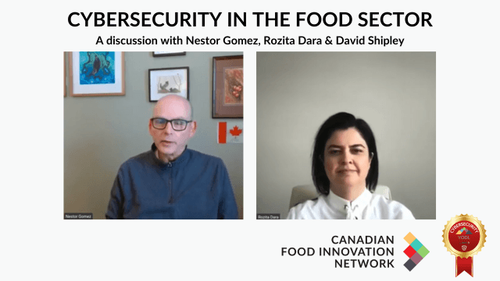
Welcome to YODL! In addition to daily original content, YODL helps CFIN Members find new partners , resources , and funding opportunities to grow their food business. Learn more about this growing community and become a CFIN Member (for free!) today . . CFIN and cybersecurity firm Beauceron have partnered to deliver a three-part webinar series on cybersecurity threats in the food and beverage industry . These webinars, made ex clusively for CFIN m embers, dive into how cybercriminals target food and beverage companies and foodtech businesses , and offer actionable steps to protect your business from unwanted threats. In Part 1 of the series Nestor Gomez , C hief T echnology O fficer for CFIN, sat down with Rozita Dara, principal investigator of data management and privacy governance research program at the University of Guelph, and David Shipley, CEO and co-founder of Beauceron Security , for an overview of cybersecurity in the food sector . They also highlight recent cyberattacks against food businesses , the b iggest risks companies now face, and steps companies can take to defend against cybercriminals. Following the video are the top three takeaways.
Community Manager-
Explained: Malware
Welcome to YODL! In addition to daily original content, YODL helps CFIN Members find new partners , resources , and funding opportunities to grow their food business. Learn more about this growing community and become a CFIN Member (for free!) today . What Is It? Malware, also known as malicious software or malicious applications, is software designed by cybercriminals to damage computer programs or systems, or to gain unauthorized access to a computer system and/or data. Malware can be in the form of viruses, worms, Trojans, spyware, keyloggers, adware and ransomware which can attack computers, smartphones, tablets and networks. As well as disrupting computer systems , malware can be used to lock up networks and/or computer systems, destroy them, wipe out information, send spam emails, or access data and intellectual property than can then be sold. Why You Should Care According to DataProt , 560,000 new pieces of malware are detected every day, for a total of more than one billion malware programs existing worldwide. Trojans, which appear to be a harmless file or program but which can damage, steal or control computers, make up 58% of all computer malware, followed by viruses (13%), and scripts (9%), a type of virus that leverage’s a computer system’s existing applications. Downloaded malicious apps can attack smartphones, and are the most common form of mobile malware, while adware, which can be activated by clicking on unwanted advertisements, accounts for 48% of malware on smartphones. Destructive malware cyberattacks have increased rapidly worldwide in the past five years, with the number of detected variations rising 62% in 2020 . Meanwhile, Internet of Things (IoT) attacks by malware topped 2 0 million , and mobile attacks were more than 28 million in the first half of 2020. Routers are a common target for hackers using IoT malware, as are emails, with 46% of hackers using email to spread malware through attached Word and Excel files. What’s Happening in Canada? The Canadian Centre for Cyber Security lists the signs that a device has been infected with malware, as well as suggesting ways Canadian businesses can protect themselves from malware. That includes: Backing up devices and information Installing software updates and patches regularly Using anti-virus and anti-malware software Using a firewall to protect local systems from outside access Using a host intrusion detection system (HIDS) to identify unauthorized access Ensur ing files and attachments are real before downloading Avoid ing public Wi-Fi Using a protective domain name system (DNS) to block unwanted content Using an ad blocker and n ot accepting pop-up advertisements Not downloading unreliable software or media
Community Manager-
50 Canadian FoodTech Resources – Canadian Centre for Cyber Security
Welcome to YODL! In addition to daily original content, YODL helps CFIN Members find new partners , resources , and funding opportunities to grow their food business. Learn more about this growing community and become a CFIN Member (for free!) today . Canada has an extensive range of research centres, food incubators, accelerators and labs supporting food and beverage innovation through the research they do and/or the services they offer. Each week throughout 2023, we’ll be highlighting an organization that’s supporting food innovation in Canada. Name: Canadian Centre for Cyber Security (CCCS) Location: Ottawa, ON Mission: The Canadian Centre for Cyber Security is Canada’s technical authority on cyber security. It opened in 2018 as part of Canada’s National Cyber Security Strategy . Focus: The CCCS offers guidance, information and services around cybersecurity for individuals, Canadian businesses, organizations , institutions and schools. Services: As well as defending federal government networks, t he centre leads the Get Cyber Safe public education program. It provides general information about cybercrime , as well as alerts and advisories, news, events, and education. It offers free cyber defence tools such Assemblyline , a malware detection and analysis tool, the CyberSecurity Audit Program to assess an organization’s cyber security status, and the Harmonized Threat and Risk Assessment Methodology , which is designed to address assets, employees, and services at risk in a business. It also offers a glossary of terms you should know when it comes to cybersecurity . What you Need to Know: The centre is part of the Communications Security Establishment (CSE), Canada’s national cryptologic agency. Among its other mandates, the CSE has responsibility for cyber security and information assurance. Notable News: The centre collaborates and builds partnerships with businesses in critical infrastructure sectors, which includes the food industry. Get Involved: Contact the Canadian Centre for Cyber Security at 1-833-CYBER-88 or at contact@cyber.gc.ca , or for more information on cybersecurity, reach out to CFIN’s Chief Technology Officer, Nestor Gomez .
Community Manager-
IN 30: Cybersecurity 101
Welcome to YODL! In addition to daily original content, YODL helps CFIN Members find new partners , resources , and funding opportunities to grow their food business. Learn more about this growing community and become a CFIN Member (for free!) today . Sometimes, all it takes is 30 minutes to learn the ins and outs of new food technologies and trends that are transforming the food and beverage industry. In this series, we’ll dig into a food innovation topic and link you to content and resources so you can become a master on the topic in 30 minutes (or less!). This week, we’re looking at cybercrime and cybersecurity , and how they affect Canada's food and beverage industry. The Overview AAG - The Latest 2023 Cyber Crime Statistics Statistics on how cybercrime is impacting businesses and individuals worldwide. Marlin Communications – The 2023 Cyber Threat Landscape: 5 Key Trends Around the world, criminals are turning to “quieter” cyber attacks , including cryptojacking and IoT malware. Sophos – 2023 Threat Report According to this report, criminal malware “as-a-service” schemes are interrupting the global economy. The Canadian Connection Agriculture and Agri-Food Canada - Cyber Security and Your Farming Business AAFC reminds producers that they can also be targeted by cybercriminals, and need to ensure their businesses are secure. Canadian Centre for Cyber Security - The centre is part of the Communications Security Establishment, offering advice and services for Canadian businesses, individuals, organizations and institutions on cybersecurity. CIRA.ca – The Canadian Internet Registration Authority offers cybersecurity awareness training, insights, threats, and implementation plans. Government of Canada - Get Cyber Safe Guide for Small and Medium Businesses The federal government provides a comprehensive overview of steps businesses can take to minimize the threat of cybercrime. Social Media Beauceron Security (LinkedIn) – Fredericton, NB-based Beauceron Security helps organizations address the risk of cybercrime. Canadian Cyber Security Network (Instagram) CCSN is a group of dedicated cybersecurity professionals, focused on growing cybersecurity in Canada. Cybersecurity and Infrastructure Security Agency (Facebook) – The U.S. CISA offers research, advice, events and more on how to avoid cybercrime. Overtime If you’ve got more than 30 minutes, these are for you: YouTube – Cyberattacks on Food Businesses Any software or online sales or management systems used by food companies may be at risk of being targeted by cybercriminals.
Community Manager-
Why CFIN is Creating Cybersecurity Content on YODL
Welcome to YODL! In addition to daily original content, YODL helps CFIN Members find new partners , resources , and funding opportunities to grow their food business. Learn more about this growing community and become a CFIN Member (for free!) today . By Nestor Gomez Today CFIN is kicking off two weeks of content on cybersecurity, corresponding with the international Cyber Security Awareness Month in Canada and the U.S. This October, technology experts and the federal government are reminding Canadians that education around cybersecurity is essential, as well as an understanding of schemes such as phishing, online scams through fake stores or transactions, fake cryptocurrency trades, data breaches, ransomware and malware attacks, and phone scams . The theme for 2023, through the federal government’s Get Cyber Safe public awareness campaign , is “Step Up your Cyber Fitness,” which is designed to encourage Canadians to stretch their cyber security muscles one step at a time. The government offers a wide range of digital resources and tools designed to protect Canadians and their businesses online , including practical implementation plans. According to Made In CA , based on information from Statistics Canada, Statista, the federal government and other sources, 85.7% of Canadian companies were hit by successful cyberattacks in 2021, a 7.7 % increase over 2020, and over half of Canadians have experienced cybercrime at least once. Ransomware attacks affected 72% of Canadian companies in 2020, with an average cost to companies of $1.9 million. By comparison, data breaches in 2021 cost Canadian companies an average of $5.4 mil lion, and online fra ud cost Canadians roughly $100 million . As an industry where large amounts of data and technology are interconnected, f ood and beverage companies and grocery retailers have been vulnerable to cyber security threats and attacks . Maple Leaf Foods , Empire Co. , JBS and Dole have all been victims of large cyber-attacks within the past two years. These attacks can i mpact every aspect of the company, including finances, reputation, customer data, supply chain, products and distribution system . U nfortunately, many companies have not invested in education, awareness, protocols and solutions to protect themselves . As cybersecurity threats continue to rise, we want to ensure that CFIN members understand the risks involved and how to protect their businesses. Over the next two weeks we’ll take a closer look at some of these challenges, as well as the technology, education and best practices companies can implement to avoid being vulnerable to cyber-attacks , protect the ir data and digital assets, and minimize the consequences when attacks do happen. Nestor Gomez is Chief Technology Officer for CFIN.
Community Manager-
The Foodtech Canadian Tech Accelerator Program – Interviews with the Trade Commissioners (French and English)
Welcome to YODL! In addition to daily original content, YODL helps CFIN Members find new partners , resources , and funding opportunities to grow their food business. Learn more about this growing community and become a CFIN Member (for free!) today . CFIN is partnering with Global Affairs Canada and Natural Products Canada to attract companies to participate in the Foodtech Canadian Tech Accelerator Program . This program provides a unique opportunity for CFIN members to secure investment, make new connections, and grow their food business. CFIN interviewed the two Trade Commissioners involved with the program to learn more about what CFIN members can expect. Carolyn Cooper speaks with Christina Connelly, Trade Commissioner with the Consulate General of Canada in Minneapolis, while Isabelle Marquis speaks with Elodie Masson Vidal, Trade Commissioner with the Consulate General of Canada in San Francisco . They discuss eligibility requirements and selection criteria for the program, support for participants, and next steps for interested companies. Additional information about the program follows the videos.
Community Manager-
AI + Food – xpertSea
Welcome to YODL! In addition to daily original content, YODL helps CFIN Members find new partners , resources , and funding opportunities to grow their food business. Learn more about this growing community and become a CFIN Member (for free!) today . This series showcases Canadian food and beverage businesses and foodtech companies that are using AI to solve a wide variety of industry challenges, including improving efficiency, pricing analysis, inventory management, quality control, food safety assurance and more. In this installment, we’re looking at Quebec City, QC-based xpertSea. What They Do xpertSea uses data and technology to bring trust, transparency and productivity to aquaculture, and incentivize sustainable production. The company builds tech and financial solutions that transform how seafood is farmed and traded , with a mission to build a better, fairer and more sustainable aquaculture industry by using reliable data to bring transparency and insights from farm to fork. The company has customers in more than 50 countries. How They’re Using AI xpertSea leverage s AI technology to help aquaculture farmers modernize their operations and boost profits by providing access to fast payments, valuable production insights and a data-driven marketplace of vetted sellers and buyers. Other technology used by the company includes v ision s ystems, o ptics, i nventory m anagement, SaaS, Internet of Things, a g t ech , c omputer vision, c loud computing, m achine learning and b ig data . In The Media Global Seafood Alliance - Seafood traceability partnership tackles mangrove restoration and better shrimp farming practices in Ecuador Conservation International and xpertSea announce a Climate Smart Shrimp pilot in Ecuador – an innovative solution to champion regenerative farming practices. AquaCultura Magazine - xpertSea featured on cover of AquaCultura magazine The article looks at the ways xpertSea is changing the shrimp industry in Ecuador through continuous improvement in production practices based on AI. T hefishsite.com - New tool facilitates sourcing sustainably farmed shrimp xpertSea launches a new data-driven solution designed to make sourcing sustainable shrimp easy for international buyers.
Community Manager-
50 Canadian FoodTech Resources – Good to Grow
Welcome to YODL! In addition to daily original content, YODL helps CFIN Members find new partners , resources , and funding opportunities to grow their food business. Learn more about this growing community and become a CFIN Member (for free!) today . Canada has an extensive range of research centres, food incubators, accelerators and labs supporting food and beverage innovation through the research they do and/or the services they offer. Each week throughout 2023, we’ll be highlighting an organization that’s supporting food innovation in Canada. Name: Good to Grow Location: North Vancouver, BC Mission: Good to Grow is a team of food industry experts and business educators who create success for food and beverage brands. Focus: The company has supported hundreds of food and beverage brands in realizing business success through workshops, cohorts, one-on-one coaching, and signature events . Services: Good to Grow offers one-on-one business coaching for growth and business development at all steps of the client’s business. It offers one-day workshops that cover topics such as business and financial planning, market access, product development, distribution, and trade, consumer and digital marketing. The Sprout Series , a seven-part workshop series, prepares new and emerging brands to diversify their market channels and sell into grocery retail, foodservice, and institutional foodservice. The Hatch Your Farm & Food Business workshop is a six-part workshop starting on November 4, 2023 in collaboration with BC Association of Farmers’ Markets, with support from the Island Coastal Economic Trust . The company also offers commercial kitchen space for food and beverage businesses to create and store products. Good to Grow also offers product development and production services including nutritional labelling, ingredient sourcing, product improvement, sensory analysis, scale up support, co-packing support, setting uniform standards for production , food safety and quality support, development of a HACCP plan, and support with regulatory compliance and certifications. What you Need to Know: Good to Grow is involved with several larger events, including the From The Ground Up Trade Show , featuring BC food and beverage brands; the From The Ground Up Conference , featuring a day of interactive panel discussions on expanding a growing food and beverage business; and Pitch & Plate, a Feed BC initiative, delivered by the Ministry of Agriculture and Food in collaboration with B.C. food industry educators, Good to Grow and Feed BC public sector institutions. It is a platform for BC institutional foodservice organizations to learn about and connect with local food and beverage producers and processors. The next Pitch & Plate events take place online on November 23, 2023, with a deadline to apply by October 9, 2023 , and in-person and online on February 7, 2024, with a deadline to apply by November 3, 2023. Notable News: Good to Grow offers The Alison Emily Resilience Award supporting businesses owned by women, LGBTQ2+ and persons with disabilities. Get Involved: Contact Good to Grow at ( 604 ) 454-8806 or info@goodtogrowproducts.com or reach out to our Regional Innovation Director for BC, Lavina Gully .
Community Manager-
An Interview with a Product Manager
Welcome to YODL! In addition to daily original content, YODL helps CFIN Members find new partners , resources , and funding opportunities to grow their food business. Learn more about this growing community and become a CFIN Member (for free!) today . Lavina Gully , Regional Innovation Director for BC and Yukon, sits down with Jeff Epstein of North Vancouver, BC’s 16 Volts and Grants for Growth , to discuss the role of a product manager, the importance of product management, and the significant advantages it offers food and beverage companies . Following the video is a Q&A between Lavina and Jeff with details from their discussion, as well as more information on product management.