Inside SIAL Canada 2026: Driving Food Innovation Through Connection and Collaboration
CFIN had the honour of taking a bite out of SIAL Canada 2026 in Montréal 🍎—connecting with partners, members, and industry leaders shaping the future of food innovation across Canada and beyond. Representing CFIN on site were CEO @Dana McCauley and @Julie Daigle , Regional Innovation Director (Quebec), who engaged with the ecosystem throughout the event. Their presence reflected CFIN’s ongoing commitment to strengthening Canada’s food innovation ecosystem and supporting high-potential foodtech ventures. Attendees could also catch Julie as a Foodtech Focus expert at the SIAL Canada Expert Hub, where she connected directly with innovators and shared insights with the community. Dana also took the stage as part of the Dairy Talks program, contributing to a forward-looking discussion on innovation as a driver of market leadership in the Canadian dairy sector. Her session explored the shift from incremental product development toward a broader innovation mindset—highlighting next-generation ingredients, value-added dairy formats, new go-to-market strategies, and the role of Industry 4.0 technologies like AI, robotics, automation, and digital supply chains in strengthening productivity and global competitiveness. A key highlight of the week was CFIN’s involvement in the 7th edition of the Startup Pitch Competition, held on April 30 on the Food & Bev Connect stage. Julie Daigle participated as the President of the Foodtech jury, joining a panel of industry experts evaluating promising entrepreneurs from the Startup Village. Beyond the competition, the Startup Pitch stage served as a strategic platform connecting entrepreneurs with buyers, investors, and key decision-makers across the agri-food ecosystem. A standout moment for the CFIN community was the recognition of Maia Farms, a CFIN member and funding recipient, which earned the Gold Prize in the foodtec h competition 🍄🏆 CFIN’s presence at SIAL Canada underscored the momentum of Canada’s food innovation sector and the value of convening the ecosystem to accelerate ideas from concept to commercialization. 📖 Explore more from SIAL Canada 2026 R elive the stories, innovations, and key moments captured throughout the show in the official SIAL Canada Daily: SIAL Canada Daily – 2026 Edition (Photos Courtesy of SIAL)
Community Manager-
Five Years of CFIN: A Letter to the Network
Thirty years ago, I worked as a chef in the kitchen of one of Canada’s top restaurants standing should er to shoulder with people who ca red about the sensory experience of food above all else . Our tech stack was al most all analog and , to be honest, we didn’t give our ordering system or the way we did inventory a lot of thought. My career broadened over time , and I ’ ve also held roles where I developed recipes at Canadian Living and wrote about food trends; built innovation strategies and products for national brands, founded a business incubator, and ran a venture creation office at a prestigious Canadian u niversity . Food was always the thread , and technology was always present but in most of the food focused businesses I’ve worked for, it was taken for granted, and creativity and hard work were what drove the businesses forward. While smart people with great ideas are essential to food business success, it’s not enough to be competitive in today’s world. Old ways of running restaurants, innovation labs and food and beverage processi ng businesses can’t compete internationally or absorb the trade shocks that have become commonpla ce in recent history. That’s why I feel l ik e CFIN is the perfect place for me to be today and why we’re adding dozens of new members per week. When CFIN was created in 2021, the mandate was intentionally broad : cata lyze Canadian food innovation with funding , build community, connect an ecosystem that had been operating in silos for decades. The funding programs took shape quickly. Since 2022, we’ve awar ded $23.3 million to 133 projects across six program s. For every $1 CFIN invested, our members committed $7.65 of their own capital toward innovation. This leverage ratio of nearly 8-to-1 has unlocked over $140 m illion in private sector spending on R&D and capital infrastructure. The other work was harder to define . What do "build community" and "connect an ecosystem" mean in practice for a sector span ning startups, processors, researchers, investors, policymakers, and operators spread across this vast country ? Th at question didn't have a tidy answer. As a result , fostering and serving this network was (and remains ) an exercise in innovation itself : something new to be built , and then tested, adjusted, and iterated upon , ad infinitum . I’m immensely proud of what we’ve built so far . A team of Regional Innovation Directors who've supported more than 2,200 organizations, brokering the introductions that became commercial partnerships, strategic investments, leadership hires, and research collaborations. A digital platform , YODL, connecting Canada's food sector across industry silos and bridging interprovincial barriers . The first comprehensive analysis of Canadian foodtech . A network of 8,500 members from every province, every part of the food value chain, every stage of business . On any given week, our community is discussing topics ranging from precision fermentation bioreactor designs and funding stacks to food packaging labeling regulations and export strategies, all in the same space. Members benefit from purpose-built tools and resources — like our Funding Finder that aggregates food and beverage funding opportunities across the country and a growing library of original sector research and analysis — alongside direct access to our Regional Innovation Directors. Canada has strong regional funders, accelerators, trade associations, and tech transfer offices, each doing necessary work in a defined lane. What this sector didn't have was a place where the conversation s , the tools, and the connections all showed up at once — where the range of problems and the range of capabilities were dense enough that the right solutions could emerge . That's what CFIN has built. That foundation is important because the next five years will be even more dynamic, and often more challenging, than the last five . To keep pace and flourish in an increasingly volatile world, Canada's food sector needs to modernize faster and more strategic ally than ever before . Trade disruption is dramaticall y reshaping supply chains . L abour constraints are compounding a productivity gap that was widening long before tariffs became front-page news. Climate pressures are intensifying. Food 4.0 — a tech-enabled food s ector that's more collaborative, productive, resilient, and competitive — is the framework CFIN is building toward, and the case for it gets more urgent by the quarter. I ’m confident that we’re up to the task . Five years ago, Canada's food innovation ecosystem was fragmented, underleveraged, and often invisible to the investors, operators, policymakers, and media who needed to see it. That's no longer true. The capacity to respond to the challenges ahead is here. Not in any single program or policy, but in the breadth of this network — the founders , processors , researchers , and investo rs who are hungry to innovate and build a better Canadian food sector . My own wide-ranging path through the food sector taught me that no single role ever showed me the full picture. It took working across kitchens, labs, newsrooms, boardrooms, and startups to understand how innovation really moves through this industry — and where it get s stuck. CFIN was built on the same insight. A sector this complex, facing challenges this urgent, needs more than funding or advice or connections in isolation. It needs all of them in the same room. That's what we've spent five years building, and I'm betting the next five will prove its value at a scale none of us can yet imagine. Thank you for being part of it. Dana McCauley, CEO, Canadian Food Innovation Network
Community Manager-
How BC is Becoming a National Foodtech Hub
Editor's Note: This article was o riginally published in the Vancouver Tech Journal on March 13, 2026 The province has a diverse food processing industry, world-class research facilities, and a deep bench of tech talent — everything a foodtech ecosystem needs to thrive. Foodtech builds the software, automation, and applied science for how food gets processed, manufactured, packaged, distributed, and sold. The industry behind it is enormous — food and beverage processing alone is Canada's largest manufacturing sub-sector , bigger than automotive, bigger than aerospace. It's a serious market, and in British Columbia, it's growing fast. But if you work in the province's broader tech ecosystem, you might not even know that. Foodtech hasn't traditionally drawn the same attention as sectors like cleantech or enterprise SaaS despite being a comparable market in scale and complexity — and one where demand for new technology is accelerating fast. What BC brings to the table BC's food processing sector is substantial — over 3,200 companies producing roughly $12.6 billion in value-added products annually. And it's being treated as a strategic priority. The province has funded a network of shared food processing hubs, UBC just opened a Food and Beverage Innovation Centre with pilot-scale production labs that processors and startups previously had to leave BC to access, and SFU's BC Centre for Agritech Innovation is partnering directly with SMEs on cost-shared R&D. At the same time, much of what the food industry needs is already being built in BC for other thriving tech sectors. Process automation, energy management, supply chain software, safety and traceability systems, data-driven quality control — these are cleantech and software problems applied to production floors and distribution networks. The talent, research base, and trade infrastructure to support a serious foodtech cluster are all here. A different kind of tech sector Foodtech doesn't work like enterprise SaaS or consumer tech. Processors and manufacturers adopt slowly and carefully, because failure is expensive in ways that go beyond lost revenue — a food safety issue, a botched line integration, a regulatory problem. Sales cycles run in quarters. The investor community that understands food is small and specialized. And the industry's own networks run through trade associations, existing supply relationships, and sector-specific events that sit well outside the broader tech community's orbit. None of this means foodtech is closed off. It means that if you want in — as a founder, investor, developer, or potential partner — you need a way to access the conversations, the deal flow, and the operating knowledge that don't surface through the usual channels. The Canadian Food Innovation Network The Canadian Food Innovation Network is a national not-for-profit, established in 2021 that functions as the operating infrastructure for Canada's foodtech sector. CFIN runs cost-shared funding programs that help companies de-risk R&D and move technology into commercial settings. Since launch , the organization has awarded over $22 million to 122 Canadian foodtech projects, matched by $25 million in industry co-investment. Those funded companies have generated $90 million in economic impact, created over 355 jobs and co-op placements, and attracted more than $82 million in follow-on investment. The network's 8,000-plus members include food processors, technology companies, ingredient suppliers, retailers, researchers, and investors — connected through YODL, CFIN's member platform, and supported by Regional Innovation Directors embedded across the country, who work directly with members to broker introductions, navigate funding, and connect emerging technology with the processors and buyers who need it. CFIN also produces the sector's most detailed intelligence . The Foodtech in Canada 2025 Ecosystem Report mapped investment flows, identified sector strengths, and gave both companies and investors a clearer picture of where the Canadian foodtech market stands. And then there's Foodtech Frontier , CFIN's annual program identifying the country's highest-potential foodtech companies. The inaugural cohort of 35 winners included eight BC companies. For investors, it works as curated, vetted deal flow in a sector where sourcing is otherwise hard. For the companies, it's structured national visibility. Plug into Canada’s foodtech ecosystem If you work in technology or investment and you've been curious about the food sector, then signing up for a free CFIN membership is the best place to start. Members get access to funding programs, sector intelligence, a national innovation community, and regional team members that know the BC landscape specifically.
Community Manager-
Other Articles
Why Canadian Foodtech Startups Are Attracting More Government Grants Than VC Funding
With C$4.1 billion invested in Canadian foodtech between 2014 and 2024, the sector has experienced impressive growth . And while Canada’s early-stage public funding landscape is robust, private venture capita l remains cautious . This is leaving a noticeable gap in later-stage financing , and many of Canada’s 200+ foodtech startups struggle to secure growth capital needed to establish long-term financial sustainability. So why is private investment lagging behind ? First, although recent growth in the Canadian foodtech ecosystem is extremely promising , it remains in a relatively early stage of developmen t, where market traction and scalable business models are just emerging . Private investors typically look for clear, proven pathways to commercial success before committing large sums , especially in capital-intensive industries like food manufacturing . In Canada, early rounds tend to be about half the size of those in comparable markets like the U.S. and the U.K. , before dropping even further in Series C rounds and beyond . This discrepancy isn’t due to any fault in the startups; rather, it reflects a private investment culture that is, for now, cautiously waiting for more demonstrable results before scaling up . Another reason for the gap is the inherent risk tolerance differences. Public funding, provided via grants and government programs, is designed to nurture innovation at the seed stage. These funds are available precisely because the public sector accepts a higher risk in exchange for long-term strategic benefits, such as sustainable food solutions and regional economic development. Conversely , private venture capital typically seeks rapid growth and quick returns. In an emerging ecosystem like Canada’s foodtech space, where scaling up technology and operations takes time, many private investors prefer to hold back until the path to profitability becomes clearer. F i nally , Canada’s regulatory and market environment ha s a role to play in the foodtech investment gap . W hile government support has laid a solid foundation, private investors remain influenced by factors such as uncertainty stemming from stringent regulatory frameworks , and the effect that has in getting innovative products to market on a time horizon that aligns with investor expectations. Canada’s foodtech funding gap isn’ t necessarily a sign of weakness; it’ s simply a reflection of an evolving ecosystem where public investment has been the catalyst for early innovation. However, bridging this gap must be considered a top priority to fuel the growth of Canada’s food sector— and it require s policymakers and industry leaders to take decisive action. This could take the form of targeted co-investment programs, where the government partners with private investors to share the financial risk of later-stage funding rounds. These programs help attract venture capital by offering matching funds, loan guarantees, or tax incentives, making private investment in foodtech startups more appealing. Successful foodtech -specific models exist globally. Europe’s EIT Food is a prime example, operating as a public-private partnership that co-invests in high-potential agrifood startups, providing not just funding but also mentorship and commercialization support to help them scale. Similarly, Singapore’s SEEDS Capital , a government-backed investment arm, has successfully attracted venture capital to its agrifood sector by offering co-matching investments, effectively reducing risk for private investors. Adapting similar strategies in Canada—whether through direct co-investment, tax credits, or government-backed loan guarantees—could catalyze private capital flow into foodtech , ensuring promising startups have the funding needed to scale, compete globally, and drive food innovation forward. Encouraging innovation through t he development of regulatory sandboxes and providing clearer commercialization pathways for novel food technologies will also be essential to garnering investor confidence . Prioritizing these efforts nationally will be critical to not just the growth and global competitiveness of Canad a’s foodtech sector , but to s ecure a resilient and sustainable food system in this new era of geopolitical upheaval. Canada’s foodtech sector is primed for growth, but unlocking private capital remains a challenge. The Foodtech in Canada 2025 Ecosystem Report dives deep into the factors at play in todays’ investment landscape and what can be done accelerate Canada’s foodtech revolution. Check out the full report here !
Community Manager-
In 30: Ghost Kitchens
Sometimes, all it takes is 30 minutes to learn the ins and outs of new food technologies and trends that are transforming the food and beverage industry. In this series, we’ll dig into a food innovation topic and link you to content and resources so you can become a master on the topic in 30 minutes (or less!). This week, we’re looking at ghost kitchens, a commercial foodservice operation without a traditional storefront or restaurant. Also known as virtual restaurants or dark kitchens, in many of these establishments food is ordered online and prepared for delivery only, via cashless transactions The Overview Canadian Institute of Food Safety - What is A Ghost Kitchen? Learn the key differences between a ghost kitchen and a traditional foodservice operation. Kickfin - What Are Ghost Kitchens: Everything You Need to Know More about the pros and cons of using or setting up a ghost kitchen. Medium - Cloud Kitchens: The Underdogs Of The Food Industry Statista says the cloud kitchen format is expected to grow 12% through 2024. The Restaurant Times - 7 Pitfalls to Avoid when Running a Cloud Kitchen Business in 2023 Some common mistakes operators may face when running a ghost kitchen. The Canadian Connection Ghost Kitchens Network is a company that partners with fast food brands to create scalable, multi-tenant ghost kitchen concepts across North America for third-party delivery, as well as offering standalone, mall and big box store locations for walk-in customers and customer pick up. Wandereater - 9 Best Ghost Kitchens in Canada Nine independent Canadian brands which rely on ghost kitchens. Social Media @virtualdiningco (Facebook) Virtual Dining Concepts works with existing restaurants and startups to establish delivery-only brands around the world. Nextbite (LinkedIn) Nextbite Brands matches companies with under-utilized kitchens to help them enter the virtual restaurant space. @freshmenu (Instagram) Ghost kitchens are thriving in India, where FreshMenu is based. The company offers an extensive menu of international cuisine prepared fresh daily. Overtime If you’ve got more than 30 minutes, these are for you: Spotify – Ghost Kitchen Trends This podcast looks at the business trends and concepts driving the ghost kitchen phenomenon. YouTube – CloudKitchens : How it Works
Community Manager-
Meet Some of the Rising Stars in Canadian Foodtech
Since our founding in 2021, CFIN has funded nearly 100 Canadian foodtech projects. We've been privileged to work with and support of Canada's most innovative foodtech companies, helping advance the sector into an unparalleled era of growth. In CFIN’s new Foodtech in Canada 2025 Ecosystem Report , we share everything we’ve learned along the way about Canada’s foodtech startup scene, now 200+ companies strong. Here, we highlight just a few of the fast-rising foodtech star tups featured in the report who are developing creative and necessary solutions to our industry's most pressing challenges. Knead Technologies Calgary-based Knead Technologies is building crucial digital infrastructure that enables surplus food to be put to work, not to waste . Their "Uber for food waste" smart logistics platform connects donors — like grocery stores and wholesalers — to food rescue organizations . Since their founding in 2022 , Knead’s platform has diverted potential food waste into 1.67 million meals while dramatically reducing carbon emissions . The company only continues to build momentum, h aving recently secured funding from CFIN’s Innovation Booster program and closed an $800,000 CAD pre-seed round . New School Foods T he days of “Quorn” and plain blocks of tofu being the only plant-based protein alternatives are now long behind us. Yet, even amidst the recent explosion of sustainable, animal-free meat analogue option s, New School Foods' whole-cut seafood alternative feels revolutionary. The Toronto-based startup’s cold-structuring scaffolding technology represents a monumental step forward in solving texture challenges, a major sticking point that continues to limit mainstream acceptance of plant-based protein alternatives . As f isheries becom e increasingly strained under an ever-growing global demand for animal protein , New School’s ability to convincingly replicate the texture and cooking experience o f salmon positions them to capture a massive market opportunity , while addressing one of the food industry’s most urgent sustainability challenges . In 2024, t he company secured an $8-million CAD seed extension and began piloting its plant-based salmon fillets with a group of chefs. You can now find New School salmon on the menu at select restaurants —it really is something you must try to believe . Opalia Foods Founded in 2020, Montreal-based Opalia Foods has made rapid progress in using cell cultivated bovine mammary cells to produce real dairy milk — without a single cow being milked. Their breakthrough technology aims to address both environmental and ethical concerns in traditional dairy farming, while producing milk that retains the exact complexity and taste of conventional dairy. Last year, the company closed a $2 - million CAD investment round led by Hoogwegt Group, a Netherlands-based dairy ingredient provider. The funding, along with industry expertise and global network of Hoogwegt , is helping Opalia accelerate product development a nd prepare to bring their cell-cultivated dairy milk to market. Relocalize Montreal-based startup Relocalize recently secur ed $5.8 - million CAD in seed funding to accelerate the deployment of their micro-factory systems . This follows a successful partnership with Southeastern Grocers — producing carbon -negative packaged ice on-demand at a Florida distribution center — that helped validate the company’s hyper-local, decentralized , and autonomous production technologies . By eliminating middle-mile transportation and enabling hyper-local production of value-added products , Relocalize is fundamentally reimagining how food and beverages can be manufactured to mak e supply chains more efficient , resilient, and sustainable. You can learn more about these innovators, along with the rest of Canada’s most influential foodtech companies, in CFIN’s new Foodtech in Canada 2025 Ecosystem Report. Check out the full report here to discover all the movers and shakers currently transforming Canad a’s food sector .
Community Manager-
Meet 5 Incredible Ingredient Suppliers from Across the Country
Across Canada’s food sector, innovative suppliers are playing a key role in transforming how food is sourced, processed, and delivered. Whether through cutting-edge technolog y solutions , innovative ingredient development, or customer-centric support and expertise , these 5 forward-thinking suppliers empower Canada’s food manufacturers and retailers to enhance product performance and optimize their operations . Dempsey Dempsey is a full‐service functional food ingredient distributor dedicated to connecting food manufacturers with innovative, global ingredient solutions. By partnering with suppliers around the world, Dempsey helps clients overcome technical challenges—from controlling syneresis and enhancing flavor to extending shelf life and boosting nutritional profiles. Their account team of trained food scientists and product developers works closely with manufacturers, offering shorter lead times and lower minimum order quantities for in-stock ingredients. Notably, Dempsey supports the distribution of novel solutions like Inne o —a clean-label anti‑listeria ingredient developed by CFIN-funded company Innoda l . Key Solutions : Customized ingredient sourcing to address technical challenges in texture, flavor, and shelf life Support from expert account managers who all come from food science and product development backgrounds Streamlined supply with reduced lead times and flexible order quantities Learn more about Dempsey . Fresh Start Foods Fresh Start Foods is a national specialty produce supplier known for its commitment to quality, consistency, and food safety. Sourcing a full range of produce both locally and globally, they transform whole fruits and vegetables into fresh-cut products and custom blends. Their SQF-certified facilities and expert produce management enable foodservice operators, retailers, and healthcare providers to enjoy reliable, high-quality produce solutions that meet diverse operational needs. Key Solutions: Nationwide sourcing of both whole and fresh-cut produce with an emphasis on quality and safety Custom-blended and prepared foods designed to match specific customer requirements Robust supply chain management ensuring consistency across multiple provinces Learn more about Fresh Start Foods . Botaneco Botaneco is a novel ingredient s olutions provide r that is redefining how oilseeds are used. Their novel water-based processing technology separates intact oleosomes and proteins from oilseeds such as canola, hemp, and sunflower. This approach unlocks additional value from these crops—creating high-value protein concentrates for aquaculture feed, plant-based foods, and even personal care products. By preserving the natural structures within the seed, Botaneco offers clean-label, sustainable ingredients that enable food processors and formulators to meet modern consumer demands. Key Solutions: Advanced water-based processing to isolate oleosomes and proteins without denaturing them Creation of sustainable, nutritious , and clean-label ingredients for diverse plant-based food applications Learn more about Botaneco . Local Line Local Line is a farm-to-fork commerce platform that connects local food suppliers with restaurants, grocers, and distributors. This digital solution streamlines the ordering process through features such as supplier discovery, order management, and integrated payments. By enabling more precise ordering and better inventory management via the platform’s user-friendly interface and robust analytics , Local Line makes it easy for businesses to track orders, manage supplier relationships, and adapt quickly to market demands. Key Solutions: Comprehensive e-commerce platform that simplifies local food sourcing and order management Tools to improve inventory accuracy and reduce food waste through precise ordering Seamless integration with existing supply chain tools, enabling faster and more efficient operations Learn more about Local Line . Marsia Foods Marsia Foods is a Canadian distributor and wholesaler specializing in essential food ingredients and additives. With a broad portfolio that includes products like dried fruits, nuts, and other specialty food components, Marsia Foods ensures that food manufacturers have access to high-quality, consistent ingredients. Their expansive market reach and commitment to quality make them a trusted partner for companies seeking to enhance product formulations and meet consumer expectations. Key Solutions: Extensive range of high-quality , globally sourced ingredients and additives for diverse food applications Reliable distribution and market reach across Canada Focus on ingredient consistency and quality to support food processors in achieving superior product performance Learn more about Marsia Foods . Eager to explore more about the many innovative ingredient suppliers operating throughout Canada? CFIN’s Resource Finder can h elp you do exactly that . This streamlined self-service tool features a curated database of suppliers and customized search options to help you quickly identify and collaborate with partners who are equipped to support your unique manufacturing or product development needs.
Community Manager-
Visualizing the Economics of Canada’s Foodtech Sector
I nvestment in Canad ian agrifoodtech has grown tremendously in the past decade , attracting over CAD $4 .1B sinc e 2014 . Agrifoodtech is a broad c lassification , referring to everything from precision fertilization systems to food delivery robots, but it can be broken down into two general categories: agtech — technology innovation that occ urs on the farm, and foodtech — technology innovation at every other step in the food value chain , which includes processing /manufacturing , retail, wholesale, and foodservice. Investment Dynamics: Foodtech vs. Agtech (2014-2024) Canada’s agrifood sector generates $150 billion (around 7%) of Canada’s gross domestic product (GDP). For context, that’s more than the Information and Communications Technologies (ICT) Auto Manufacturing sectors combined . The potential for tech nology to inspire widespread sector growth in Canadian agrifood is profound. In the past decade, investors have noticed this potential—at least on the “ag” side of the agrifood sector. Relative to global investing norms, Canadian agtech punches above its weight while foodtech lags behind . These charts illustrate that , despite the distribution of Canadian companies classified as either agtech or foodtech track ing closely to global averages , distribution of investment across the two categories does not : Rather than reflecting an over indexing of agtech innovation at the expense of foodtech , these figures illustrate an overall foodtech investment gap . As one of the world’s leading agricultural producers, Canada can and should be investing heavily in on-farm innovation to drive advances in production efficiency , sustainable land management, and climate resiliency. But our relative underinvestment in the post-farmgate or “value-adding” segments of the agrifood sector is considerably slowing the growth potential for one of the country’s largest, most consequential industries . Where Foodtech Funding is Flowing Although this gap in investment capital continu es to limit the overall maturation of Canada’s foodtech ecosystem, there are certain innovation areas where Canada i s emergi ng as a global leader. Note: Sustainable Packaging & Plastic Alternatives is mostly driven by publicly listed outlier company Good Natured with $133M raised to date. Above are Canada’s top 10 foodtech domains, ranked by the number of companies operating in each domain. L ooking at the compound annual growth rate s (CAGR) from 2018-2023 , Canada is outpacing global averages in a few key categories : P lant- B ased, B iotech/ S ynthetization, and Upcycled Ingredients . What is Canada doing to succeed in these foodtech domains? And what is needed to sustain and build on that success across the entire ecosystem? You will find answers to those questions, and even more insight into the economics of Canadian foodtech , in CFIN’s new Foodtech in Canada 2025 Ecosystem Report. R ead the full report here .
Community Manager-
Friday Food Innovation Roundup – February 7, 2025
It’s been a nother hectic (and exciting) two weeks for food innovators ! From groundbreaking industry reports and funding announcements to a fresh batch of eye-catching j ob postings , here is everything you need to know about . H ighlights from this edition include: 💡 CFIN’s inaugural Foodtech in Canada 2025 Ecosystem Report 💰 Nova Scotia expands its precision fermentation hub with $1M investment 🛠️ New food innovation job s at Maple Leaf Food s, Loblaw , and Earth’s Own 🧠 The fascinating story of how refrigeration reshaped our entire food system Let’s dive in ! 💡 Food Innovation News CFIN Publishes Foodtech in Canada 2025 Ecosystem Report It has arrived! This week, CFIN released our inaugural Foodtech in Canada 2025 Ecosystem Report , offering the most comprehensive overview of Canada’s foodtech ecosystem to date. The report outlines the Canadian foodtech sector’s growth and investments between 2014 and 2024, as well as its key challenges and opportunities ahead. Nova Scotia expands precision fermentation hub with $1M investment – Vegconomist The Government of Nova Scotia is investing $1M CAD to expand The Verschuren Centre’s fermentation plant — enhancing automation, increasing capacity , and creating skilled jobs. This move strengthens Canada’s position in precision fermentation and will support a new training program in partnership with local colleges. How Calgary-based startup Knead tackled the NFL draft’s food waste with software – BetaKit Discover how Calgary-based Knead Technologies helped redistribute 100,000 pounds of surplus food at the 2024 NFL Draft and recently closed an $800K pre-seed round. Knead’s platform connects food donors with food rescue organizations and has already rerouted over 2 million pounds of surplus food to those in need. 💰 Upcoming Opportunities Program Info Sessions for CFIN ’s Innovation Booster and Foodtech Next Programs – Applications open late February Join Alex Barlow, CFIN VP of Programs for two Info Sessions, one for the Innovation Booster on Feb 24 and another for Foodtech Next on Feb 25 , to learn about our latest funding call s and have your application questions answered. Discover all the F&B industry opportunities and events on the horizon over on CFIN’s Events Page ! 🛠️ Job Openings Here’s a few cool new food innovation jobs that caught our eye: New Platform Innovation Manager – Maple Leaf Foods – Mississauga , ON Food Scientist - Agri-Food Innovation – Loblaw Companies Limited – Brampton , ON Director of Food Technology – Earth's Own Food Company – New Westminster , B.C. Have an open position you’re looking to fill ? Be sure to post it on the Food Innovator Career Hub ! 🌟 Highlights from YODL Catch up on some of this week’s top YODL highlights … Product Development Experts - Please reach out! Seeking plant-based protein powder manufacturer Intellectual Property Essentials for Food Innovators – Webinar Recap 🧠 Brain Food If you’re hungry for some additional food for thought , here are some podcasts, books, and videos that we've been enjo y ing lately . 🎙️ Forever Fresh – Radiolab This Radiolab episode features Nicola Twilley, author of 📖 Frostbite: How Refrigeration Changed Our Food, Our Planet, and Ourselves , for a fascinating conversation on the science of cold, the secret to fruit’s "eternal youth," and why the humble salad bag might be the unsung hero of modern grocery stores. 📺 Is Canada’s food system broken? – TVO Featuring Food Cycle Science CEO, Bradley Crepeau, t his short TVO documentary explores Ontario’s food waste problem, and profiles the community organizations, local businesses, researchers, and municipalities that are working to tackle food waste while improving food access. Do you h ave something worth including in our next Friday Food Innovation Roundup ? R eply to this post to let us know about your news, even ts, or job openings ! Thanks for reading!
Community Manager-
What the Experts are Saying About the State of Canadian Foodtech
CFIN’s just-published Foodtech in Canada 2025 Ecosystem Report was informed by interviews with the top investors, researchers, entrepreneurs, and executive s shaping the rapidly evolving foodtech landscape in Canada. Here, we ’ve collected some of t he ir most compelling insights on the transformations and challenges within the sector, as well their prognostications on what the future will hold for Canadian foodtech . Canad ian Foodtech is Rapidly Growing "Pre- C ovid, if you asked me about the Canadian foodtech industry I would have replied 'what foodtech industry'? I was literally travelling everywhere else around the globe to find technology, labs, startups and even some universities. Now, 5 years later I see a much more dynamic and active space . " Joseph Lake, VP Applied Technology & Innovation, McCain Foods Limited Despite Growth, Investment Gap is Limiting Canada’s Global Competitiveness “ For Canada to truly become a foodtech hub, we need more early-stage investors who are ready to take big risks on bold ideas. There’s incredible talent and innovation here, but startups often struggle to find investors willing to back them at the earliest stages when the risks—and the potential rewards—are highest. If we can build a stronger community of risk-tolerant investors, it’ll unlock so much potential in Canada’s foodtech scene and help turn great ideas into global breakthroughs. ” Cam Crowder, General Partner, Redstick Ventures "Access to industry, processors, and investors who can help startups scale and connect globally are critical. Investment capital from Corporate Venture strategics or established VC firms for scaling companies is continuing to mature in Canada but we still fall behind nationally when compared to other leading markets . " Lindsay Smylie, Director of Alberta, Plug and Play Tech Center Industry Fragmentation is Still a Key Barrier to Innovation “ W e really need to foster a strong culture of collaboration among all stakeholders. While we’re great at kicking off innovative projects and ideas in the food sector, we often stumble when it comes to following through and scaling these innovations effectively. This gap between coming up with brilliant ideas and bringing them to market is a challenge we need to tackle head-on. Creating an ecosystem where startups, academia, established food companies, and government at all levels can work together seamlessly is key. ” Bradley Crepeau, CEO, Food Cycle Science “To be a successful innovation hub, we have to have a strong growth mindset, take risks, and execute our initiatives well. More practically , some things we can do to position Canada as a hub for food innovation and foodtech include a continued focus on growing regional strengths while increasing industry collaboration. This includes ensuring post-secondary institutional research has value for industry, supporting work integrated learning opportunities to address labour force challenges, supporting knowledge transfer, and improving diversity in the sector.” Michele Evans, Assistant Deputy Minister, Alberta Region, Prairies Economic Development Canada Elevating Foodtech is a National Strategic Imperative “Over the past 5 years, Canada's foodtech industry has undergone a remarkable evolution, marked by growth and diversification of innovation. But we need to do more. Canadian productivity is at an all-time low and the food industry is the slowest to adopt technology. I'm preaching to the choir here, but I truly believe that any innovation aimed at increasing productivity and improving sustainable development should receive the most attention. We can't go on like this and technology is here to help us change things for the better in this area . ” David Desjardins , Co- Founder & Managing Partner, Food Tech Factory Discover More Insights in the Full Report Canada’s foodtech ecosystem is at a critical juncture in its evolution. T he insights shared here are just the beginning . To understand where we are and where we are heading, c heck out the full Foodtech in Canada 2025 Ecosystem Report here !
Community Manager-
5 Things We Learned About Foodtech in Canada: Highlights from CFIN’s Groundbreaking New Report
CFIN’s just-released Foodtech in Canada 2025 Ecosystem Report is a first-of-its kind analysis o f the state of Canadian foodtech . By comprehensively mapping the investors, support organizations, and the 200+ foodtech companies o perating across the country, this report reveal s where our foodtech sector is excelling , where it is being challenged, and how these challenges can be overcome to build Canada into a global food innovation leader . Here are five key thing s we learn ed about Candian foodtech in creating this report . Foodtech Has Immense Untapped Potential to Supercharge Canada’s Economy Canada’s agrifood sector is a powerhouse, contributing $150 billion to the national GDP and employing over 2.3 million people . But here’s the paradox: while food processing and manufacturing account for the lion’s share of this economic activity, investment in foodtech signif icantl y lags behind agtech . Since 20 14, 44% of C anada’s agrifoodtech inves tments have gone to agtech , compared to just 56% for foodtech —far below the global average of 83%. This relative underinvestment in off-farm innovation is problematic, especially considering the value-added nature of foodtech . Food manufacturing is Canada’s largest manufacturing subsector, representing 16.5% of manufacturing GDP . Investments in foodtech can act as an economic force multiplier. Unlike primary agriculture, which focuses on raw commodity production, foodtech creates higher-value products that drive greater economic returns and export opportunities. By directing more capital into foodtech , Canada’s agri f ood sector can better leverage the country’s natural agricultural strengths to transform into a dynamic engine of economic growth. Canada’s Plant-Based Sector is Leading the Pack Canada’s plant-based protein sector is outpacing global growth, with 2 6 % of our foodtech companies focused on plant-based innovation—nearly double the global average of 14%. What’s driving this growth? Strategic investments , innovative product development, and Canada’s position as leading global producer of protein-packed plants . Ambitious new projects like Roquette’s $600M pea protein facility in Manitoba — the largest of its kind in the world — and revolutionary startups like New School Foods and Smallfoo d are transforming Canada into a hub of plant-based innovation . I t’s not all smooth sailing , however . Challenges like high production costs and consumer concerns around taste and texture still need solving. But the sector’s potential is undeniable, with plant-based foods already a $1.7B industry in Canada. Solutions to the Food Waste Crisis Have Broad Cross-Sectoral Support Food waste is a crisis hiding in plain sight, with nearly half of all food produced in Canada ending up in the trash. That’s over $58 billion of lost value every year— further compounded by the environmental toll of food waste-related methane emissions . Food waste continues to be one of the thorniest economic and environmental problems to solve. Thankfully, support for food waste innovation is broad , with governments, investors, and food recovery organizations all championing the cause. Canadian innovators are also stepping up. LOOP Mission has turned millions of kilograms of rejected fruits and vegetables into juices, snacks, and other products, while upcycling leaders like Crush Dynamics are finding ways to transform agricultural byproducts into high-value food ingredients. Watch this Space: “Food-Biotech” Emerging as Canadian Innovation Strength Biotechnology is quietly becoming a driving force of Canada’s foodtech ecosystem , and functional foods—products designed to offer specific health benefits—are at the heart of this transformation. The Canadian functional food and beverage market is projected to reach $19.2 billion by 2026, growing at a healthy compound annual growth rate (CAGR) of 6.3%. Despite food biotech’s promise as an emerging sector , our interviews with industry experts identified r egulatory timelines for new biotech ingredients as on ongoing barrier to growth for Canad ian innovators. S caling production facilities is also capital and time-intensive, making it difficult to attract investors . But w ith strategic investment s in R&D infrastructure and smart regulatory changes , Canada could become a leader in biotech-enabled functional foods that address the growing consumer demand for health-focused, sustainable products. Public Funding Supports Growth, But Private Investment is Lagging Canada’s foodtech sector is heavily supported by public grants, which account for 30% of total funding. While this is a testament to government commitment, it also highlights a glaring gap: private investment. By comparison, the US and UK have private venture capital driving 60% of foodtech funding rounds. In Canada, that number is just 40%. This reliance on public funding is a double-edged sword—startups often have the necessary support to get off the ground but are left struggling when they need private capital to scale . Without efforts to encourage the flow of more venture capital into foodtech , Canada risks losing its competitive edge in the innovation domains detailed above. Discover More Insights in the Full Report Canada’s foodtech ecosystem is on the brink of incredible transformation, and the insights shared here are just the beginning. Check out the full Foodtech in Canada 2025 Ecosystem Report here !
Community Manager-
In 30: Cobots
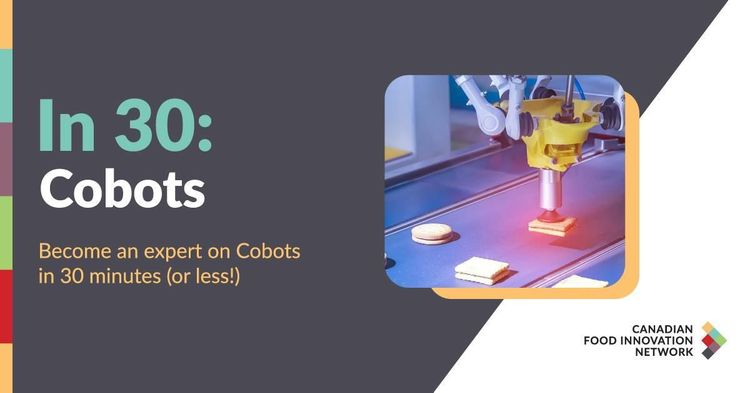
Sometimes, all it takes is 30 minutes to learn the ins and outs of new food technologies and trends that are transforming the food and beverage industry. In this series, we’ll dig into a food innovation topic and link you to content and resources so you can become a master on the topic in 30 minutes (or less!). This week, we’re looking at the use of cobots — collaborative robotic systems that work alongside human workers — and their use in the food industry . The Overview WiredWorkers - What is a cobot? The ultimate collaborative robot guide Learn how cobots differ from robots, and how their use can benefit any manufacturing operation. WiredWorkers - Cobots in the foo d industry A deeper dive into the ways cobots are being used in the food and beverage industry to solve common challenges such as labour shortages and safety concerns. Collaborative Robotics - 7 reasons why manufacturers should invest in cobots Even more reasons why food companies are looking at cobots to boost efficiency and ensure product consistency. The Canadian Connection Cyberworks Robotics provides autonomous self-driving technology for material handling forklifts and tow-tuggers as well as industrial floor scrubbers. Kinova produces robotics including the Link 6, a collaborative robot designed to work with grippers, vacuum applications, weld tips and other cobot tools. Social Medi a C o b o t T e a m ( L i n k e d I n ) offers and represents automation solutions that help expand their clients’ human workforce potential. They provide a unique approach to collaborative robots, including the identification of best applications, application engineering, operator training, and on-going service and support. Cobotnation (Instagram) Cobot Nation creates custom designed automation systems for a range of industries. Overtime If you’ve got more than 30 minutes, these are for you: YouTube – What are Cobots?
Community Manager-
Intellectual Property Essentials for Food Innovators
L ast week , we hosted our inaugural Unpuzzling webinar on Intellectual Property (IP) Essentials for Food Innovators . CFIN’s Hubba Khatoon and Julie Daigle were joined by IP professionals for an engaging session that covered the importance of IP in food innovation, practical strategies for IP management, and resources available to help food and beverage companies protect their intellectual assets. Here are a few of the key takeaways that the food industry's top IP experts shared throughout the webinar . Why IP is the Secret Sauce for Food Innovation Success I P is a key asset for food and beverage companies aiming to secure a competitive edge in the market. “Ninety-two percent of the valuation of companies in the S&P 500 comes from intangible assets,” s ai d Alla Darwish, Director of Commercialization & IP Mobilization at Conestoga College . “It shows how vital IP is for any business's success, especially in innovation-driven markets . ” Darwish explored why protecting unique recipes, processes, or branding is essential to ensuring long-term business success. Despite the potential benefits, v ery few Canadian companies possess an IP strategy, presenting a significant opportunity for innovators to get ahead. Tips on Mastering the Art of IP Strategy Dumitru Olariu, IP Advisor at the Canadian Intellectual Property Office (CIPO) , stressed the importance of a robust IP strategy for food and beverage companies. "An IP strategy involves decisions and methods designed to maximize the contribution of your IP assets to achieve your business goals," Olariu explained. He outlined the key types of IP, from patents to trade secrets, and detailed a strategic approach to managing these assets. Olariu emphasized the necessity of integrating IP considerations into every phase of business planning and execution. This includes conducting regular IP audits to identify and protect valuable assets, understanding competitive IP landscapes, and ensuring that IP strategies adapt to changing business conditions. By doing so, companies can fully l everage innovations and m aintain a competitive edge in the market. Where to Find IP Funding Opportunities L ayla Lahiji , Venture Manager at ElevateIP Alberta , share d advice for innovators looking for support in initiat ing IP implementation processes like patent drafting and registration. “ ElevateIP has a number of different funding recipients that are region-based,” she said. Lahiji explored the servi ces offered by some of those regional funding recipients like Innovate Calgary , Springboard Atlantic , momentumPI , and N ew Ventures BC — and how innovators across Canada can work with those organizations to access IP funding opportunities. A Solid IP Foundation Begins with Smart Contracts Ally Bharmal, Partner at Fasken and Co-Lead of the firm’s national food and beverage group , emphasized that thorough, well-articulated contracts are the first line of defense when protecting IP. He highlighted three critical areas for companies to focus on: internal team agreements, non-disclosure agreements (NDAs) for business discussions, and IP ownership clauses in external contracts. "Having proper IP assignment clauses ensures that any innovation developed by employees or consultants is owned by the company ,” Bharmal explained. “ Without these, businesses risk losing control of their most valuable assets." He also covered the importance of including confidentiality and ownership provisions in contracts with suppliers, co-manufacturers, and collaborators to safeguard trade secrets and other IP assets. Food Cycle Science: A Case Study in Foodtech IP Success Lesley Thompson, VP of Sustainability and Communications at Food Cycle Science , provided an inspiring example of the importance of IP in food innovation . F unding support from CFIN enabled the company to accelerate its R&D and commercialization efforts, leading to a necessary expansion of its IP portfolio. By leveraging both external IP lawyers and internal teams, Food Cycle developed a strategic , customized approach to managing patents, trade secrets, and trademarks . Thomspon emphasized th at any successful strategy requires flexibility and constant fine-tuning. "An IP strategy is more like a rose bush—you need to keep deadheading and pruning so that it stays healthy ,” she said. This proactive approach has been critical to Food Cycle’s ability to maintain a competitive edge and unique valu e proposition as other companies flood into the food recycling space. “IP has become an incredibly valuable asset for our company,” Thompson continued . W hile IP strategies can be complex, time consuming, and expensive, she c onsider s it an essential investment and encourag ed all food innovators to explor e the IP support organizations and resources covered throughout the webinar .
Community Manager-
Working Smarter: 5 Ways to Make Recruitment and Training Easier in 2025
For many food manufacturers, maintaining a skilled workforce can feel like a never-ending uphill battle. And, as a tidal wave of manufacturing workers hit retirement age, the industry will need to hire and retain 142,000 new workers by 2030, making the path ahead appear only steeper still. But it does not have to be this way. By understanding where traditional talent management approaches are falling short, food manufacturers are finding innovative ways to adapt and forge a better path forward, building stable teams and reducing the constant drain of recruitment and retraining. Here are five strategies that successful food manufacturers are using to transform their approach to talent management, making both recruitment and training more efficient and effective in 2025. Partner with Workforce Development Organizations As manufacturing evolves, so do the skills required for many manufacturing positions. Digital skills and soft skills—like critical thinking, problem solving, and creativity—are more important than ever as manufacturing processes become increasingly digitized and automated. To adapt, food manufacturers can build strategic partnerships with industry programs and organizations that can help accelerate workforce development. For instance, Food Processing Skills Canada often partners with employers for work placement programs and can help manufacturers access funded training and upskilling opportunities for existing staff. Employer participation in FPSC programs like Succeeding at Work and the Student Work Placement Program can unlock grant funding for staff retraining and upskilling programs, along with wage subsidies to help you build a robust talent pipeline and help your team to adapt to the rapidly evolving nature of manufacturing work. Build a Formal Retention Strategy Most Canadian food manufacturers are small businesses (less than 100 employees). Many struggle to match the training, onboarding and compensation packages, and career advancement opportunities that workers can find at larger corporations and find themselves locked in a constant cycle of recruitment, training, and turnover. Fortunately, there are still actions that smaller manufacturers can take to improve their recruitment efforts, and this begins with building a formal employee retention strategy. This strategy should be informed by market data along with insights from your existing workforce. Conducting stay interviews can help you understand what your team values, giving you the ability to make highly desirable changes (like flexible shift patterns and schedules) that will boost employee retention rates. Go Where the Talent Is: The “Nichification” of Job Boards The days of relying solely on generic job boards are over. Food manufacturers looking to recruit effectively in 2025 should leverage the proliferation of niche recruitment platforms that align with their specific industry needs. Focusing recruitment efforts on specialized job boards can help you identify candidates with the exact skills and interests required for your roles, saving time and resources while improving hiring outcomes. For instance, CFIN's Food Innovator Career Hub (FICH) is tailored specifically to employers and jobseekers in the food sector. Job posting can be shared directly via the discussion forum , and FICH also hosts a repository of the top food industry-specific job boards , including Careers in Food , which focuses exclusively on food and beverage manufacturing. While they may not have the massive pool of applicants you’ll find on the big job boards, these platforms are like fishing in a small pond packed with big fish . Instead of competing with unrelated industries, your postings stand out to the right audience. It’s the “quality over quantity” approach: your recruitment team can spend less time vetting a flood of applications and more time engaging with talent that fits your needs. Bridging the Labour Gap With Augmented Reality-Enhanced Onboarding One of the most exciting—and practical—emerging use cases for augmented reality (AR) technology is as a training and onboarding tool in complex manufacturing environments. By overlaying digital instructions onto real-world tasks, AR systems provide instant guidance that reduces errors and accelerates training completion. With one third of the manufacturing workforce over the age of 55 , AR is poised to fill a critical gap in retaining the knowledge of skilled retirees and training the next generation of workers. Solutions like DeepSight's autonomous AR training platform offer modular options that can scale with business needs to make them accessible for smaller operations, but the upfront investment of novel technologies often proves to be a major barrier. However, it is possible for manufacturers to find financial support through initiatives like the SCAP AgriInnovate Program , which helps food businesses adopt innovative, productivity-enhancing technologies like AR. Make a Strategic Embrace of AI AI-based solutions have incredible potential to supercharge all the recruiting and training solutions covered above. Wherever quality data exists in your training and recruitment processes, AI can be leveraged to drive substantial efficiency gains . One notable example would be the AI-based management of a workforce skill and abilities database to identify current or future talent gaps. Such a program would help optimize employee retention and internal recruiting efforts, while identifying current or future talent gaps that could be addressed through upskilling initiatives. As unbridled enthusiasm over the potential of AI has been tempered, discussions of its benefits to food manufacturers have become more nuanced and realistic. Fully autonomous AI manufacturing facilities are not coming anytime soon, but its short-term impact will still be profoundly transformative. For every food manufacturer, large and small, now is the time to develop a well-considered AI adoption strategy.
Community Manager-
The Network Effect: Innovation Without Borders - Connecting Canada’s Bilingual Food Sector
How CFIN Facilitates New Opportunities for its Members When CFIN’s Julie Daigle invited David Singer, Co-Founder of Index Biosystems to attend the Future of Food Symposium in Montreal, he did not hesitate to accept. The event would be an exceptional opportunity for David to connect with key industry decision makers and introduce them to Index’s groundbreaking BioTags ®—microscopic yeast-based “barcodes” that can be incorporated directly into agricultural products, enabling unparalleled traceability throughout the entire food supply chain. Despite the potential food safety and traceability benefits of BioTags , getting buy-in from the food sector on new technology is a complex and arduous process. For an industry with a conservative approach to technological innovation, personal relationships trump product value propositions in getting that buy-in. “For foodtech startups, building the right relationships and getting industry support is a huge barrier to growth,” says David. “You need to know who to engage with, and you need to prioritize relationship-building if you ever hope to stand out in a competitive industry with an often-cautious approach to change. Julie has been critical in helping Index do that.” Facilitating Key Connections As CFIN's Regional Innovation Director for Quebec, Julie brings over two decades of experience working for and supporting the growth of innovative food businesses. She knows firsthand how connection acts as an innovation force multiplier. With her singular blend of industry savvy and a broad bilingual network, Julie helps CFIN members leverage that force by sparking new relationships and opportunities they may otherwise never find. “CFIN is all about bringing people together to create solutions,” says Julie. “When I see companies like Index Biosystems working to make our food system safer and more sustainable, I’m dedicated to making sure they have access to the resources and connections they need to succeed.” In 2024, Julie and David reconnected at SIAL Canada in Montreal, one of the largest food industry events on the continent. After chatting about the pain points he was navigating in scaling up Index and establishing larger industry partnerships, Julie invited David to join her the Future of Food Symposium that same week, where she knew she could facilitate an introduction to some of Quebec’s leading food innovators, ranging from likeminded startups to some of the largest and most influential food sector companies in Canada. “The connections that Julie has facilitated for Index have been transformative,” says David. “She has helped us accelerate business relationships and unlock potential collaborations with Quebec companies far faster than we would’ve otherwise.” Join the Community! Bridging the Gaps in Canada’s Food Innovation Ecosystem One of Julie’s most impactful skills is her ability to navigate linguistic and cultural boundaries in Canada’s diverse food sector. Fluent in French, English, and Spanish, Julie plays a critical role in fostering collaboration between innovators located in other provinces —like the Ontario-based Index Biosystems—and Quebec’s major food sector players. “Quebec has such a massive food sector, but language can be a barrier, especially for SMEs from other provinces,” says Julie. “Being multilingual allows me to bridge that gap and help entrepreneurs forge connections and scale necessary industry innovations more rapidly.” Julie’s deep knowledge of the food industry, paired with her multilingual abilities and global perspective, makes her uniquely suited to the role uniquely positions her to foster cross-provincial relationships. “Innovation is impossible in isolation,” says Julie. “Creating new outputs demands the constant introduction of new inputs— new ideas , new technologies , new partnerships. Ultimately, innovation comes from connecting those inputs to one another in every way we can.” Paving the Way for Canada’s Food Innovators Julie’s work with Index exemplifies the broader impact of CFIN’s Regional Innovation Directors. By creating opportunities and fostering cross-provincial connections, Julie helps members like Index overcome barriers and unlock new possibilities. “CFIN and Julie have been essential partners in our journey,” David says. “We’re excited about the path ahead and the connections yet to come.” For Index, the path ahead includes scaling their collaborations with industry leaders and researchers, raising capital, and expanding their reach. With countless more connections being forged by CFIN’s RID’s every day, the future of Canadian food innovation has never been more exciting. Join the Community! Innovation sans frontière s : favoriser les liens au sein du secteur de l’alim entation bilingue du Canada Comment le RCIA facilite de n ouvelles opportunités po ur ses membres Lorsque Julie Daigle a invité David Singer , cofondateur d’ Index Biosystems , à participer au symposium Aliments du futur à Montr é al , il a accepté sans hésit er . L’événement serait une excellente occasion pour lui d’interagir avec des décideuses et décideurs importants du secteur et de leur présenter les BioTags MD révolutionnaires d’I ndex, un « code - barres » microscopique à base de levure qui peut ê tre intégr é directement dans les produit s agricoles , permettant ainsi une traçabilité sans égale tout au long de la chaîne d’approvisionnement alimentaire. Malgré les avantages potentiels des BioTags en matière d ’innocuité et de traçabilité des aliments, obtenir l’adoption d’une nouvelle technologie par le secteur de l’alimentation est un processus complexe et ardu. Dans un secteur qui adopte une approche conservatrice à l’innovation technologique, l’obtention de cette adoption dépend souvent plus d es relations personnelles que d es propositions de valeur des produits. « Pour les jeunes pousses en technologies alimentaires, établir les bonnes relations et obtenir le soutien du secteur est un immense obstacle à la croissance, dit David . Dans un secteur concurrentiel qui adopte une approche souvent prudente au changement, v ous devez savoir qui approcher et priorisez l’établissement de relations s i vous espére z un jour vous démarquer . L’aide de Julie a été indispensable pour qu’Index y arrive. » Faciliter des liens importants À titre de directrice régionale de l’ innovation du RCIA pour le Québec, Julie met à profit deux décennies d ’ expérience qu’elle a acquise en travaillant pour des entreprises en alimentation innovantes et en sout enant leur croissance. Grâce à sa connaissance approfondie du secteur e t à son vaste réseau bilingue, Julie aide les membres du RCIA à tirer parti de cette force en favorisant l’établissement de nouvelles relations et opportunités qu ’ils n’auraient autrement jamais pu trouver . « La raison d’être du RCIA est de réunir les gens dans le but de créer des solutions, indique Julie. Lorsque je vois des entreprises comme Index Biosystems travaillant p our rendre notre système alimentaire plus sû r et plus durable, je suis déterminée à veiller à ce qu’elles accèdent aux ressources et aux relations dont elles ont besoin pour réussir . » En 2024, Julie et Davi d ont renoué au SIAL Canada à Montr é al , l’un des événements le s plus importants dans le secteur de l’alimentation sur le continent. Après avoir jasé des irritants auxquels il faisait face a lors qu’il tentait de développer Index et d’ établir des partenariats avec des acteurs plus importants du secteur, Julie a invité Davi d à se joindre à elle au symposium A liments du futur qui se tenait durant la même semaine et où elle était convaincu e de pouvoir lui présenter certains des innovateurs et innovatrices en alimentation de premier plan d u Québec , que ce soit de jeunes pousses comme la sienne ou certaines des entreprises les plus importantes et les plus influentes du secteur de l’alimentation au Canada . « Les liens que Julie a facilités ont été transformateurs pour Index, souligne David. Elle nous a aidés à accélérer l’établissement de relations d’affaires et à explorer d es possib ilités de collaboration avec des entreprises québécois es , et ce, beaucoup plus rapidement que nous aurions pu le faire. » Combler le fossé l inguistique dans l’écosystème canadien de l’innovation en alimen tation L’une des compétences que possède Julie qui change la donne est sa capacité à é liminer les barrières linguistiques et culturel le s qui existent au sein du secteur de l’alimentation diversifié du Canada. Maîtrisant le français, l’anglais et l’espagnol, Julie joue un rôle crucial en favorisant une collaboration entre des innovateurs et innovatrices implantés dans d ’autres provinces, comme Index Biosystems , une entreprise ontarienne, et les principaux acteurs du secteur québécois de l’alimentation. « Le secteur québécois de l’alimentation est très vaste , mais la langue peut être une barrière, surtout pour les PME d’autres provinces , explique Julie. Le fait d’être tri lingue me permet de combler ce fossé et d’ aide r les entrepreneurs et entrepreneures à tisser des liens et à mettre à l’échelle plus rapidement des innovation s sectorielles nécessaires . » Ses vastes connaissances du s ecteur de l’alimentation, jumelées à ses habileté s multilingu es et sa perspective mondiale , font d e Julie une personne particulièrement bien placé e pour favoriser des relations qui dépassent l es frontières provinciales . « L’innovation est impossible en isolement, mentionne Julie. Créer de nouveaux extrants exige l’ introduction constante de nouveaux intrants, qu’il s’agisse de nouvelles idées, de nouvelles technologies ou de nouve aux partenariats. Au bout du compte, l’innovation est le fruit de la mise en relation de ces intrants par tous les moyens possibles . » Ouvrir la voi e pour les innovatrice s et innovateurs canadiens Le travail de Julie avec Index illustre l’impact élargi des directrices et directeurs régionaux de l’innovation (DRI) du RCIA. En créant des opportunités et en favorisant les relations au-delà des frontières provinciales , Julie aide les membre s comme Index à surmonter les obstacles et à créer de nouvelles possibilités. « Le RCIA et Julie ont été des partenaires essentiels dans notre parcours, ajoute David. La voie qui s’ouvre devant nous ainsi que les relations que nous tisseron s dans l’avenir nous r empli ssent d’enthousiasme . » Pour Inde x , la voie d evant comprend le développement de ses collaborations avec des chefs de file et des chercheurs et chercheuses du secteur , la levée de capitaux et l’élargissement de sa porté e . Alors que les DRI du RCIA forgent chaque jour un nombre i ncalculable de relation s, l’avenir de l’innovation en alimentation au Canada n’a jamais été aussi excitant .